

Energy Conservation – Decorative Lighting in Budapest Turned Off
Based on estimates, the Paks Nuclear Power Plant contributes about half a percent to Hungary’s GDP, meaning that a loss of its electricity generation would directly reduce economic output, Gábor Regős, chief economist at Gránit Capital Management (KVG), told Világgazdaság.
By Tuesday evening, the water level of the Danube had already risen by 5 centimeters, and the last turbine is operating steadily, so the likelihood that the entire power plant will be shut down to zero has decreased for the time being. Previously, however, the expert had pointed out that if the power plant were to cease production for about twenty days during a quarter, this could reduce quarterly GDP by about 0.1 percentage points and also affect the forint.
Added to this are potential restrictions on energy consumption by large industrial customers. The exact impact depends on the extent to which companies can conserve energy without curtailing production, and whether the measures apply throughout the day or only between 5:00 p.m. and 10:00 p.m.
The loss could be mitigated by the fact that many companies experience production shutdowns and vacation periods in the middle of summer anyway.
Some companies can also shift energy-intensive activities to less critical times of day by reorganizing their shifts.
According to Gábor Regős, Hungarian industry is extremely energy-intensive, which poses a significant disadvantage in the current situation. Battery manufacturing consumes a particularly large amount of energy, but the metalworking, chemical, and building materials industries could also be severely affected by the restrictions.
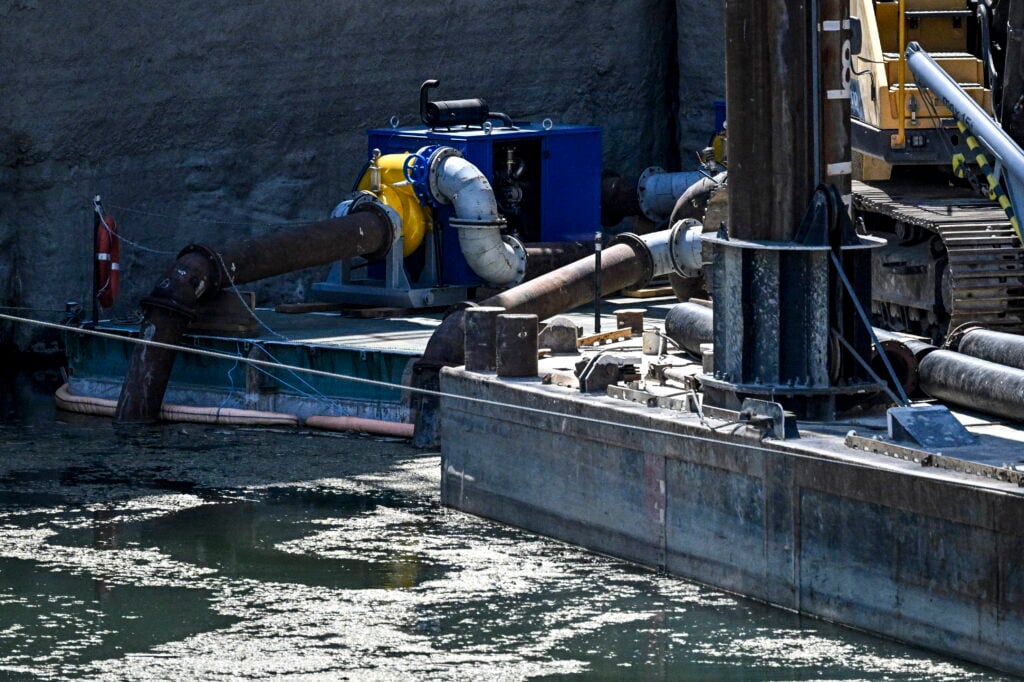
Low water levels at the Paks Nuclear Power Plant. Photo: MTI/Róbert Hegedüs
However, there is an important difference between the shutdown of the Paks nuclear power plant and that of manufacturing companies. The electricity currently not being generated by Paks cannot be replaced later, which therefore represents a permanent loss.
In the industrial sector, the situation is somewhat more favorable. Due to low demand, capacity utilization has not been particularly high so far anyway, which is why companies will be able to make up for some of the lost production later.
This assumes that customers are willing to wait out the delay and not look for other suppliers.
The economist emphasized that suppliers must now adapt not only to energy restrictions but also to the fluctuating demand from large factories. They also need energy for their own production, while at the same time they may be affected by a temporary decline in orders.
In the best-case scenario, the current situation will have no noticeable impact on GDP on an annual basis. However, this requires that the production restrictions not last significantly longer than a week. In the event of a prolonged energy crisis, the economist believes that even an impact on annual GDP of a few tenths of a percentage point cannot be ruled out.
Quarterly economic output could decline by several tenths of a percentage point due to the shutdown in Paks and industrial restrictions combined.
In addition to GDP, the deterioration of the current account also poses a risk. Foreign trade is being affected simultaneously by the decline in industrial exports and by the larger volumes of more expensive electricity imports required to offset production shortfalls at Paks.
Imports could have a greater impact on the current account, as not only the volume of energy purchased from abroad but also its price could rise. In terms of GDP, the effects of declining exports and rising imports may already be more balanced.
However, in addition to electricity imports, world market prices for oil and natural gas are also crucial for the balance of payments. Their trajectory could be influenced primarily by current developments in the war in Iran.

MVM’s new energy storage system in Tiszaújváros. Photo: MTI/József Erdős
The forint has lost only a small amount of value so far, but the fact that it was unable to recover last week despite the drop in oil prices is a warning sign. Compared to the previous euro exchange rate of around 350 forints, a more sustained weakening has already occurred; the question is whether this trend will continue.
The energy crisis is likely to be a temporary shock and should therefore not, in and of itself, have any lasting impact on the exchange rate. However, the forint’s performance is also influenced by the country’s risk assessment and the course of the war in Iran. According to Gábor Regős, it would certainly be a bad sign if the euro exchange rate were to rise above 370 forints again. This is particularly true because
the central bank recently identified the range between 355 and 360 forints as a band with which it is satisfied, while the exchange rate is already below that level.
The forint is thus under pressure from several factors at once, but a favorable development of these factors could also strengthen the Hungarian currency. The most important question now is whether the energy crisis will indeed remain only temporary or whether the longer-term constraints will already be reflected in the economic performance for the entire year.

Via MTI; Featured photo: MTI/Szigetváry Zsolt