
Every December, the Swedish coast north of Uppsala locks under ice.
The bays go grey and still.
Fish drop to the bottom, and the birds that depend on open water begin a long, cold search for somewhere to feed.
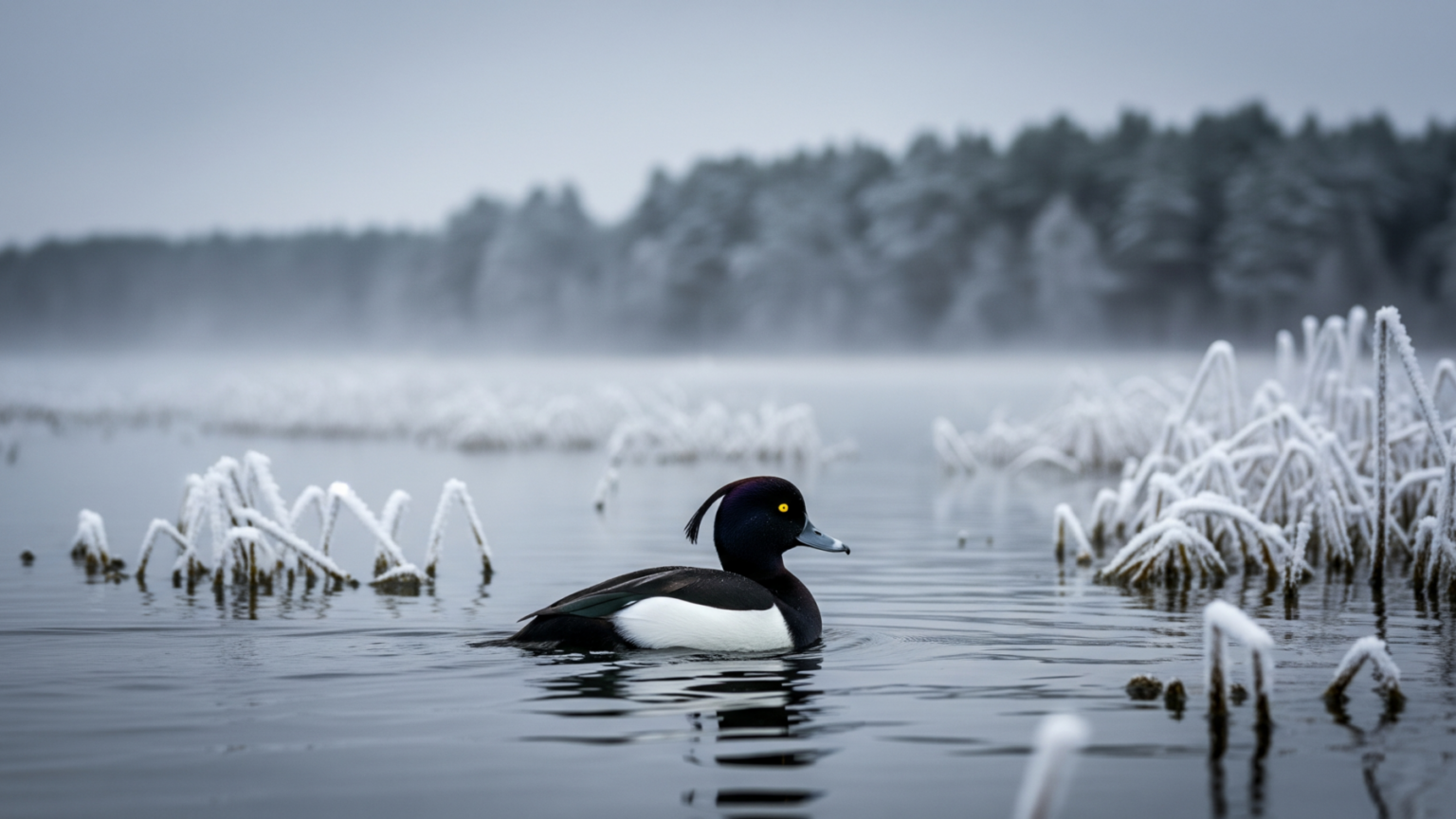
The bird that showed the strongest response was the tufted duck, a compact diving bird with a drooping crest and a habit of plunging to the seabed for invertebrates.
But in one 90-hectare basin on the Baltic shore, the surface never closes over.
Steam rises off it through the darkest mornings of the year.
Something underground keeps the water warm, and the creatures that found it did not wait for an invitation.
A basin built for machines, not birds
Engineers blasted the inlet into existence in the late 1970s, carving a natural archipelago into an enclosed pool.
Their goal was purely industrial.
A nuclear power station was rising nearby, and its condensers would need enormous volumes of water to carry heat away from the reactor cores.
The basin was the exit point for that heat, the final handoff between reactor and sea.
Roughly 140,000 liters of brackish water pass through the plant’s cooling system every single second.
By the time that water reaches the enclosed basin, its temperature has climbed by as much as 10 degrees Celsius above the surrounding sea.
The engineers called it Biotestsjön, a name meaning roughly “the biotest lake.”
It was designed as a monitoring site, a place to measure what heat does to coastal biology.
What the warming water quietly changed
The first thing the extra warmth did was keep the basin liquid all winter.
While the bays on either side sealed with ice, Biotestsjön stayed open through the long Nordic dark.
Related
Fish that need warmth began congregating inside it.
Some cold water species retreated, but the ones that thrived in warmth grew larger and more numerous than anywhere else on that coast.
An accessible, year round food supply was forming in the middle of a season when almost nothing else was available.
Predators followed the fish.
Sea eagles found the basin and stayed, drawn by open water and easy hunting in a landscape that offered nothing else.
According to Vattenfall, the plant’s operator, no denser sea eagle population exists anywhere else in Sweden than in the Forsmark area today.
What the researchers set out to measure
Scientists had long noticed the unusual congregation of waterbirds near the cooling outflow.
What nobody had formally tested was whether the cooling system was genuinely drawing birds in, or whether the numbers simply reflected local geography.
A team of researchers designed a study to find out.
They counted seven waterbird species across multiple sectors of the Forsmark coastline, comparing areas touched by the cooling water discharge against control areas with no thermal influence.
They tracked the numbers across seasons, drawing on years of monitoring records held by Swedish University of Agricultural Sciences researchers at the plant.
The results, published in Ibis, were unambiguous.
The tufted duck and the accidental refuge
The bird that showed the strongest response was the tufted duck, a compact diving bird with a drooping crest and a habit of plunging to the seabed for invertebrates.
In normal winters, tufted ducks struggle when coastal waters freeze because they cannot reach the bottom fauna they depend on.
The study found that the cooling water system provided preferential wintering areas.
Related
Tufted ducks were more abundant in winter in areas affected by the cooling system than in any control areas nearby.
No engineer drew a tufted duck on any blueprint for this facility.
It was a thermal exhaust valve, and the birds simply moved into the warmth it left behind.
For a striking parallel in how reactor heat shapes surrounding environments, the story of Paks nuclear station is worth reading.
A footprint that no one planned for
Forsmark’s three reactors were commissioned between 1980 and 1985, meaning the basin has been running warm for more than four decades.
That is long enough for entirely new ecological patterns to lock in.
Researchers now use the basin as a living laboratory for climate change, because its warmer water mimics what future Baltic summers may look like everywhere.
The NRC’s recent work on transport regulations reflects how carefully nuclear operations are scrutinized, yet thermal discharge ecology remains a comparatively understudied frontier.
Cold water fish species have declined inside the basin, and the intake screens remain a mortality source for any fish drawn into the system.
The same infrastructure harms one group of species and shelters another, sometimes within meters of each other.
What the Forsmark story ultimately offers is something rarer than a simple win or loss.
It is a reminder that a machine built to do one thing can become, over decades, something its builders never imagined: a winter stronghold for a small diving bird searching for open water on a frozen coast.
Editor
Hugo is an engineer with strong technical expertise and deep knowledge of the space industry. Multilingual from an early age, his writing combines technical clarity with a strong interest in science and energy.
