

Scan AI
athletes introduced to North American World Cup to create 3D avatars
Offside, etc. for judging decisions
48 countries to provide analysis platforms
All participating countries with power up leveling
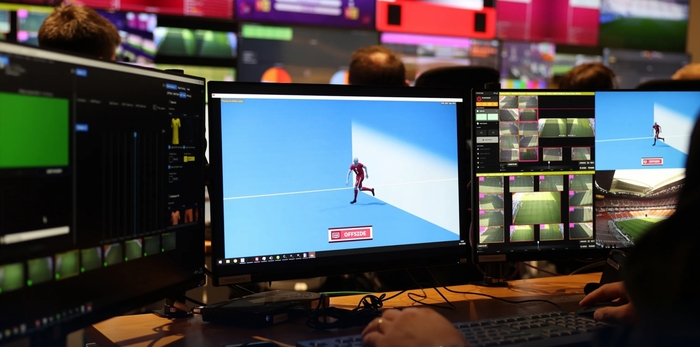 사진 확대
사진 확대 FIFA scanned the bodies of the North American World Cup players with AI and produced them with 3D avatars to enhance the completeness of the semi-automatic offside reading system (SAOT). FIFA
Artificial intelligence (AI) has changed the appearance of the FIFA World Cup. AI helped make offside decisions on the field, and analyzed the opponent’s tactics on the bench. The 1248 players were reborn as AI avatars. The 2026 North American World Cup, which ended on the 21st of last month (Korea Standard Time), became the first “AI World Cup” in history where AI is involved in judgment, tactics, and broadcasting.
The quadrennial World Cup is a state-of-the-art competition. High-definition (HD) broadcasting began at the 2002 World Cup in Korea and Japan, and goal line technology (GLT) was introduced at the 2014 World Cup in Brazil. The 2018 World Cup in Russia and the 2022 World Cup in Qatar introduced new VARs and semi-automatic offside reading systems (SAOTs), respectively.
In the North-China World Cup, AI has been applied to various fields and is said to be the most technologically advanced than previous competitions. The most notable technology is the AI avatar. FIFA partnered with Lenovo, North American World Cup’s official technology partner, to create a 3D avatar by scanning the bodies of 1,248 participants with AI.
FIFA’s biggest reason for creating AI avatars is to make a more accurate decision by supplementing SAOT. SAOT, which was first introduced at the Qatar World Cup four years ago, is a semi-automatic offside reading technology that analyzes offside in real time using data from several cameras and ball sensors installed in the stadium. However, the controversy over the ruling did not go away. This is because the height and physique of the player were not accurately reflected.
To solve this problem, FIFA scanned the bodies of all the players. It takes only one second to create an AI avatar. AI avatars made from a single scan played a key role in reducing offside misjudgment in this tournament. FIFA said, “AI avatars produced just like players can detect even minute differences in connection with SAOT,” adding, “You can track them even if they move quickly or are not visible on the camera.”
AI does not make the final decision. AI first detects whether it is offside and then delivers the relevant information to the VAR referee. The referee comprehensively reviews this and makes a final decision. FIFA said, “AI avatars do not replace referees,” adding, “They played a role in helping make the right decision.”
North American World Cup’s official ball Tri-Oda has an inertial measurement unit (IMU) sensor that increases the accuracy of AI analysis. The sensor records the moment the ball touches the player’s feet and the path of movement in real time. This data is delivered to AI avatars and SAOTs and is used to make offside decisions.
AI is also used on benches. FIFA has made the Generative AI-based analysis platform Football AI Pro available to all participating countries this North American World Cup. Football AI Pro, which has learned various data held by FIFA, provides game analysis and strategies that each team’s coaching staff wants.
Football AI Pro has helped the power of North American World Cup participating countries to level up. FIFA said, “Through the Football AI Pro, all participating countries have an equal level of data analysis opportunities.”
AI has even changed its broadcasting environment. Unlike previous competitions, North American World Cup judges wore small cameras on their heads. The Referee View, which was implemented through this, gave viewers an immersive feeling as if they were running directly on the ground. FIFA provided a clearer screen by applying AI-based image correction technology that minimizes shaking. On top of that, AI visualized data, such as reconstructing offside situations with 3D graphics, to help viewers understand.
AI was also used to run the competition. Smart Wayfinding, an AI navigation system, provided the most efficient movement route for spectators visiting the stadium.
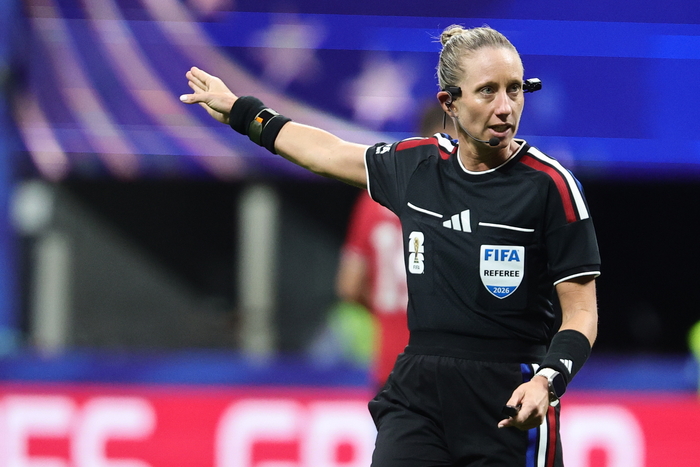 사진 확대
사진 확대 A referee who played with a small camera on his head in North American World Cup. Reuters Yonhap News