

On July 28, Cathie Wood‘s Ark Invest bought roughly $15 million worth of Nvidia (NVDA +2.27%) stock across five of its exchange-traded funds (ETFs) — the largest portion of which being $8.1 million coming through the flagship ARK Innovation ETF. On the very next day, Wood spread a $14.7 million purchase of Taiwan Semiconductor Manufacturing (TSM +0.44%) (TSMC) stock across four of Ark’s funds.
These moves arrived in the same window as Meta‘s second-quarter earnings results, which highlighted rising artificial intelligence (AI) infrastructure spending. The timing of Wood’s buying invites a clear question: What does simultaneous doubling down on Nvidia and TSMC suggest about her views of the durability of AI demand?

Image source: Getty Images.
Why buy Nvidia stock around the time of Meta’s earnings?
Meta’s capital expenditure (capex) guidance for 2026 was lifted to a range of $130 billion to $145 billion, up from a prior forecast between $125 billion and $145 billion. Meanwhile, the company’s capital outlay reached $31.1 billion during the second quarter alone. Meta’s management stressed that the company is supply-constrained and is prioritizing near-term capacity for training models, serving agents, and expanding its data center footprint.
Since Nvidia supplies the dominant share of the GPUs that power AI workloads, a sustained increase in Meta’s capex budget is likely going to translate into additional orders for Nvidia silicon. Against this backdrop, Wood appears to be betting that Nvidia will capture a meaningful slice of Meta’s expanding wallet, converting the company’s accelerating infrastructure spending directly into revenue growth.
Why buy TSMC stock alongside Nvidia?
Even though Nvidia is a leading designer of AI chips, the company does not fabricate its own silicon. Instead, Nvidia outsources its chip manufacturing to TSMC. Given this relationship, it’s natural that an uptick in shipments for Nvidia’s GPUs feeds higher wafer starts for TSMC.
TSMC’s latest financial results reflect this linkage. During the second quarter, its revenue climbed 36% year over year to $40.2 billion while net income surged 77.4%. By purchasing TSMC stock alongside Nvidia, Wood is simply extending the same AI infrastructure thesis one step downstream — capturing the manufacturing profit that accompanies additional purchases of Nvidia’s GPU architecture that hyperscalers like Meta continue to buy.
Should investors follow Cathie Wood’s lead?
Nvidia and TSMC both currently trade at roughly 25 times forward earnings. This sits well below prior levels witnessed during earlier cycles of the AI revolution.
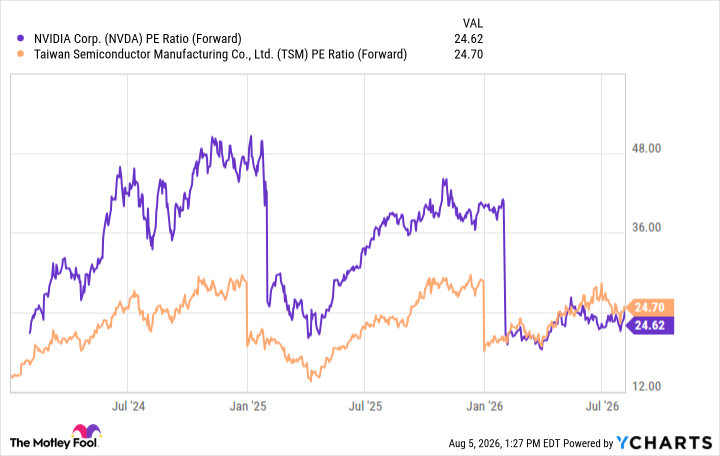
NVDA PE Ratio (Forward) data by YCharts
For investors that share Wood’s conviction that hyperscaler capex budgets will remain elevated for several more years, these valuation profiles look reasonable. In my eyes, following Wood makes sense in this instance as capital rotates away from the hyperscalers and makes its way back into leading infrastructure opportunities across semiconductors and manufacturing.
Adam Spatacco has positions in Nvidia. The Motley Fool has positions in and recommends Meta Platforms, Nvidia, and Taiwan Semiconductor Manufacturing. The Motley Fool has a disclosure policy.