
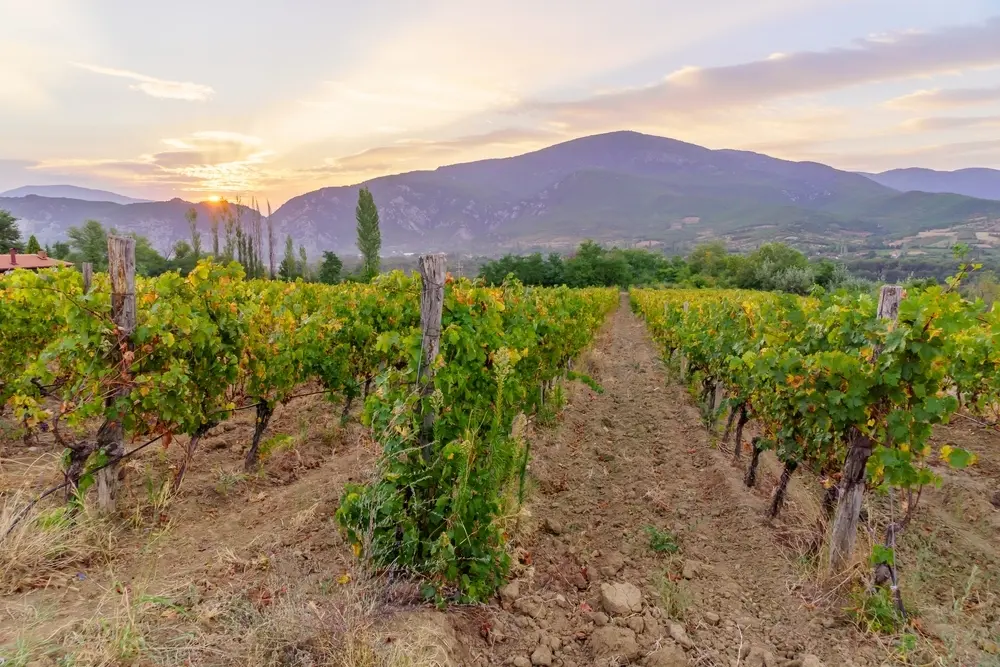
Though the former Yugoslavia boasts a long and distinguished wine heritage, one that stretches back to prehistory, its reputation was blighted during the socialist years and subsequent process of privatisation. Whilst many wineries have embraced modern approaches, they are still struggling to contend with many legacies of the past. It is a cautionary tale of the pitfalls of transition and the pathway back to international recognition.
Following the second world war, many larger private wineries were nationalised and consolidated into cooperatives (known as ‘Agrokombinats’) operated under a system of workers’ self-management. As Gvozden Radenković, founder of Bela Kula winery, explains, “those large industrial plants bought raw materials (grapes) from natural persons-individual agricultural producers (read peasants) and made wine from those grapes, which they packaged under the industrial brand and thus sold both in the country and abroad.”
A system that once depended on the ingenuity of individual winemakers was now heavily centralised. As Milica Pletvarska, an enologist and master distiller, emphasises, “decision-making often emphasised social stability over efficiency.” Whilst ensuring employment and reasonable pay, there were, in her words, “limited incentives for technological innovation and quality improvements.” Fulfilling domestic production quotas was the overriding priority. Market competitiveness was not a consideration, nor the shifting tastes of consumers, particularly beyond Yugoslavia’s borders.
At the peak of production in the seventies, Yugoslavia was among the top ten wine-producing countries in the world, churning out over six million hectoliters of wine annually. By comparison, the successor states combined produce an estimated 2.5-3m hectoliters today (according to data submitted to OIV, the International Organisation of Vine and Wine), less than half of the peak. Exports accounted for 20-25% of annual wine output according to The Oxford Companion to Wine, with 1-1.5m hectoliters sold abroad (equivalent to 130-200m standard bottles per year).
Pletvarska reflects on how Macedonia held “a clearly defined role within the Yugoslav federation as the primary supplier of grapes and bulk wine, particularly for more industrialised republics such as Slovenia, Croatia, and Serbia.” This forced specialisation prompted the expansion of vineyards in the Povardarie (Vardar River Valley) region, with the mass planting of specific grapes and construction of large-capacity fermentation facilities to ensure economies of scale. Rural communities became dependent on these industrial monoliths, with hundreds of thousands of tons of grapes being passed into their hands.
Whilst priority was given to quantity over quality, Radenković stresses that this “certainly didn’t mean that the wines of post-war Yugoslavia were bad,” otherwise they “would not have found their way to foreign markets.” The Yugoslav Export Wine Association handled trade. Wines from NAVIP, a producer in Serbia, were sold in bulk to West Germany to be bottled and packaged, as Radenković explains, “under the brand name of famous retail chains such as Racke and Spar.” Macedonian Tikveš and Montenegrin 13. Jul (now Plantaže) were widely exported, whilst wines from Slovenia, Istria, Herzegovina, and Dalmatia – sold under the Adria export brand – found success in the US. “In the ‘60s, the Slovenian Ljutomerski Shipon (Furmint) reached the picky British market accustomed to French quality,” Radenković says.

Harvest in Palic, Serbia – ©Damir Vujkovic/Shutterstock
As the system started to break down in the late eighties and early nineties, the wine industry went into a downward spiral and subsequent privatisation. It was a process that echoed other industrial sectors, with, in Radenković’s words, assets being “privatised not because of the continuation of the activity, but because of significant infrastructure and facilities or because of the position on the land in attractive construction zones.” Many wineries were only privatised after bankruptcy had been declared, meaning the new owners had no obligations to the workers and wine. Buyers often lacked serious guarantees to underpin the proclaimed investment plans.
For Pletvarska, privatisation “was a long, messy process.” Many were burdened by debts and other financial liabilities. Where wineries were brought-out by management and/or employees, they tended to lack the means to invest in modernisation, leaving them “technologically unprepared to compete in an increasingly quality-driven global wine market.” Breaking up large vineyards, meanwhile, led to fragmented land ownership that undermined their efficiency. A fundamental lack of transparency further discouraged investment, particularly from abroad.
The post-transition reality was rather dire. “Many vineyards entered a state best described as semi-abandonment,” Pletvarska reflects, drastically cutting back production or giving up entirely. Subsistence production took hold. Many grapes were either, in her words, “used for homemade wine or rakija, or sold through informal local markets, bypassing the failing industrial system. The result was a deterioration of grape quality, as many didn’t have the time or resources to invest in vineyard maintenance.
As Radenković concludes, privatisation “almost completely destroyed the entire segment of the economy related to winemaking and viticulture.” Of all the industrial producers, only one – Rubin Kruševac – survived in its original form. The first wave of [of nationalised property] restitution in Serbia in the mid-nineties dealt an additional blow. As he explains, “many industrial producers whose vineyards are located on nationalised and commercialised private land were left without a raw material base because they were obliged to return the land to their owners after denationalisation.” Many vineyards were torn-up or abandoned, and numerous wineries were forced to operate with significantly reduced capacity. From some 135-140,000 hectares of total vineyard in Yugoslavia in the seventies, this number plummeted to roughly 65-70,000 hectares by the early part of this century, according to combined data from the respective State Statistical Offices and Chambers of Commerce of the newly independent countries.
This gaping supply hole left by the collapse of these industrial giants was filled with, in Radenković’s words, “imported wines of dubious quality and low price.” As in other economic sectors, export strength had been severely undermined. Whilst new small producers quickly emerged, mastering “modern oenological principles and producing serious quality wines,” they have struggled to compete with “strong global brands that produce wines of a lower quality and price category.” He describes it as a battle between David and Goliath, and calls for Serbian producers to “tighten the sling and in the future offer wines in that price segment as well,” in order to regain a part of that significant market.
North Macedonia also epitomises some of the fundamental transformation challenges. “International buyers associated Macedonian wine with bulk, anonymous products,” Pletvarska explains, “making it difficult for wineries to position themselves in the premium bottled segment.” Those who tried increasing prices to reflect the higher quality found themselves losing their long-established customer base. There was also uncertainty as to which grape varieties to plant and what style of wine to produce.
Vineyards across the former Yugoslavia have been playing catch-up. In the mid-eighties, there was only one pioneering producer from Župa who, operating in the legal grey zone, sold wine under its own label. It took another decade before others followed this example. Struggling to gauge consumer tastes, producers were, in Radenković’s words, unsure in which “direction to turn their sails.” Such producers have also been more exposed to modern trends, applying “modern oenological disciplines and tools.” As he notes, this leads to “a rapid increase in the quality and individual identity of Serbian wines…[which] in some cases is at the level of world premium brands.”
The legacies of this troubled transition are still being felt. Modern wineries in Serbia, North Macedonia, Montenegro, and elsewhere are grappling to restore their reputation and standing. The pursuit of quality and excellence requires simultaneous investments in technology and knowledge. The extent to which the wine world has changed means that much time has been lost, and there are no shortcuts to help catch-up. Instead, it is the perspiration and determination of a new generation of winemakers that is finally putting the former Yugoslavia back on the global wine map.