
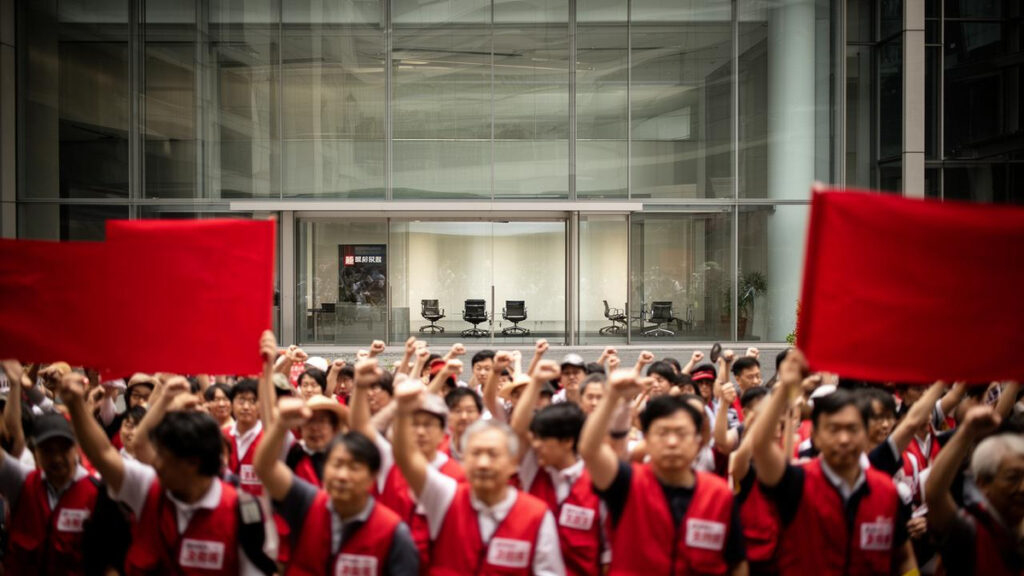
Labor unions at South Korea’s major financial public institutions have launched large-scale collective action in opposition to the government’s second-phase public institution relocation plan. The unions of the three major state-run policy banks — Korea Development Bank (KDB), Industrial Bank of Korea (IBK), and Export-Import Bank of Korea (KEXIM) — held a “Total Struggle Rally to Block Relocation” in Seoul’s Yeouido district after work on the 11th, strongly condemning what they called the artificial dispersion of organizations that would undermine policy finance capabilities. The Korea Deposit Insurance Corporation (KDIC) union also held a policy forum on the same day, presenting arguments against relocation and joining the coordinated effort.
Approximately 2,000 union members were expected to gather at the Yeouido rally, with Representative Kim Hyun-jung of the Democratic Party of Korea and Representative Han Chang-min of the Social Democratic Party, both members of the National Assembly’s Political Affairs Committee, attending to lend support to the unions’ position. These policy banks are highly likely to be included in the second-phase public institution relocation targets to be announced next month. The government is reportedly reviewing plans to distribute headquarters across multiple regions, including Busan, Daejeon, Jeonju, and Naju.
In a joint statement released the previous day on the 10th, the policy bank unions declared: “Artificially splitting the heart of policy finance — which requires a high degree of expertise and global and nationwide networks — and banishing it to the provinces is an economic disaster that will shake the foundations of the nation’s advanced industries and the SME funding ecosystem.” They questioned, “Is there any country in the world that deliberately tears apart its financial institutions? When even concentrating all financial capabilities in one city is barely sufficient, how can we compete with Hong Kong, London, New York, Shanghai, and Tokyo by mechanically dispersing our core financial institutions?” They further emphasized: “KDB is responsible for the National Growth Fund and Advanced Strategic Industry Fund, upon which the nation’s destiny depends; IBK handles policy finance for SMEs and small business owners, the roots of the real economy, on the front lines; and KEXIM is dedicated to driving the export industry and managing South Korea’s economic security and financial diplomacy.” They urged an immediate halt to consideration of forced relocation.
The KDIC union, facing speculation about relocation to Sejong City, also held a policy forum on the 11th and made its opposition clear. Citing research from the law firm Lin, Professor Lee Sang-hoon of Kyungpook National University, and Professor Jeon Seon-ae of Chung-Ang University, they argued that Seoul, with its dense concentration of major financial institutions including banks and securities firms, is the optimal location for performing financial stability functions.
The biggest concern among financial public institutions is large-scale personnel attrition. At KDB, voluntary resignations surged to 97 in 2022 and 87 in 2023 — when discussions about relocating the headquarters to Busan intensified — more than doubling from 37 in 2020 and 46 in 2021.
The following table shows KDB’s annual voluntary resignation figures:
Note: Resignations surged beginning in 2022, when discussions about relocating the headquarters to Busan intensified.
A KDB union official stated, “We estimate that 20-30% of total personnel will resign if relocation materializes.” Observers note that younger employees show overwhelmingly higher intent to leave, making the erosion of the organization’s mid- to long-term competitiveness inevitable. According to a survey of 740 current employees conducted by the KDIC union in June, only 12% of those with less than five years of service and 13% of those with five to ten years indicated willingness to continue working if relocated. In stark contrast, 53% of employees with over 20 years of service expressed willingness to stay. The law firm Lin, which conducted the survey, analyzed: “The shorter the tenure, the more sharply the willingness to continue working declined, raising serious concerns about operational capability gaps.” Additionally, 91% of KDIC employees responded that maintaining the headquarters in Seoul was appropriate.
The financial public institution unions have resolved to mobilize all means, including a general strike and litigation, if the government does not halt its relocation review. In particular, they are paying close attention to the revised Yellow Envelope Act (amendments to Articles 2 and 3 of the Trade Union Act). Since the amended law adds “business management decisions affecting working conditions” to the scope of labor disputes, the unions believe there is now legal room to challenge the government’s unilateral relocation decision. One union leader strongly protested, stating, “The relocation discussions are being conducted so secretly that they resemble a military operation. It is utterly unacceptable to discuss relocation without any consideration for individual employees.”