

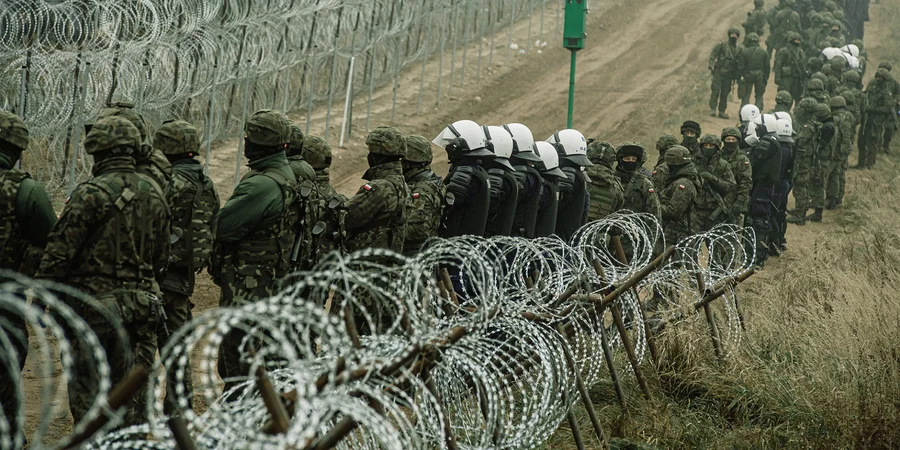
Russia may stage sabotage operations to test NATO’s readiness to respond (Photo: via Reuters, Handout)
Poland, Lithuania, Latvia and Estonia are tightening
security around critical infrastructure amid fears that Russia could stage a
false-flag attack using Ukrainian drones, Reuters
reported on Aug. 10.
Lithuania said last week that Moscow may be preparing such
an attack. Poland, Latvia and Estonia have also warned of possible sabotage
that Russia could use to test NATO’s readiness to respond amid doubts over
continued U.S. commitment to the alliance.
“We’re not naive. We have the information, we read between
the lines and we do our job. We’re strengthening security at critical
infrastructure sites and constantly exchanging information with our
intelligence services about what to do next,” Lithuanian Defense Minister
Robertas Kaunas said.
Lithuania last month deployed troops to help police guard a
liquefied natural gas terminal, an oil terminal, a key power link with Poland
and a pumped-storage hydroelectric plant.
Latvia has stepped up security around all critical
infrastructure, including a dam on the Daugava River near Riga and the
Incukalns underground gas storage facility, Prime Minister Andris Kulbergs
said.
“A potential hybrid threat is now more likely than before,”
he said.
An intelligence official from one of the Baltic states said
assessments indicated that Russian military and domestic intelligence agencies
were preparing a false-flag attack on infrastructure in Russia, the Baltic
states or Poland using Ukrainian-made drones. Such an attack could be carried
out within days of approval from Russian leaders, including Russian dictator
Vladimir Putin.
The greater concern, according to the assessments, is not
the attack’s immediate impact but the “political chaos” it could trigger at
NATO headquarters in Brussels as European countries and the United States
debate how to respond — and whether to respond at all, the official said.
In Poland, the country’s largest oil and gas company, Orlen,
is assessing alternative gas import routes in case its usual supply routes are
disrupted, a source familiar with the company’s operations said.
Orlen imports 80% of Poland’s gas through the liquefied
natural gas terminal in Swinoujscie on the Baltic Sea and an undersea gas
pipeline from Norway that comes ashore nearby. Infrastructure operator
Gaz-System is operating under “heightened vigilance,” another source with
direct knowledge of the situation said.
Orlen declined to comment on specific preventive measures. A
Gaz-System spokesperson said the company was monitoring the geopolitical
situation and responding as necessary.
State-owned Polskie Elektrownie Jadrowe, which is building
Poland’s first nuclear power plant, said forged corporate documents intended to
mislead stakeholders had surfaced. The company said the documents could be
traced to a location “east of Poland.”
The company is investigating the incident with security
services and law enforcement and is monitoring for possible sabotage or other
threats.
Poland’s power grid operator and an army unit began
tightening security around a power link with Ukraine in July. The link helps
stabilize Ukraine’s power grid.
Mysterious drones have also appeared across Europe. Last
week, authorities in Germany found a drone carrying explosives at Leipzig/Halle
Airport. German Interior Minister Alexander Dobrindt called it a hybrid attack
but did not assign blame to any country. Russia rejected suggestions from
German politicians and media that it was involved.
Wojciech Kononczuk, director of Poland’s Center for Eastern
Studies, or OSW, said a wave of Russian accusations that the Baltic states were
cooperating with Ukraine could be laying the groundwork for Russian attacks on
those countries.
Kononczuk said the message to Europe would be that if it did
not accept Moscow’s demands, Russia would spread instability. The move would be
risky, based on a calculation that the West would lack the political will to
respond.
Threat of Russian provocations — key details
On June 28, Polish Foreign Intelligence Agency chief Col.
Pawel Szota publicly said Russia was ready to send “little green men” into the
Baltic states. In his assessment, Putin is now a hostage to his own defeat,
which could keep Russia fighting in Ukraine for several more years while it
also carries out hybrid attacks along NATO’s eastern flank.
On June 29, Lithuania’s Defense Ministry said there were no
objective signs that Russia was preparing a full-scale military attack on the
Baltic states.
On July 3, The Telegraph, citing sources close to Polish
President Karol Nawrocki, reported that the United States had warned Warsaw
that Moscow was preparing an armed provocation on Polish territory. According
to the report, it could be mounted from Kaliningrad or Belarus and involve
scenarios ranging from missile and drone strikes to an illegal border crossing.
On July 15, Polish Foreign Minister Radosław Sikorski said
Russia could be preparing a false-flag operation using Ukrainian drones.
Follow us on Twitter, Facebook and
Google News