
Every U.S. president over the last 20 years has tried to move the United States out of the Middle East, an area so steeped in bad history and poor policy that one wonders why Washington bothers to be involved in the region at all. Barack Obama campaigned on ending the George W. Bush-era war in Iraq, only to direct a surge of 50,000 U.S. troops into Afghanistan and return the U.S. military to Iraqi soil once the Islamic State started expanding. Joe Biden wanted to focus on U.S. strategic competition with China, only to expend diplomatic capital to a war in Gaza. Donald Trump, meanwhile, insisted dumb wars would no longer be fought under his watch, then chose to embark on the dumbest one of this generation.
The Middle East hasn’t been kind to the United States. The United States hasn’t been kind to the Middle East either. Frankly, both could use a break from each other, which is why last week’s big news from three of the region’s major powers has the potential of being significant.
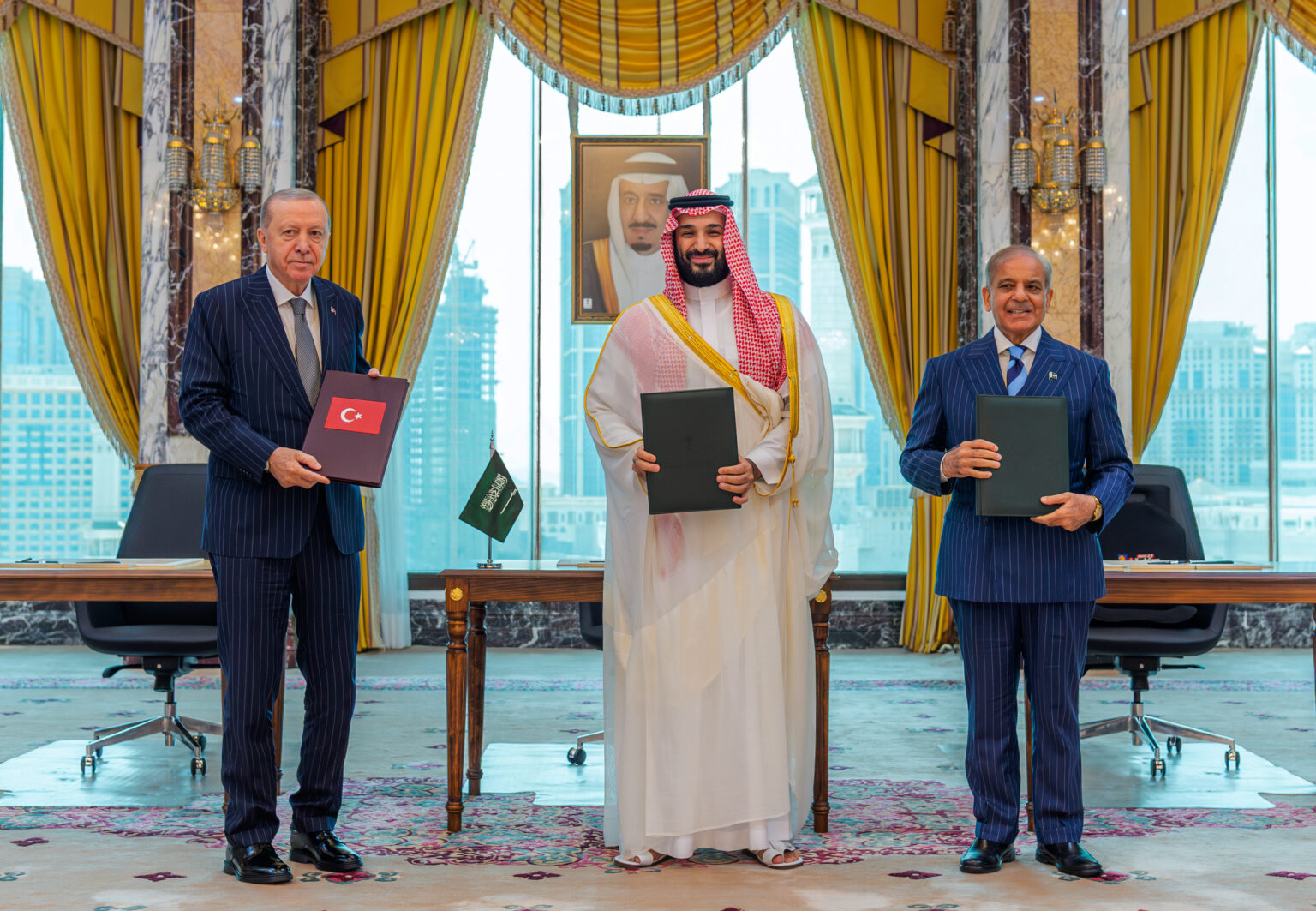
Saudi Arabia, Pakistan and Turkey on Friday announced that they have entered into a mutual defense agreement that sounds quite similar to what the United States has with its NATO allies. Called the “Mecca Joint Defense Agreement,” Riyadh, Islamabad and Ankara declared that an attack on any one of them would henceforth be considered an attack on all of them. The accord is a supplement to a bilateral deal the Saudis and Pakistanis signed with each other in September, which brought a squadron of Pakistani fighter jets and about 8,000 Pakistani troops to the oil-rich kingdom.
Saudi Arabia in particular could use some protection. The U.S. war in Iran and its predictable consequences, up to and including Tehran’s decision to shutter maritime traffic in the Strait of Hormuz and launch attacks against the kingdom’s energy infrastructure, has forced Saudi Crown Prince Mohammed bin Salman to ask a question he’d prefer to avoid asking: Is Riyadh’s traditional security relationship with Washington as useful as it seems? Salman isn’t the only Arab leader asking this; Jordan, which boasts long-standing military and intelligence collaboration with the United States and hosts around 4,000 U.S. troops, has learned in recent weeks that a U.S. military presence can attract Iranian missile attacks as much as prevent them.
Saudi Arabia, however, has it even worse than Jordan. Since the war with Iran began in February, the kingdom has been the target of three entities: Iran to the northeast, Iranian-backed Iraqi militias to the north and the Houthis to the south, an old foe the Saudi military attempted to subdue with a seven-year air campaign that ended in a stalemate in 2022. On Sunday, the Houthis struck the Jazan oil refinery with a drone, causing damage to a key facility at a time when Saudi oil output is lower than it ordinarily would be.
All of this, though, is small potatoes compared to the fundamental issue the kingdom faces right now. The bottom line is that Saudi Arabia is in the middle of a region whose security situation is dicey and whose politics are even more treacherous now due to the war in Iran. Normally, the Saudis would be phoning Washington for more air defense missiles and air-to-ground munitions and perhaps a larger U.S. military presence to provide reassurance. The problem is that the country the Saudi government contacts during troubling times is also the country that ignored Riyadh’s advice and propelled the wider region into a conflict nobody outside of Israel wanted.
By strengthening its defense relationships with Pakistan and Turkey, the Saudis are sending a message to the Trump administration that U.S. unreliability is pushing them in another direction. Like all middle powers, Saudi Arabia is expanding its options, trying to lessen its dependence on any single country and doing what it can to promote its own defense.
Some in the U.S. foreign policy community will likely view this development with a mixture of dread and paranoia — dread because U.S. policy has become so destabilizing to the Middle East that even some of Washington’s most consistent security partners are looking elsewhere for support and paranoia because China, America’s one true peer competitor in the international system, today is likely looking at all of this with glee.
But there’s a silver lining here. Instead of greeting this new alliance with panic, we should treat it as an opportunity to downsize the U.S. military presence in this region. Such a course correction would serve Washington’s Arab partners just as much as it would serve the United States.
The more Uncle Sam is involved in the Middle East, the worse the Middle East becomes. Look no further than the Strait of Hormuz, where the U.S. decision to attack Iran has transformed a once-free and open international waterway into a restricted area policed by Iranian drones and missiles.
Will Turkey and Pakistan go to war on Saudi Arabia’s behalf if the time calls for it? Those countries will have to decide for themselves. The United States should get out of the way and let them figure it out rather than continuing to pretend it has all the answers.
As the last six months have shown, it clearly doesn’t.
Daniel DePetris is a fellow at Defense Priorities and a foreign affairs columnist for the Tribune.
Submit a letter, of no more than 400 words, to the editor here or email letters@chicagotribune.com.