
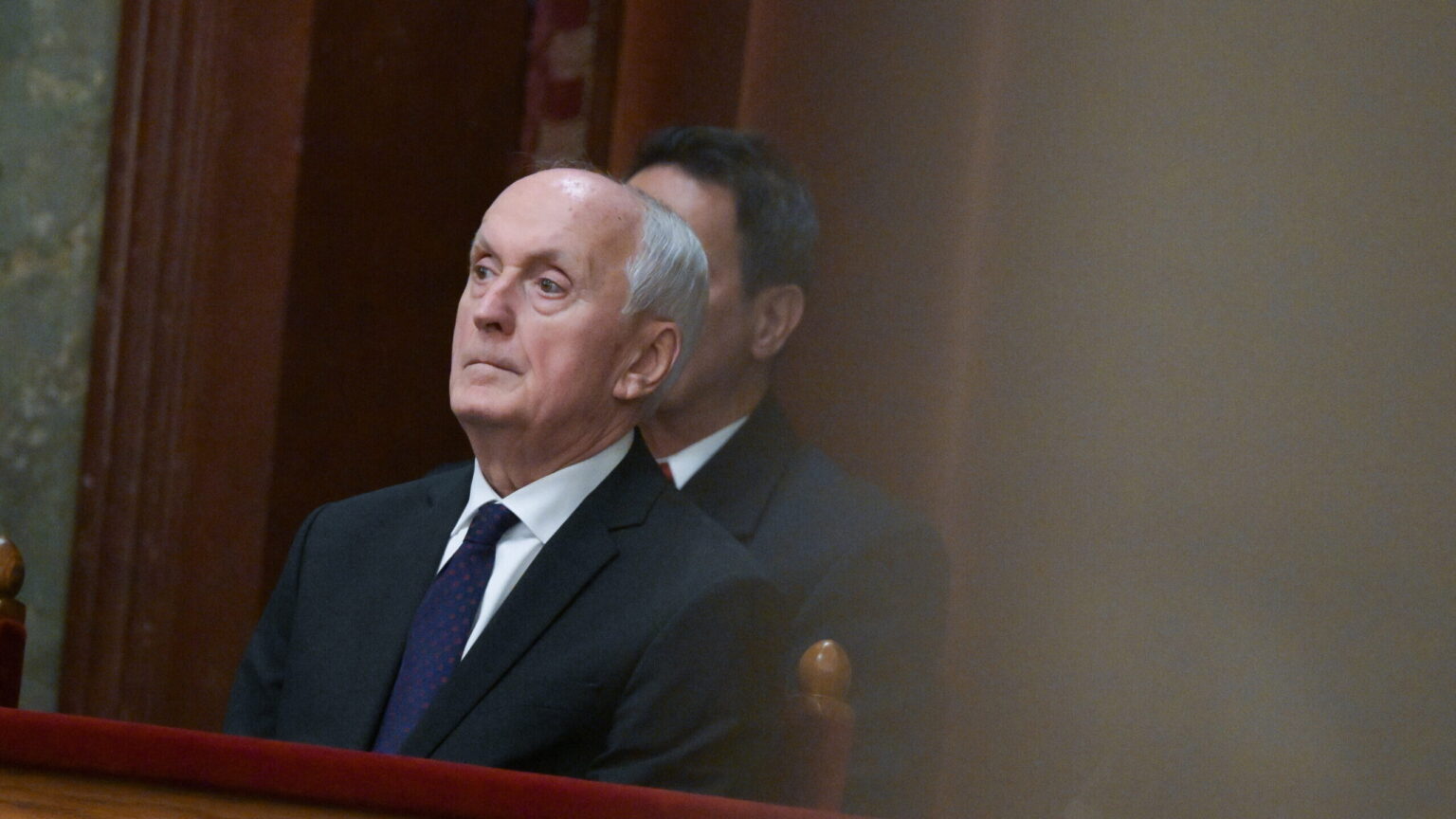
András Baka was elected Hungary’s new president on Tuesday with the backing of the governing Tisza Party’s two-thirds parliamentary majority. The former Supreme Court president received 140 votes in the 199-seat National Assembly, comfortably above the 133 needed for election in the first round.
Hungary’s president is elected by parliament in a secret ballot for a five-year term. A candidate must secure written nominations from at least one-fifth of MPs—currently 40 lawmakers—and needs the support of two-thirds of all 199 MPs, or 133 votes, in the first round.
Baka’s election holds clear symbolism, as he was one of the best-known institutional casualties of the 16-year rule of Viktor Orbán and Fidesz–KDNP. Parliament elected him president of the Supreme Court in 2009 for a six-year term, but his mandate was terminated three and a half years early when the second Orbán government reorganized the court system and replaced the Supreme Court with the Kúria. The European Court of Human Rights later ruled that Hungary had violated Baka’s rights in connection with his premature removal.
His arrival also mirrors the departure of his predecessor. President Tamás Sulyok’s term was cut short in July after Tisza used its two-thirds majority to amend the Fundamental Law, ending his mandate after he refused Prime Minister Péter Magyar’s calls to resign. Sulyok signed the amendment but called his own removal unlawful and damaging to the rule of law. The presidency has since been exercised temporarily by parliamentary speaker Ágnes Forsthoffer.
Magyar announced Baka as Tisza’s candidate on Saturday after the governing parliamentary group chose him by secret ballot from a shortlist of three. The process followed the failed attempt to persuade chess grandmaster Judit Polgár to take the post and several weeks of social media casting in which Magyar and government minister Bálint Ruff publicly met potential candidates, including lawyer Botond Fülöp and historian Ignác Romsics.
Magyar said Baka offered the strongest guarantee that the presidency could ‘regain its true dignity’, unite the country and serve as a constitutional counterweight to the government. Tisza deputy leader Márk Radnai was more explicit, saying Hungary needed a president who was not the government’s ‘extended arm’ and who could say no to the political majority when necessary. ‘Yes, us too,’ he added.
Baka himself had outlined a similar view before his nomination. Speaking in June, he rejected the idea that possession of a two-thirds majority allowed a government to do whatever it wished, arguing that constitutional government also depended on institutional practice, legal standards and checks on political power. His willingness to apply those principles to Tisza is now likely to become one of the main measures of his presidency. Baka already criticized the 12-year term limit imposed on MPs as part of the same amendment that removed Sulyok from office.
Supporters have presented his nomination as a break with the ‘political subordination’ of the presidency. Progressive Budapest Mayor Gergely Karácsony said the NER—the acronym for the system built under Orbán—era had ‘begun with the firing of András Baka’ and would end with his election as president.
Fidesz has attacked the nomination from precisely the opposite direction. Parliamentary group leader János Bóka called Sulyok Hungary’s ‘last legitimate president’ and said the party would boycott the election because it considered his removal illegitimate. He accused Baka of taking part in an unlawful process and predicted that he would become a ‘puppet’ of Tisza’s parliamentary majority.
Former justice minister Bence Tuzson highlighted Baka’s own words from 2011, when the then Supreme Court president described the possibility of removing a senior constitutional office-holder—him, in that case—through a last-minute constitutional amendment as ‘simply astonishing’.
Hard-right Our Homeland (Mi Hazánk) leader László Toroczkai has made a similar argument, saying rule-of-law guarantees cannot depend on which political side holds power. He also criticized Baka over parts of his judicial record and said the party would not support him despite not questioning his professional experience. The party attempted to nominate energy lawyer Máté Tóth, but its six MPs could not secure enough endorsements for a valid nomination.
Hungary’s president has limited executive authority but can act as an important check on the government and parliament. The head of state can send legislation back to MPs for reconsideration or refer it to the Constitutional Court before signing it into law, and can also initiate legislation. The president appoints or nominates a number of senior officials, represents Hungary abroad and serves as commander-in-chief of the armed forces. In narrowly defined circumstances, the president can also dissolve parliament.
Baka therefore enters the presidency with an unusually clear political test: whether the jurist once removed by a two-thirds Fidesz majority will be willing to use the powers of the office against a two-thirds Tisza majority when he considers it necessary.
Related articles:
At a time when public debate is increasingly polarized and superficial, Hungarian Conservative remains committed to depth, intellectual honesty, and independent conservative thought.
Producing high-quality journalism requires resources. Your contribution helps us expand our coverage, reach new audiences, and keep our content accessible.

Please consider supporting our mission.