

Bechtel said Aug. 7 it has taken over management of the construction site for Poland’s first nuclear power plant from state-owned Polskie Elektrownie Jądrowe, as earthwork begins on the three-unit AP1000 design project
The shift moves the long-planned development into large-scale site preparation ahead of first nuclear concrete targeted for 2028.
Bechtel and Westinghouse are developing the 3,750-MWe plant for the utility firm, as a consortium, with the latter supplying the AP1000 technology and the former serving as construction contractor.
]]>
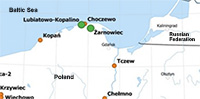
The Lubiatowo-Kopalino nuclear plant site is on Poland’s Baltic Sea coast northwest of Gdansk.
Map courtesy of ResearchGate
With the handoff, Bechtel now is coordinating contractors and supervising construction activity and site safety at the Lubiatowo-Kopalino site in Choczewo, north of Gdansk near Poland’s Baltic Sea coast. More than 400 people are working on the project, about one-third of them local hires, the company said.
With the initial earthworks contract, Bechtel is starting “the first permanent plant work” that is intended to create “the platform for the next phase,” said Project Director Ed Gore.
Polish contractor Budimex is performing the initial earthwork across a 740-acre site. The package includes grading and leveling, drainage upgrades and about 10 miles of temporary roads, along with areas for offices, logistics facilities, warehouses and equipment maintenance.
A June 30 Stage 2 preparatory work permit provides a more detailed picture of the construction infrastructure now taking shape: it authorizes surveying and site leveling; about 88 acres for warehouse and technical support facilities; 7.5 acres for office and worker support facilities; and 13.5 acres for parking.
]]>
Looking for quick answers on construction and engineering topics?
Try Ask ENR, our new smart AI search tool.
Ask ENR →
]]>
Temporary potable- and raw-water systems, sanitary and storm sewers, electrical distribution and telecommunications infrastructure are also authorized. According to the permit, diesel generators will supply power to the site until permanent construction power is available. The planned temporary electrical network will later use an underground medium-voltage loop with distribution transformers rated from 500 kVA to 2,500 kVA.
ENR reported in December 2024 that the project schedule had slipped by three years, with the first nuclear concrete pushed to 2028 and the commercial operation of the first unit to 2036. At the time, Bechtel was conducting geological and hydrogeological surveys across 30 hectares to inform design of the three reactors, inflow basin and cooling-water channels.
Building the Construction Platform
A mobile concrete batch plant is planned, along with foundations for longer-term batch plants that will support later construction. Eleven specialized workshop buildings will support structural fabrication, reinforcing steel, HVAC, electrical work, coatings, precast concrete, stainless steel, valves and other trades. Nine principal temporary warehouses and hardened laydown areas will provide material storage and handling.
]]>

The Lubiatowo-Kopalino construction site is within a forested area near Poland’s Baltic Sea coast, where permit requirements constrain the layout of temporary construction facilities and preserve a coastal wildlife corridor.
Image courtesy of PEJ
Among the largest facilities will be a 76,400-sq-ft module assembly building east of the future generating units. Rising about 146 ft, the steel-framed structure will be built on a monolithic reinforced-concrete mat foundation.
The permit requires construction-support facilities to remain at least 330 ft from the Mierzeja Sarbska Natura 2000 site, part of the European Union’s network of protected habitats, and 80 ft from the Biebrowski Canal. Along the coast, a forested wildlife migration corridor at least 650 ft wide must remain between the dunes and the northern edge of the cleared zone. Construction within that corridor is generally prohibited, except for tunneling associated with the plant’s cooling-water and fish-recovery systems.
The permit also requires at least one year of groundwater monitoring before nuclear-facility construction begins, using a minimum of five piezometers recording water levels on both the upgradient and downgradient sides of the nuclear island. Excavations must be protected from groundwater inflow, with permitted measures including cutoff walls, diaphragm walls and soil-cement columns.
Work Advances Ahead of EPC Contract
“Steady progress on our project is crucial to maintaining the construction schedule,” urility President Marek Woszczyk said when participants extended their Engineering Development Agreement in December while negotiations continued on the main EPC contract. The amendment incorporated “some of the work that was originally supposed to be included in the EPC contract,” he said, allowing that work to proceed before the construction agreement is finalized.
]]>

Crews conduct geotechnical investigations for Poland’s first nuclear power plant. The project’s expanded engineering program calls for 1,000 borings totaling about 9.3 miles and 7,000 laboratory tests.
Image courtesy of PEJ
Westinghouse Poland President Mirosław Kowalik said the extension allows design and engineering work to advance, including documentation needed to procure long-lead items and support the license application, while Bechtel Polska President Leszek Hołda said it allows engineering and preparatory work to continue “until the conclusion of the EPC contract.”
The amended scope includes design of the nuclear island, turbine island and balance-of-plant systems and another geotechnical campaign involving 1,000 borings totaling nearly 9.3 miles and 7,000 laboratory tests. Procurement work also is continuing on long-lead plant components.
Polskie Elektrownie Jądrowe submitted its nuclear construction-license application March 31. Prepared by more than 200 specialists, the filing includes the preliminary safety analysis report, quality-assurance program, safety classification and physical-protection design. Woszczyk said the filing and its attachments comprise “over 40,000 pages,” demonstrating what “the scale and complexity of our project.”
Poland’s National Atomic Energy Agency has up to 24 months to decide on the nuclear construction license application, excluding the time required for supplemental documentation. Polskie Elektrownie Jądrowe is set to apply for a building permit from the regional government in 2027. Until both approvals are in place, current activity remains preparatory work, with the first nuclear concrete targeted for the fourth quarter of 2028.
The three Westinghouse AP1000 units will total 3,750 MWe. Construction of each is expected to take about seven years before testing and commissioning, with commercial operation targeted for 2036, 2037 and 2038.