
OWASSO, Okla. — Artificial Intelligence is becoming a bigger part of Oklahoma classrooms. Now, a new state law is requiring every district to adopt an AI policy.
In Owasso, those plans have already been well underway.
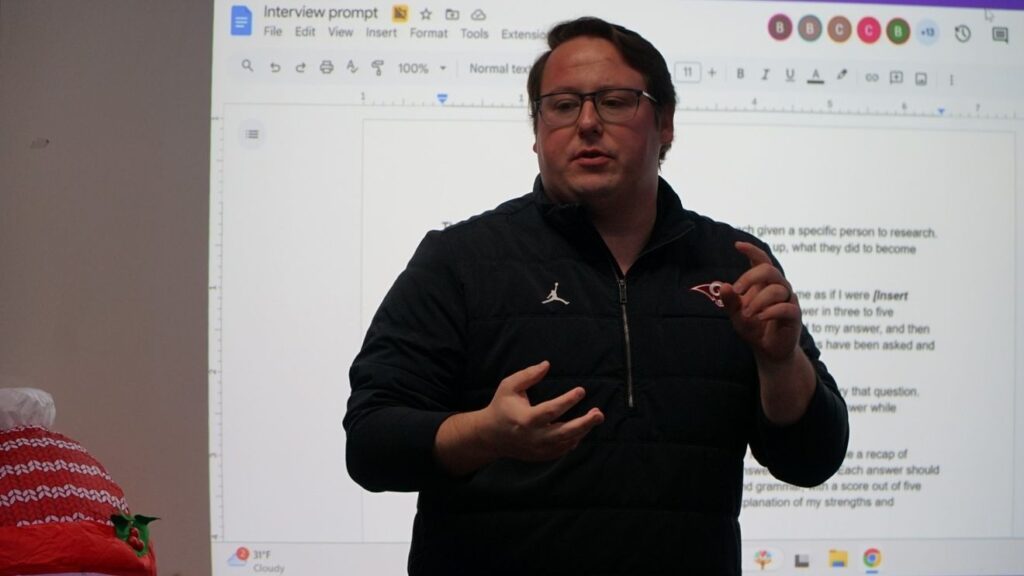
Eight grade students at Owasso Public Schools were giving the following English assignment last December:
- Students are given a specific person to research
- Students tell Google Gemini to act as an interviewer and interview them [the student] as if they were the research subject.
- Students give Gemini the task of asking questions they should be able to answer in three to five sentences. Gemini is to ask one question at a time, wait for a response, respond to the answer, and then ask the next question.
- This process is continued until 10 total questions have been asked and answered. If any questions are incorrect, Gemini is to let the student know and allow them a chance to retry the question.
- Gemini ensures all questions are written at an 8th grade understanding. Once all questions are answered, Gemini is to thank the student and provide a recap of the ‘interview,’ and then grade the answers individually based on three categories: coherence, knowledge, and grammar with a score out of five points for each category.
- After grading, Gemini provides a “clear explanation of [students’] strengths and weaknesses in [their] responses.”
Students researched a historical figure, then used Google Gemini to take part in a simulated interview.
“It was kind of like a biography, book report type thing,” said Mark Officer, Executive Director of Instructional Technology for Owasso Public Schools. “…they would ask you questions about that person. It was kind of like a check on if you actually studied and knew about the person.”

Officer is the Assistant Superintendent of Teaching and Learning for Owasso Public Schools. He helped lead the district’s rollout of AI last year, making it available as an optional learning tool for students in grades eight through 12.
“We just want to give them the tools that they need to be successful in what we perceive to be the world after they leave us,” said Officer. “And so, it’s become painfully clear in the last24 months that AI is not going away.”
As more schools begin embracing the technology, there’s now a state law on the books requiring every Oklahoma school district to adopt an Artificial Intelligence policy before the start of the 2027-2028 school year.
“I think that most people recognize that the technologies are changing. We need some guardrailsbut whatever we write in statutewhatever we pass in the bill is already old because things are changing so quickly,” said Oklahoma Senator Ally Seifried.
In Owasso, those guardrails start with the platform itself.
“Our Google classroom is a wall garden, if you will. It’s got boundaries, so when they’re using AI, it stays within Owasso,” said Dr. Margaret Coates, Superintendent of Owasso Public Schools.
District leaders said technology is only part of the equation. They also have an academic integrity policy, making it clear AI can support learning, but not replace a student’s own work.
“Using AI to produce work as opposed to your own brain is no different than writing down a notebook during attest and getting the answers,” said Coates. “It’s the same type of plagiarism.”
As AI continues to change, the district said its approach will have to evolve with it.
This year the district is expanding its use of the technology, it will be available for students grades three and up.