
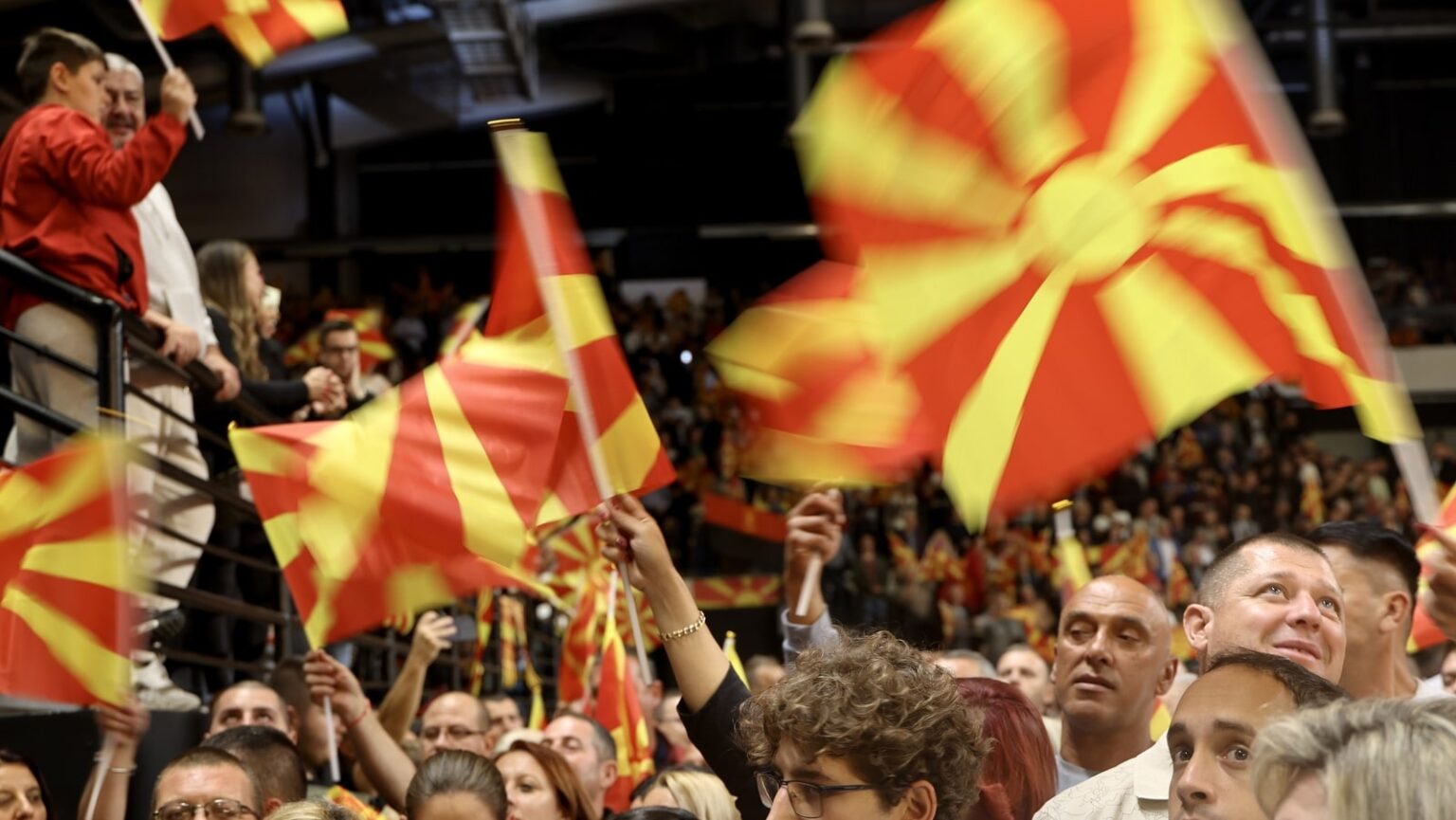
 Supporters of the VMRO DPMNE party wave national flags during a rally at the start of the local election campaign in Skopje, September 2025. Photo: EPA/GEORGI LICOVSKI.
North Macedonia’s political parties received almost 9 million euros from the state budget this year for their regular operations, with the ruling VMRO DPMNE party taking a record 2.5 million euros and the main opposition Social Democrats, SDSM, seeing its funding fall by around 40 per cent to about 1 million euros.
A BIRN analysis of the 2026 payments, based on data obtained from the Ministry of Justice, shows that the three largest recipients, VMRO DPMNE, the SDSM and the ethnic Albanian Democratic Union for Integration, DUI, together received about 45 per cent of the total funding.
Adding in the smaller Levica [Left] and ZNAM parties, more than half of the money went to just five parties.
The DUI received about 472,000 euros, down from about 840,000 euros last year.
Both falls and rises reflect the parties’ performance in the 2025 local elections and the number of municipal councillors they secured.
North Macedonia’s system ties state funding to electoral performance.
Thirty per cent of the available money is distributed equally among parties and coalitions that meet a 1-per-cent electoral threshold. The other 70 per cent is allocated according to the number of elected MPs and municipal councillors.
This makes local elections particularly important. While parliament has 120 seats, the country’s municipalities have 1,307 elected councillors. In the 2025 local elections, the VMRO DPMNE-led coalition won 548 council seats, compared with 231 for the SDSM-led coalition.
“A councillor and an MP are worth the same, so this explains the competition to get as many councillors as possible,” a source from one of the parties told BIRN under condition of anonymity.
The system acts as an important financial incentive for smaller parties without any MPs, or even any councillors, as they can still qualify for some state funding simply by passing the 1-per-cent threshold in any single municipality during local elections.
In some of the smaller municipalities in local elections, that threshold can be crossed by winning only a few dozen votes.
BIRN previously reported on how seven smaller parties exploited this feature to secure more than 80,000 euros each for the following four years. In some cases, such parties run alone in just one, or in a few, municipalities to reach this threshold, while at national level remaining part of coalitions led by big parties.
Overall, 62 parties qualified for regular state funding in 2026, the data show, although around one-third of them received less than 20,000 euros.
Apart from the almost 9 million euros in annual funding, which consumed 0.15 per cent of the state budget, the state also reimburses party election campaign expenses and provides additional annual funding for the research centres of the four parties with the strongest electoral results.
In 2026, an additional 320,000 euros was allocated for those research centres, shared between VMRO DPMNE, the SDSM, the DUI and Levica.
The funding comes with obligations, such as submitting annual financial statements and reports and declaring any donations to the State Audit Office, which oversees use of the funds.
The law requires the parties to publish these financial reports on their websites by the end of each April. In reality, this requirement is frequently ignored, according to BIRN’s analysis.
The State Audit Office told BIRN that the law does not clearly designate who is responsible for monitoring this obligation. Another issue is that parties are not legally required to have an official website.
The Audit Office said they have begun discussing digitalisation of parties’ financial reporting, including the possibility of creating a single online platform where all the parties would publish their financial reports.