
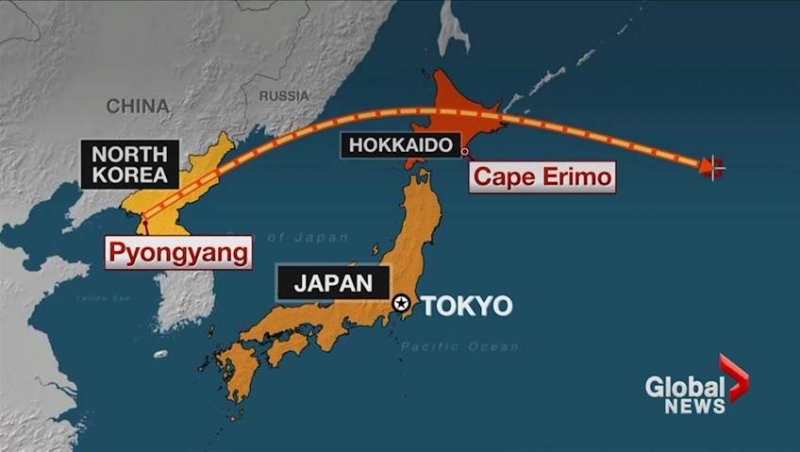
North Korea fired a ballistic missile toward the East Sea, also known as the Sea of Japan, in its second such launch in less than a week, adding to tensions ahead of a major annual military exercise between South Korea and the United States.
South Korea’s Joint Chiefs of Staff said the missile was launched from the Wonsan area on North Korea’s eastern coast at around 6 a.m. The projectile traveled more than 700 kilometers before falling into the sea.
South Korean and US military authorities began a detailed analysis of the launch to determine the missile’s exact type, flight characteristics and other technical specifications.
The initial assessment did not definitively identify the weapon. However, a flight distance exceeding 700 kilometers is consistent with the capabilities of some short-range ballistic missiles in North Korea’s growing arsenal.
The launch followed another North Korean ballistic missile test six days earlier. South Korea’s military identified that projectile as a short-range ballistic missile launched toward the East Sea.
The timing is particularly significant. South Korea and the United States are preparing for their annual Ulchi Freedom Shield exercise, one of the most important recurring components of their military alliance.
North Korea has repeatedly condemned joint US-South Korean military exercises, portraying them as preparations for an invasion. Seoul and Washington maintain that their exercises are defensive and necessary to preserve readiness against potential North Korean aggression.
The latest missile launch therefore fits a familiar pattern of action and reaction around major military exercises. However, repeated launches also have a practical military purpose for Pyongyang: they allow North Korea to test weapons, train missile units and demonstrate that it possesses the capability to threaten military targets throughout South Korea.
Why is the timing ahead of Ulchi Freedom Shield so important?
The proximity of the launches to Ulchi Freedom Shield strongly shapes how the latest North Korean activity is being interpreted.
The annual exercise is designed to strengthen the combined defense posture of South Korea and the United States. It generally involves command-and-control training, computer-simulated scenarios and field exercises intended to test how the allies would respond to a major security crisis or armed conflict on the Korean Peninsula.
For Seoul and Washington, such exercises are a central element of deterrence.
Approximately 28,500 US troops are stationed in South Korea, and any large-scale conflict would require American and South Korean forces to operate through an integrated command structure. Regular exercises are therefore intended to ensure that military units can communicate and coordinate effectively.
Pyongyang views the drills very differently.
North Korea has long characterized major allied exercises as rehearsals for war and has frequently demanded that they be reduced or cancelled. It argues that the deployment of sophisticated US military assets and large-scale exercises near the peninsula constitute direct threats to its security.
This competing interpretation creates a recurring security dilemma.
South Korea and the United States conduct exercises because they consider North Korea a military threat. North Korea points to those exercises as justification for expanding its nuclear and missile capabilities. Those weapons programs then encourage Seoul and Washington to strengthen their exercises further.
Missile launches immediately before or during major drills can therefore serve as political signals.
However, they should not be viewed exclusively as symbolic protests. North Korea can simultaneously use such launches to evaluate missile performance and provide operational training for the units responsible for deploying the weapons.
The result is that periods surrounding major exercises frequently become moments of elevated tension on the Korean Peninsula.
What type of missile might North Korea have launched?
South Korean authorities had not initially announced a definitive identification of the missile, making it important not to assign a specific model solely on the basis of its reported flight distance.
The projectile traveled more than 700 kilometers, putting its observed performance within the broad category associated with short-range ballistic missiles.
North Korea possesses several missile systems capable of threatening targets across South Korea.
One of the most prominent is the KN-23, a solid-fuel short-range ballistic missile frequently compared with Russia’s Iskander system because of similarities in appearance and certain flight characteristics.
The KN-23 has demonstrated ranges broadly sufficient to account for a flight of more than 700 kilometers depending on the particular variant, payload and trajectory.
North Korea also operates other short-range systems, meaning flight distance alone cannot establish that the latest projectile was a KN-23.
Military analysts typically require additional information such as maximum altitude, speed, trajectory, launch platform and maneuvering characteristics before making a more confident identification.
Solid-fuel missiles have become especially important to North Korea.
Unlike liquid-fueled systems that can require more extensive preparations before launch, solid-fuel missiles can generally be prepared and fired more rapidly. That improves survivability because launch units can remain concealed, move to firing locations and launch before an adversary has sufficient time to detect and destroy them.
Mobile short-range missiles are particularly relevant to a potential conflict on the Korean Peninsula because they can target air bases, command facilities, ports and other military infrastructure.
Determining exactly which missile was used will therefore help South Korean and US analysts understand whether Pyongyang was testing an established system, a modified variant or another capability.
What is the KN-23 and why does South Korea consider it dangerous?
The KN-23 is one of the most prominent short-range ballistic missiles developed by North Korea and represents an important element of Pyongyang’s regional strike capabilities.
It is often described as resembling Russia’s Iskander missile system, although North Korea’s weapon has its own design characteristics and has appeared in different configurations.
Its importance comes from a combination of mobility, solid-fuel propulsion, range and potentially challenging flight characteristics.
Mobile launchers make missile forces more difficult to locate before they fire. North Korea’s mountainous terrain and extensive network of underground facilities further complicate efforts to track missile units.
A weapon capable of traveling roughly 700 kilometers or more can potentially reach a wide range of targets on the Korean Peninsula when launched from North Korean territory.
That includes military bases, airfields, command facilities, logistics hubs and ports.
Another concern is missile defense.
Some modern short-range ballistic missiles can fly on trajectories designed to make interception more difficult than with traditional ballistic systems. Changes in altitude or maneuvering during flight can complicate the calculations required by defensive systems.
The potential payload is also significant.
North Korea has repeatedly emphasized the development of tactical nuclear capabilities alongside conventional missile forces. This means South Korea, Japan and the United States assess certain short-range systems not simply as conventional battlefield weapons but as possible delivery platforms within North Korea’s nuclear strategy.
There is no basis from the flight distance alone to conclude that the latest launch carried any nuclear payload. Missile tests ordinarily use non-nuclear payloads.
The strategic concern is instead about capability: whether the same missile platform could potentially deliver different types of warheads during a conflict.
This dual-capable potential makes systems such as the KN-23 particularly important to allied defense planning.
Why does North Korea repeatedly launch missiles around joint military exercises?
North Korea has a long history of using missile launches, artillery exercises and military statements to respond to US-South Korean drills.
The approach serves several purposes simultaneously.
First, it allows Pyongyang to register political opposition. A missile launch receives far more international attention than a diplomatic statement and provides a visible demonstration that North Korea rejects military pressure.
Second, launches can support deterrence messaging.
Pyongyang wants Seoul and Washington to understand that their military installations could be targeted if conflict breaks out. Testing missiles around major exercises reinforces that message.
Third, these events provide genuine military training.
Missile units need to practice receiving orders, moving launchers, preparing weapons and conducting launches under operational conditions. Repeated tests can therefore improve readiness.
Fourth, weapons launches generate technical information.
Engineers can examine propulsion, guidance, accuracy and other performance indicators and use the results to improve future missile designs.
The distinction between “test” and “exercise” can consequently become blurred.
A launch may simultaneously evaluate technology, train military personnel and deliver a political message.
North Korea can also vary its response depending on the scale and nature of allied exercises. It has previously responded to major drills with combinations of missile launches, artillery activity and increasingly confrontational rhetoric.
That creates an escalation risk.
South Korea and the United States may respond to North Korean weapons tests by strengthening surveillance or conducting additional military activities. Pyongyang can then portray those measures as further justification for its own response.
Breaking this cycle has proved extremely difficult because both sides view their actions as defensive and the other side’s actions as threatening.
What is Ulchi Freedom Shield and what do South Korea and the US practice?
Ulchi Freedom Shield is a major annual exercise intended to strengthen the combined readiness of South Korean and US forces.
The training is built around scenarios that test military command structures and responses to security contingencies on the Korean Peninsula.
One important component is command-and-control.
In a major crisis, large numbers of South Korean and American military units would need to coordinate operations across land, air and maritime domains. Commanders must be able to exchange intelligence, issue orders and respond rapidly as battlefield conditions change.
Exercises allow the alliance to test these procedures before an actual emergency.
Training can also address increasingly complex threats, including missile attacks, drones, cyber operations and other forms of asymmetric warfare.
Civil-defense and government-response components are also relevant to the broader Ulchi framework. A conflict on the Korean Peninsula would not be purely a military challenge. Government agencies would need to maintain essential services, protect civilians and respond to attacks against critical infrastructure.
North Korea strongly objects to these exercises.
Pyongyang argues that the scenarios effectively prepare allied forces for military operations against the North.
South Korea and the United States reject that characterization and maintain that their alliance and exercises are defensive.
The disagreement reflects a deeper problem: military readiness measures intended to deter conflict can be interpreted by an adversary as preparation for conflict.
Ulchi Freedom Shield therefore has significance beyond the specific units participating. It has become part of the annual strategic signaling between North Korea and the US-South Korean alliance.
Could North Korea’s latest launches be preparations for a larger weapons test?
It is possible that North Korea could conduct additional weapons tests around the exercise period, but two short-range launches alone do not establish that a larger test is imminent.
Pyongyang has historically conducted clusters of military activities during periods of heightened tension.
These can include short-range ballistic missiles, cruise missiles, artillery exercises and tests involving longer-range systems.
North Korea may escalate or reduce the intensity of its activity depending on the political message it wants to send and developments in US-South Korean military activity.
A larger test could involve an intermediate-range or intercontinental ballistic missile, although there is currently no basis from the latest short-range launch alone to conclude that such a test will occur.
Military authorities therefore watch preparations at known launch sites and other indicators to determine whether additional activity may be planned.
The frequency of recent launches nevertheless deserves attention.
Two ballistic missile launches within less than a week suggest sustained military signaling rather than a single isolated event.
Pyongyang may also use the Ulchi Freedom Shield period to demonstrate multiple parts of its arsenal rather than relying on one missile type.
For South Korea and the United States, this creates a difficult balance.
They must maintain sufficient surveillance and military readiness to respond to potential escalation without allowing every weapons test to trigger an uncontrolled cycle of countermeasures.
The most important indicators will be the type, frequency and geographic pattern of any subsequent North Korean launches.
A continuation of short-range tests would suggest sustained pressure focused primarily on the peninsula. Tests of substantially longer-range systems would carry broader implications for Japan and the United States.
How does North Korea’s missile program threaten South Korea and Japan?
North Korea has developed a diverse missile arsenal designed to threaten targets at different distances.
For South Korea, geography makes short-range ballistic missiles particularly important.
Most of the country lies within reach of North Korean missile systems, while areas close to the border can also be threatened by artillery and other weapons.
Missiles with ranges of several hundred kilometers can potentially target air bases, ports, command centers and other strategically important facilities throughout South Korea.
Japan faces a different but related threat.
Longer-range North Korean missiles can reach Japanese territory, where important US military facilities are also located. Those bases could play a major role in supporting operations on the Korean Peninsula during a conflict.
North Korea has additionally developed intermediate-range and intercontinental systems intended to extend its deterrent far beyond Northeast Asia.
This layered arsenal complicates missile defense.
Different missiles travel at different speeds, altitudes and trajectories. Defenders therefore require multiple detection and interception systems rather than one universal solution.
The possibility that some missiles could carry nuclear warheads further increases the stakes.
North Korea portrays its nuclear arsenal as essential to deterring attacks against the country. South Korea, Japan and the United States view the same arsenal as a major security threat requiring stronger deterrence and missile-defense cooperation.
That fundamental disagreement drives much of the region’s military competition.
The latest launch is therefore important even if it involved a relatively familiar short-range system.
Each successful launch provides additional evidence of operational readiness and reminds neighboring states that North Korea possesses a large and increasingly diversified missile force capable of threatening critical targets across the region.
Can South Korea and the US intercept North Korean short-range ballistic missiles?
South Korea and the United States operate multiple missile-defense capabilities intended to detect and intercept ballistic threats, but no defensive architecture can guarantee that every incoming missile would be destroyed.
South Korea has developed a layered approach combining domestic and US-supported systems.
Patriot interceptors provide protection against certain short-range ballistic missile threats, while the US deployment of the Terminal High Altitude Area Defense system adds another layer of defense.
South Korea has also been developing indigenous missile-defense capabilities as part of its broader strategy for responding to North Korea’s expanding arsenal.
Early warning is crucial.
Satellites, ground-based radar and other sensors must detect a launch, determine the missile’s trajectory and provide targeting information quickly enough for an interceptor to engage it.
Short-range missiles create particular difficulties because flight times can be brief.
A missile launched from North Korea toward a target in South Korea may provide defenders with only a limited window in which to respond.
Large salvos would create an additional challenge.
Even sophisticated missile defenses have finite numbers of interceptors. An attacker could attempt to overwhelm defenses by launching multiple ballistic missiles alongside cruise missiles or drones.
This is why the US-South Korean strategy relies on more than interception.
Deterrence, surveillance and the ability to respond against launch infrastructure are also central components of allied planning.
Joint exercises such as Ulchi Freedom Shield are partly intended to test how these different elements function together.
North Korea’s continued development of maneuverable and solid-fuel missiles means the competition between offensive missile technology and defensive systems is likely to remain one of the defining features of security on the Korean Peninsula.
What happens next as the US-South Korea exercises approach?
The period surrounding Ulchi Freedom Shield will be closely watched for additional North Korean military activity.
Pyongyang could respond with further missile launches, artillery exercises, military statements or other demonstrations of its weapons capabilities.
However, escalation is not inevitable.
North Korea often calibrates its military activity to communicate dissatisfaction without necessarily crossing thresholds that would provoke a significantly stronger response from South Korea or the United States.
Seoul and Washington are meanwhile expected to proceed with their planned training while maintaining heightened surveillance of North Korean military movements.
The challenge for all sides is preventing reciprocal military signaling from developing into a genuine crisis.
The Korean Peninsula contains large conventional forces positioned relatively close to one another, alongside North Korea’s nuclear arsenal and a substantial US military presence.
That means miscalculation can carry unusually serious consequences.
The latest launch also reinforces a broader strategic reality.
North Korea’s missile program is no longer based on a small number of experimental systems. Pyongyang has spent years building a diversified arsenal that includes short-, medium-, intermediate- and intercontinental-range weapons as well as cruise missiles and increasingly sophisticated solid-fuel systems.
Repeated testing contributes to making those capabilities more operational.
For South Korea and the United States, exercises such as Ulchi Freedom Shield are intended to demonstrate that the alliance can respond effectively to those threats.
For North Korea, the same exercises are presented as justification for strengthening its military capabilities.
The latest missile launch is therefore another episode in a continuing security cycle: allied exercises prompt North Korean demonstrations, which in turn reinforce the allies’ argument that intensive military readiness remains necessary.