
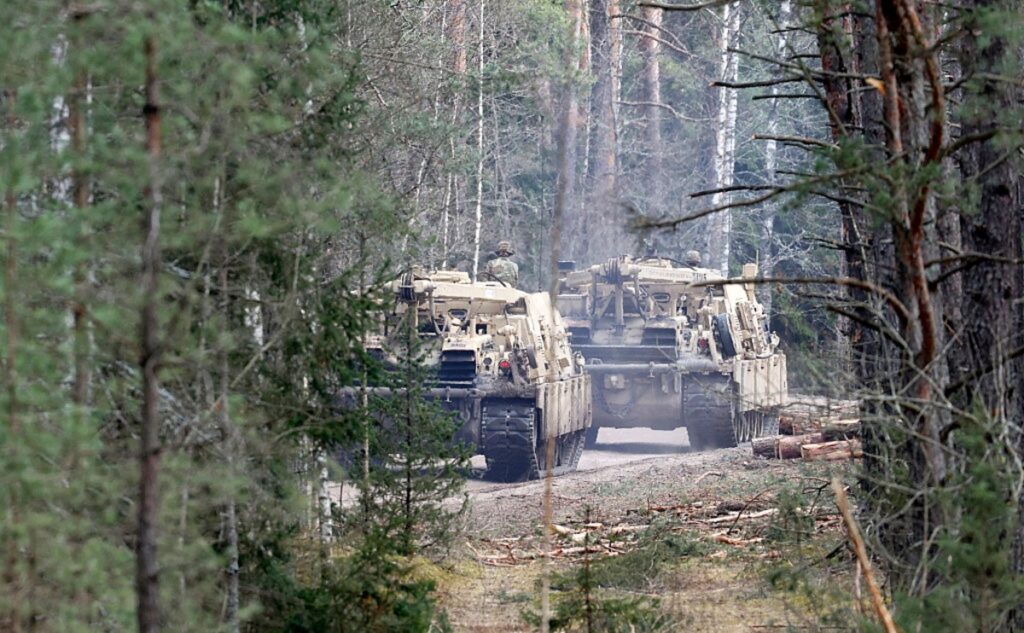
Lithuania’s government approved an expanded terrain-denial program on August 12, 2026, trading plans for planted tree lines in favor of restored wetlands that will render stretches of its borders physically impassable to heavy armor — a strategy derived directly from what Russian forces discovered, to their cost, in the bogs and floodplains of northern Ukraine. The €50 million (approximately $58 million USD) buildout nearly doubles the country’s network of pre-positioned engineering obstacle parks while carving a new counter-mobility belt into the ground itself, and it is built around a single engineering principle: restored peatland cuts terrain load-bearing capacity by 75 percent, and no army can bulldoze water.
The decision arrives inside a specific and named strategic window. Estonian Defense Forces Commander Andrus Merilo warned in May 2026 that Russia could restore its combat readiness as early as 2027. Lithuania and the broader Baltic Defense Line need to be substantially complete before that window opens. As of August 13, 2026, Lithuania remains — by satellite analysis from open-source analyst Clément Molin — the most exposed yet least fortified of the four states fortifying the eastern NATO frontier.
What Lithuania Just Approved
The Lithuanian Cabinet of Ministers approved on August 12, 2026 changes to its counter-mobility plan first adopted in July 2024. The revised program establishes a 20-meter-wide (approximately 66-foot-wide) counter-mobility belt running from the border patrol road into Lithuanian territory along the country’s frontiers with Russia’s Kaliningrad Oblast and Belarus. In areas the Lithuanian Armed Forces designate as operational zones, the belt widens to 150 meters (approximately 492 feet).
The government extended the deadline for completing the network of engineering equipment parks — pre-positioned storage depots for concrete obstacles, dragon’s teeth, roadblocks, and Czech hedgehogs — from the original April 2025 target to the end of 2028. The extension was necessary, the Defense Ministry explained, because the number of planned parks has grown from 27 to 50. State-owned rail infrastructure company LTG Infra will provide additional storage for the materiel. The deadline for installing reserve obstacles on nationally important roads and bridge approaches, and for fitting bridges with structural holders for explosive demolition charges, was also moved to end-2028.
Most significantly, the plan shifts away from planted tree barriers as the primary natural obstacle. Lithuania will instead restore marshlands — with that work due by the end of 2030. The Defense Ministry noted that restored swamps would render targeted areas impassable to heavy military equipment within several years. Plans for defensive drainage ditches and stream networks in the Marijampolė municipality were dropped after the ministry identified better terrain conditions in the Vilkaviškis and Šakiai districts — areas that sit directly adjacent to the strategically vital Suwałki Gap.
“Military counter-mobility is an important part of Lithuania’s defense preparedness,” Deputy Defense Minister Tomas Mikelkevičius said. “We seek to make the best possible use of Lithuania’s terrain and engineering measures to impede an adversary’s movement if necessary and create more favorable conditions for our armed forces to operate.”
The additional spending — €50 million (approximately $58 million USD) from the State Defense Fund between 2026 and 2030 — comes on top of Lithuania’s original 2024 estimate of approximately €600 million (approximately $693 million USD) for the full decade-long system.
Why Wetlands Beat Tree Lines: The Physics of Terrain Denial
The swap from tree barriers to bog restoration is not an aesthetic decision. It reflects a specific engineering calculation about which terrain modifications are durable, self-sustaining, and hardest for an attacker to neutralize.
Wet peatland can support a load of approximately 0.25 kg/cm² (roughly 3.6 pounds per square inch). Drained bog — the same ground after drainage — supports approximately 1.0 kg/cm² (about 14.5 psi). That 75-percent reduction in load-bearing capacity is the number that matters to a military planner. A modern main battle tank — a Russian T-90M weighs approximately 48 metric tons (about 106,000 pounds); a Leopard 2A7, approximately 68 metric tons (about 150,000 pounds) — exerts ground pressure far beyond what saturated peat can bear. A tank does not sink slowly in restored wetland. It bogs.
Tree lines, by contrast, can be felled by mechanical means or burned. They require replanting and maintenance. A line of birch or pine along a border is a barrier that degrades over time and can be eliminated in hours by combat engineering units. A restored bog requires no maintenance, self-reinforces as the water table rises, and the wetter it becomes, the more impassable it is. There is no mechanical action an attacker can take that neutralizes saturated peat under fire.
History confirms the mechanism. During Germany’s 1941 advance toward Leningrad, swamps in the region limited mechanized force movement and prevented a clean Blitzkrieg execution. In February 2022, Russian armored columns advancing on Kyiv through northern Ukraine found that Soviet-era drainage of the Polissia region’s wetlands had converted natural obstacles into passable corridors — but when Ukraine breached a dam near Kozarovychi on February 25, flooding the Irpin River floodplain, Russian tanks stalled on the approaches to the capital. Throughout the subsequent three years of war, mud, waterlogged fields, and natural obstacles repeatedly confined armored advances to paved roads, where they became vulnerable to systematic ambush.
Aeco, a German peatland-restoration company, published an analysis in April 2025 calling for the strategic rewetting of bogs and swamps across Ukraine, the Baltic states, Poland, Finland, and Germany as a defensive investment. “Naturally wet and equally rewetted peatlands are impassable for tanks, slowing down troop movements and forcing them into more predictable corridors that are easier to defend,” the company’s report stated. Lithuania is now implementing exactly that logic at government-approved scale.
Dragon’s Teeth, Czech Hedgehogs, and the Channelization Logic
Wetland restoration addresses impassable ground. The 50 engineering parks address passable ground: terrain that armor could theoretically cross but that can be blocked and channelized by pre-positioned concrete obstacles.
Dragon’s teeth are pyramidal reinforced-concrete blocks — typically 90 to 120 centimeters (approximately 35 to 47 inches) tall — arranged in staggered rows on a concrete base sunk into the ground. Their purpose is not to destroy tanks but to lift tank treads off the ground by catching the vehicle’s hull geometry from below, immobilizing it. Combined with mines laid between the teeth, barbed wire to impede infantry, and diagonally placed steel beams, a dragon’s teeth field converts passable terrain into a slow-movement zone that holds vehicles in place long enough to be engaged by pre-positioned fires.
Czech hedgehogs — X-shaped steel obstacles — serve a similar function on roads and at bridge approaches. They can be deployed rapidly from pre-positioned stockpiles, which is exactly what Lithuania’s 50 engineering parks are designed to enable: obstacle materiel ready to be rushed to key points without transport through contested ground.
The doctrinal principle tying all of this together is channelization. An attacker facing a combination of impassable wetland on one flank, dragon’s teeth fields on another, and mined road approaches ahead does not stop moving — it is herded. The obstacle system narrows the number of viable approach routes, concentrating the attacking force onto corridors where defensive fires — artillery, anti-tank missiles, drones — have been pre-planned. A smaller defending force can cover those corridors effectively. The obstacles buy the hours and days the defending force needs to mass at the right points.
This is the strategic concept known as deterrence by denial: making the attacker’s objective physically and operationally harder to achieve, not just threatening costly retaliation after the fact. Unlike nuclear guarantees or weapon stockpiles, terrain that has been permanently modified imposes no per-use cost, requires no maintenance, and does not depreciate.
Bridge demolition holders extend the concept to infrastructure. The fitted structural brackets allow explosive charges to be placed on bridges quickly under combat conditions — eliminating the time-consuming field engineering that delays demolition during a rapid advance and turning every major crossing into a potential checkpoint that the defending force controls.
What Lithuania Is Racing Against: NATO’s Most Exposed Frontier
Lithuania’s terrain-weaponization push exists within a specific geographic and strategic context that has no parallel among NATO’s other eastern-flank members.
Lithuania is the only NATO member simultaneously bordered by Russia’s Kaliningrad Oblast to the west and Belarus — now operationally integrated into Russian military doctrine through the Zapad exercise series — to the east and south. That geometry frames what defense planners call the Suwałki Gap — NATO’s overland chokepoint: the approximately 65-kilometer (roughly 40-mile) strip of Polish-Lithuanian border squeezed between Kaliningrad and Belarus that represents NATO’s only overland land link to the three Baltic states.
If a Russian-Belarusian pincer operation closed the Gap, Estonia, Latvia, and Lithuania would be cut off from overland reinforcement by the rest of the alliance. All ground force movement, all logistics, all vehicle convoys and supply trains would have to route by sea or air. Former U.S. CIA Director David Petraeus named Lithuania as Russia’s likeliest target specifically because of this geometry. “Lithuania has featured prominently in his speeches and we should have listened a lot more,” Petraeus said at the Policy Exchange think tank in London.
The fortification push is occurring against a backdrop of sustained friction. In July 2026, Latvia logged its 111th consecutive day of migrant crossings engineered from Belarus — a documented pressure campaign. Also in July 2026, Latvia discovered its first smuggling tunnel under the border. Russia shut seven rail crossings with Latvia, Estonia, and Finland in June 2026 without public explanation. The Institute for the Study of War assessed in August 2026 that Russia was conducting a “Phase Zero” campaign — setting informational and psychological conditions for potential future action against the Baltic states.
The revision of Lithuania’s plans to shift focus toward the Vilkaviškis and Šakiai districts, rather than Marijampolė, is notable precisely because Vilkaviškis and Šakiai sit closer to the Suwałki Gap’s Lithuanian side. The wetland restoration and obstacle parks in those districts directly address the terrain on the most likely axis of a Gap-seizure attempt.
Lithuania Inside the Baltic Defense Line
Lithuania’s program is one national contribution to the Baltic Defense Line, the joint fortification initiative that the defense ministers of Estonia, Latvia, and Lithuania agreed on January 19, 2024 in Riga. The line runs along approximately 950 kilometers (roughly 590 miles) of the three nations’ shared eastern borders with Russia and Belarus.
Each country funds and constructs its own section independently. Latvia committed €303 million (approximately $350 million USD) over five years and completed a 280-kilometer (174-mile) fence along its Russian border by the end of 2025. Estonia is installing 600 concrete bunkers along its 300-kilometer (roughly 186-mile) Russian frontier — its first border drone sensors came online in May 2026. Estonia also reallocated €500 million (approximately $575 million USD) toward air defense and long-range strike in April 2026.
Poland’s parallel East Shield, a 700-kilometer (roughly 435-mile) defensive system along its borders with Russia and Belarus with a projected cost of $2.5 billion, launched construction in November 2024. Satellite analysis published by Euromaidan Press in July 2026 showed the East Shield going up more slowly than publicly announced, however — leaving the region’s combined defenses thinner than officials’ statements suggest at precisely the point where the threat is judged greatest.
Germany permanently stationed the 45th Panzer Brigade “Litauen” in Lithuania on April 1, 2025, with plans to reach 2,000-troop capacity. Lithuania has committed defense spending of approximately €4.79 billion (approximately $5.5 billion USD) in 2026, representing 5.38 percent of GDP — more than double NATO’s baseline 2 percent target and among the highest rates in the alliance.
Kaunas and the Technology Dimension
Lithuanian Defense Minister Robertas Kaunas — a Kaunas University of Technology graduate and engineer by profession — has been pursuing a parallel track alongside the physical terrain program. His ministry has been developing an AI-powered unified air defense network intended to connect radars, surveillance cameras, and other detection systems into a single integrated architecture. “We want to connect all detection capabilities available in Lithuania into a single system. That requires software based on artificial intelligence,” Kaunas said. Defense industry representatives described the ambition as formidable; one industry association representative called it ambitious “not only for Lithuania, but globally.”
Kaunas has also pursued joint drone manufacturing with Ukraine and invited Ukrainian manufacturers to test drones in Lithuania. The counter-mobility terrain program and the drone/AI surveillance layer are designed as complementary systems: obstacles that slow and channel movement create engagement windows that a sensor-fused targeting network can exploit.
Does It Work? Counter-Mobility’s Real Limitations
A fair assessment of Lithuania’s terrain program requires acknowledging what the historical record on anti-tank obstacles actually shows.
Dragon’s teeth, despite their WWII legacy, have a documented vulnerability. The Wikipedia entry on the fortification notes that their use by opposing forces with combat engineers and specialist clearance vehicles demonstrated that they “proved far less of an obstacle than many had expected” in practice. A prepared breaching team with explosive clearance capability or a bulldozer can create a lane through a dragon’s teeth belt. Against a peer adversary with combat engineers, static obstacles must be covered by observed fire to be effective — obstacles alone only delay.
Lithuania’s design attempts to address this limitation through layering. The three-tier zone system combines:
- Zone 1 (0–3 km / 0–1.9 mi from border): Dense obstacles, minefields, anti-tank ditches, and trenches at the frontier itself.
- Zone 2 (3–20 km / 1.9–12.4 mi): Drainage modifications, road obstacles, bridge preparations.
- Zone 3 (20–50 km / 12.4–31 mi): Felling preparations for roadside trees, additional infrastructure.
The new counter-mobility belt sits inside Zone 1 and is backed by pre-positioned engineering parks whose stocks can rapidly reinforce any point that is breached or thinned. The wetland component is the element that cannot be breached by engineering — it can only be flanked, and flanking routes run into other obstacles.
The broader open question is whether the full system can be completed before the strategic window that matters most. Estonia’s military chief has identified 2027 as the year when Russia could restore combat readiness and act if it perceives an opportunity. Lithuania’s wetland restoration is not due until 2030. The engineering parks are not due until end-2028. The gap between the strategic threat timeline and the completion schedule is the central tension in the program — and it is one the Lithuanian government’s August 12 decision does not resolve, only acknowledges by accelerating what can be accelerated now.
Frequently Asked QuestionsWhat exactly stops a tank in a restored peat bog — is it really just water?
The mechanism is soil load-bearing capacity, not surface flooding. Wet, saturated peat can support approximately 0.25 kg/cm² (about 3.6 pounds per square inch) of load before yielding — roughly 75 percent less than drained bog at 1.0 kg/cm² (about 14.5 psi). A modern main battle tank weighs 48 to 70 metric tons (about 106,000 to 154,000 pounds). Even distributed across wide tank tracks, that mass far exceeds what saturated peat can hold. The tank doesn’t sink in a dramatic Hollywood sense — it progressively loses traction and becomes immobilized as the ground beneath the tracks gives way. The key advantage over man-made concrete obstacles is that peatland cannot be mechanically cleared by a combat engineering unit under fire. You can blow up concrete blocks; you cannot remove a high water table.
Why is the Suwałki Gap specifically named in all discussions of Baltic defense?
The Suwałki Gap is the approximately 65-kilometer (40-mile) strip of Polish-Lithuanian border that is squeezed between Russia’s Kaliningrad exclave to the west and Belarus to the east. It is the only land route connecting the Baltic states — Estonia, Latvia, and Lithuania — with the rest of NATO. If a coordinated Russian-Belarusian operation seized the Gap, all three Baltic states would be cut off from overland reinforcement. They could be resupplied only by sea and air, which is far slower and more limited than ground routes. NATO planners consider this the alliance’s single most acute structural geographic vulnerability on its eastern flank. Lithuania’s decision to shift obstacle park locations toward the Vilkaviškis and Šakiai districts specifically — both closer to the Gap than Marijampolė — reflects exactly this concern.
How does this terrain engineering compare to Lithuania’s other defense investments, including the nuclear posture shift?
They operate on entirely different timelines and mechanisms. Lithuania’s nuclear posture shift — repealing the constitutional WMD ban — cleared a legal barrier to potentially hosting US nuclear weapons under NATO’s nuclear-sharing framework, but the actual infrastructure (WS3 vaults, F-35A dual-capable aircraft certification, USAF support squadrons) would take years and hundreds of millions of dollars per base to implement. Terrain engineering works now, or within the 2028–2030 window of this program’s completion. Restored wetlands and pre-positioned obstacle parks impose no per-use operational cost, require no adversary deference to deterrence logic, and begin working the moment terrain becomes saturated. They represent what military planners call deterrence by denial — changing the physical reality of what an attacker can do — rather than deterrence by punishment, which is what nuclear guarantees represent.
What does Lithuania’s counter-mobility program mean for ordinary citizens near the border?
The most tangible effect is on land use. The 20-meter counter-mobility belt and the wetland restoration areas extend onto or near private land in border municipalities. Lithuania has also equipped engineering parks along routes served by the national rail network (LTG Infra), meaning some industrial and rail-adjacent land is being repurposed for defense storage. Citizens in Vilkaviškis and Šakiai districts — the newly designated priority areas after Marijampolė plans were dropped — will see more intensive terrain modification activity over the coming years. The broader implication is what military planners are explicit about: these measures are not designed to stop an attack entirely but to make the first hours and days of one expensive enough to slow it while NATO reinforcements move. A reader living in the border zone is living inside the defended perimeter, not behind it.