
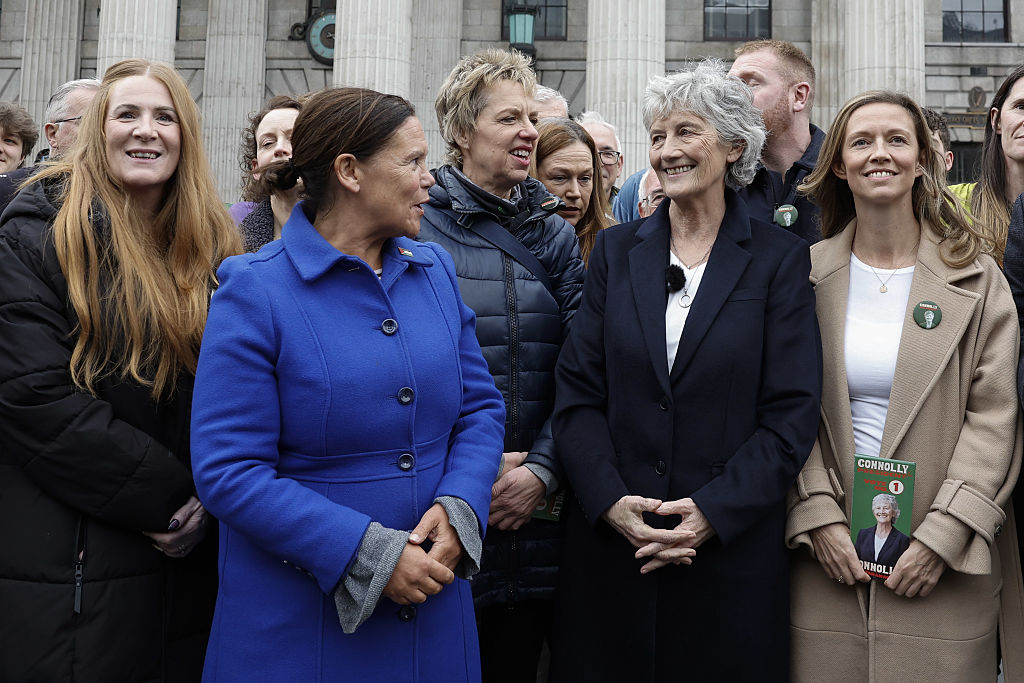
One of the buzziest postelection stories — at least for bored political correspondents who enjoy cozy relationships with politicians — has concerned the frailties of the previously vaunted Connolly coalition. There are, we are beginning to be told, unbridgeable differences between its constituent parts. In the wake of a stream of “public criticisms,” a well-briefed reporter even declared the burgeoning alliance dead.
PBP, Labour, and the Soc Dems have all repeatedly voiced concerns about Sinn Féin’s opportunistic drift right on immigration. The center-left parties also fret over the party’s “populist” opposition to certain forms of taxation. Tentative signs of unity have, however, been visible at least three occasions.
After the latest coalition government was formed in 2024, the parties of the Left spoke as one to vociferously oppose a plan to hand pro-government independents the speaking time of opposition Teachtaí Dála (TDs). They have also united at various points to push back against attacks on Irish neutrality and to support a full ban on trade in both goods and services with Israeli settlements in Palestine.
Somewhat miraculously, these parties canvassed and campaigned together as part of the joint presidential campaign for independent socialist Catherine Connolly, who ended up winning 63.4 percent of the vote — the largest vote tally and share for any presidential candidate in the state’s history.
Sinn Féin leader Mary Lou McDonald hailed this “historic political effort which, for the first time, brought together the combined Opposition to present a positive alternative to the jaded politics of Fianna Fáil and Fine Gael.” Unwilling to allow the momentum to dissipate, PBP called for “a major conference of the left to discuss the next steps of continuing and deepening left co-operation.” For her part, Soc Dems leader Holly Cairns opted for a vacuous Obamaism: “Change doesn’t stop here.”
The presidential election was not a good bellwether for the promise of a left government.
But the presidential election was not a good bellwether for the promise of a left government. Before long, talk of a unified candidate in the Galway West by-election came to nought.
Connolly’s own election campaign had focused on the issue of neutrality, and the coalition behind it was fragile and ramshackle. Sinn Féin appeared to back Connolly only because of a dearth of suitable internal candidates and her increasingly outspoken views on reunification, while Labour only got on board reluctantly due to Sinn Féin’s presence.
Despite the kumbaya optics of the Connolly campaign, it is unrealistic to suggest that any of these forces has ever desired an unconditional form of “left unity.” Attempts at unity have foundered on questions of ideology, strategy, personality, and policy.
This degree of fractiousness may seem absurd, but behind it lies a crude rationale. The electoral system often rewards small parties with seats, minor influence, and — if you play your cards right — ministerial berths. And perhaps nobody understands this fact better than Sinn Féin, which is desperate to escape the cordon sanitaire it has been placed under by the establishment parties.