
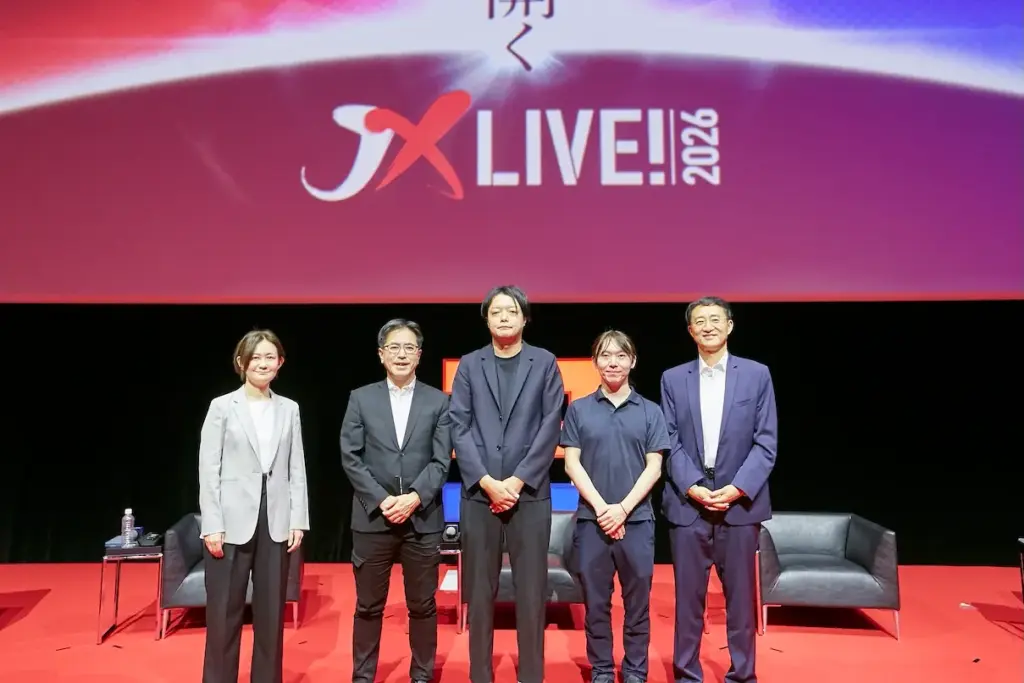
Tokyo’s Toranomon Hills hosted JX Live! 2026 on July 28, the flagship annual event of JANE (Japan Association of New Economy), the business lobby chaired by Rakuten’s Hiroshi Mikitani.
The event takes its name from JANE’s “JX,” or Japan Transformation, banner—a call for entrepreneurs to drive the country’s economic reinvention.
The closing session, Realizing an AI Society, brought together four figures: PKSHA Technology’s Katsuya Uenoyama, Team Mirai founder and Upper House member Takahiro Anno, Hakuhodo DY Holdings Chief AI Officer Masaya Mori, and Rakuten Group Managing Executive Officer Ting Cai.
Labor Disruption Has Already Begun
Anno, whose party, Team Mirai, won its first Diet seats this year, argued that AI’s disruption of employment in Japan is not a future risk but a present one.
Citing US research covering 2022 to 2025, he said entry-level positions in fields like consulting and software engineering had already seen steep losses. “When you look at entry-level jobs, employment numbers had actually fallen by about 16%,” he said of the American data.
He argued Japan’s situation is more complicated than America’s because of its severe labor shortage.
Rather than uniform disruption, he predicted a patchwork outcome, with some industries flooded with workers even as others go begging for them.
His policy prescription centered on labor mobility. “How smoothly and quickly we can move labor between industries is going to become an extremely important consideration, both institutionally and as policy,” he said.
Anno called for retooled vocational schools, clearer forecasting of future labor demand, and statistical early-warning systems to catch sudden spikes in AI-driven job loss before they hit.
Watch scenes from JX Live!
A Case for Japan’s Frontline Capability
Anno also offered a more optimistic read on where Japan’s advantage might lie: in the problem-solving strength of its frontline workers—the kind of hands-on ingenuity long credited with Japan’s manufacturing success, in which teams fine-tune and refine processes step by step on the factory floor.
For three decades, he argued, that strength had been suppressed as companies bent their workflows to fit centrally imposed software—a shift that penalized Japan’s characteristic mix of high skill and comparatively low IT literacy.
AI-assisted “vibe coding,” he suggested, could reverse that trend by letting workers build their own automations without deep IT expertise. “What’s called ‘vibe coding’ might become something that people working on the front lines can do too,” he said, potentially reviving the frontline-driven strength Japan once had.
Anno also pointed to communication and consensus-building as an underrated upside of AI more broadly. He described internal conflicts that AI-assisted information-sharing could head off before they start, and speculated that the same principle might scale up to national or even global decision-making.

Automation Is Not the Whole Story
Not every panelist framed AI’s promise purely in terms of what it could take off workers’ plates.
Katsuya Uenoyama of PKSHA Technology, whose company builds AI agents deployed across Japanese industry, pointed instead to something AI can do that no amount of human effort can replicate: detecting fraudulent credit card transactions in a fraction of a second.
The goal, he said, is “reducing crime to build a peaceful, safe, and secure society.”
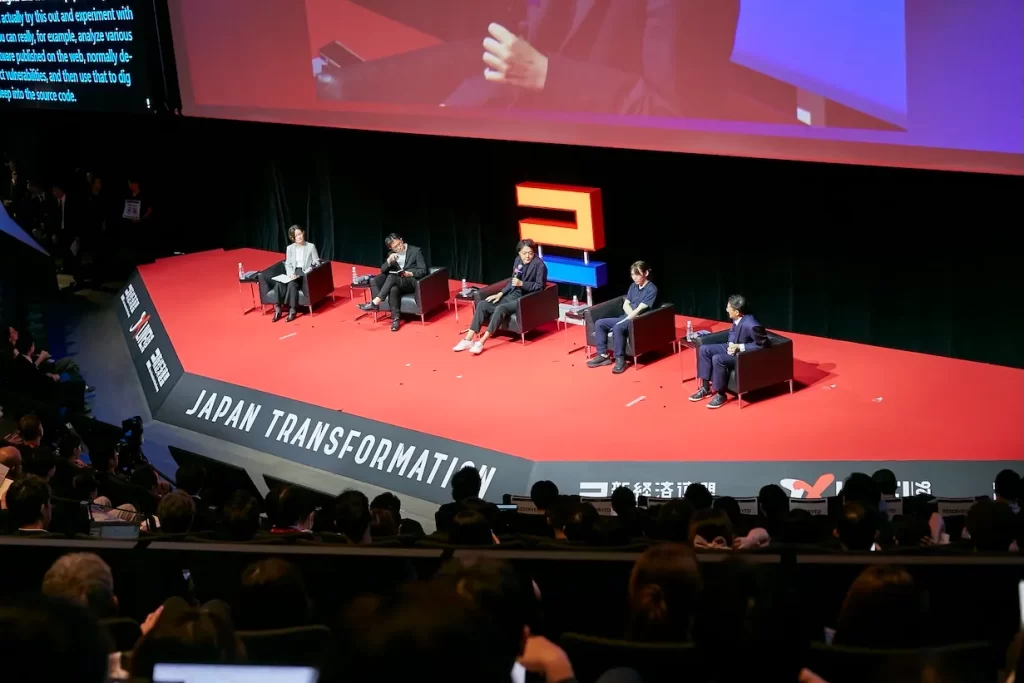 Panelists engage in discussion. (©JANE)
But Uenoyama also complicated the case for AI-driven speed with a finding from inside his own company: “after we banned one of our teams from using AI, we found that over about six months, that team’s growth rate was higher than the others.”
If even an AI company sees teams grow faster without it, he suggested, the technology’s benefits are not as unconditional as they might seem.
That tension between capability and dependency was echoed by Masaya Mori of Hakuhodo DY Holdings, who co-founded the Human-Centered AI Consortium just a week before the panel.
Mori argued Japan’s real edge lies in embedding AI into the tacit knowledge and craftsmanship already present in its manufacturing workforce—”achieving Japan-quality physical AI through robotics.”
But he cautioned against mistaking that for an actual strategic vision, calling it merely reactive, and urged the room to articulate a genuinely new vision of Japanese society rather than simply responding to demographic decline with automation.
Rakuten’s Ting Cai brought that caution down to an individual scale, describing his own discomfort with AI-drafted status reports. He still writes his own updates to leadership by hand: “every word is one I’ve picked out myself.”
RELATED:
Author: Daniel Manning
Continue Reading