
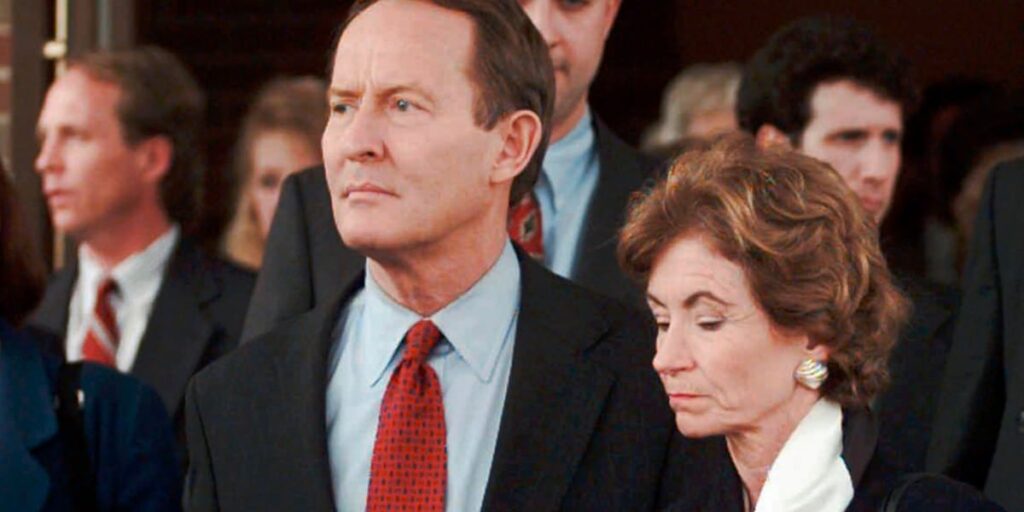
MEMPHIS, Tenn. (WMC) – Inside the lobby used bookstore of the Benjamin L. Hooks Central Library, 86-year-old Lamar Alexander dynamic as ever, let his fingers dance across the keys of a piano to the rhythm of Chuck Berry’s classic tune, “Memphis.” It is a city, much like the state of Tennessee, that the elder statesman knows by heart.
As Tennessee prepares to elect a new governor in just 76 days, Alexander, who was only 38 years old when he first won the governorship in 1978, is reflecting on his massive marathon of public service.
From his early days walking across the state to secure his first term, to serving as the President of the University of Tennessee, U.S. Education Secretary, and a three-term U.S. Senator, Alexander has captured a front-row seat to American history in his new 500-page memoir, The Education of a Senator: From JFK to Trump.
The book traces his history working with 10 different United States presidents, offering candid observations on the commanders-in-chief he encountered. Alexander’s political journey actually began under the Kennedy administration as a Justice Department intern. By the time Richard Nixon took office, Alexander had earned a workspace in the West Wing, a mere 50 feet from the Oval Office.
“What surprised me the most was what happened to Nixon,” Alexander recalled. “He was on his way to being one of the most consequential presidents, and then Watergate hit, he lied about it and he lost the presidency.”
Decades later, Alexander found himself dealing with a completely different political force in Donald Trump. “Trump’s behavior surprises me every day,” Alexander smiled. “Someone said, one of the senators said, by noon every day, he’s done almost everything my mother taught me not to do.”
Yet, it was Alexander’s mother who set his life in motion, encouraging him to play the piano at age three and insisting he get a library card at age four—a tool he still champions today.
During the library interview, Alexander lit up when remembering his deep-rooted connection to Memphis. When asked what first comes to mind regarding the city, his answer was immediate: “I think of the Jobs Conference we had in 1980.”
During his first term as governor, Alexander brought together Memphis’s top CEOs, political leaders, and grassroots community advocates to brainstorm a vision for the city’s future.
The collaborative effort sparked a massive urban renaissance, directly resulting in the renovation of historic Beale Street, the revitalization of the Orpheum Theatre, and the construction of both the convention center hotel and Agricenter International.
“But Memphis did it itself. They came up with a plan, funding most of it,” Alexander noted. “The state put in $20 million, which in today’s dollars would be $40, 50, 60 million. And there was a great sense of pride because people from all parts of town were working together. Wouldn’t hurt to try that again.”
That emphasis on cooperation defined Alexander’s final years in Washington. Before leaving the U.S. Senate in December 2020, his farewell speech highlighted a string of major bipartisan victories, including the Great American Outdoors Act to repair national parks, music modernization legislation to help songwriters earn fair royalties online, and permanent funding for historically Black colleges.
In a political climate increasingly defined by polarization, Alexander insists that overcoming division requires a simple human touch.
“Well, it’s not brain surgery. You just get to know each other,” he said.
To bridge the partisan divide during his 18 years in the Senate, Alexander and his late wife, Honey, hosted 60 Senate couples—both Democrats and Republicans—at their home in the Great Smoky Mountains.
“The thought would be that if we knew each other, we might trust each other, we might find something that we agree on,” Alexander said, offering a piece of advice for the current generation of leaders. “We need to put down social media, push it off to the side and resume talking to each other.”
That willingness to listen was born on the campaign trail. After losing the 1974 gubernatorial race to Ray Blanton, Honey Alexander suggested a radical shift in strategy for 1978.
Alexander embarked on a famous trek, walking across the entire state on foot from Mountain City all the way to the banks of the Mississippi River in Memphis.
Six decades later, Alexander looks back with no regrets.
“Nearly 60 years, I’ve seen public life from about every angle,” Alexander said. “What I’d like people to know is—I got up every day as governor or senator thinking that I might be able to do something good to help my state or my country, and I went to bed most nights thinking that I had.”
Invoking the legacy of civil rights leader Ben Hooks, Alexander reminded Tennesseans that the work of building a community is never truly finished. “Ben Hooks used to teach his students at the University of Memphis: we’ve come a long way but we have a long way to go. And we know the recipe.”
For Alexander, that recipe always returns to harmony—whether found in a room full of opposing politicians or in the notes of a Chuck Berry song played on a vintage library piano.
The Education of a Senator: From JFK to Trump is currently available in hardcover for $37.50 and as an eBook for $15.99. True to Alexander’s roots, it can also be borrowed for free at local public libraries.
Click here to sign up for our newsletter!
Click here to report a spelling or grammar error. Please include the headline.
Copyright 2026 WMC. All rights reserved.