
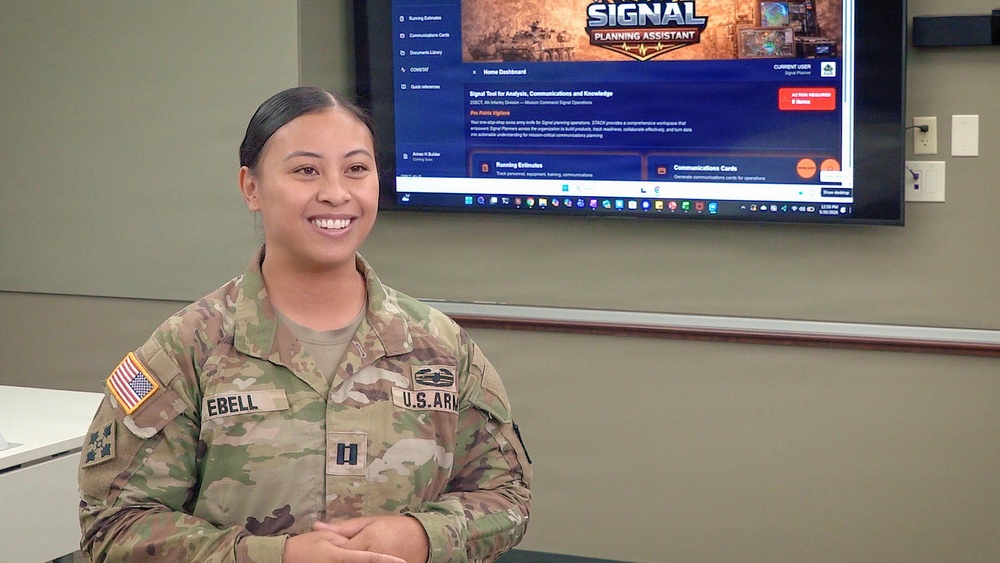
This is the first of five articles in a series focused on the U.S. Army Command and General Staff College’s newest elective: AI Basics. The series describes the new elective, executed as part of the Command and General Staff School’s Command and General Staff Officer Course in academic year 2026. It includes experiences from Soldier Developers who are graduates of CGSOC, the course, and producers of a no-code software product.
FORT LEAVENWORTH, Kan. – Like nearly a third of Command and General Staff Officer Course peers from the class of 2026, Maj. Regina Ebell had little experience with artificial intelligence before coming to Fort Leavenworth.
Her first intentional experience with AI was with her staff group early in the “Best Year” of her life.
For Ebell, the intermediate understanding of the technology that was part of daily conversations wasn’t enough.
“Through that self-directed use I had become comfortable with AI as a practical tool, but I recognized the limits of that informal understanding,” she said. “I took the elective to elevate it — to develop a deliberate, well-founded grasp of the technology so that I could employ it effectively, both personally and professionally, to increase efficiency rather than simply use it at a surface level.”
Like the more than 120 other Soldier Developers who completed the AI Basics elective, Ebell graduated CGSOC with an AI agent she built specifically for her branch, the Signal Corps.
Her AI agent, STACK, which stands for Signal Tool for Analysis, Communications, and Knowledge, is more than cleverly named.
According to Ebell, the agent solved more than one blind spot for Signaleers at the battalion level and above.
“First, it serves as a Signal common operating picture, automating the aggregation of communications status reports, running estimates, and Annex H production so that planners spend less time consolidating administrative data and more time on complex problems such as contested electromagnetic spectrum operations and resilient PACE planning,” she said. “Second, it functions as an on-demand reference for inexperienced battalion S6s, returning doctrinally grounded answers drawn from authoritative sources, which shortens the proficiency timeline for officers new to the role.”
Giving command teams back time spent on administrative tasks is a key reason AI is force multiplier, Ebell explained.
As the S6 at her first unit following CGSOC, 2nd Stryker Brigade Combat Team, 4th Infantry Division, Ebell, like the other elective graduates, is looked to as the unofficial subject matter expert of AI’s impact to warfighting.
The exponential growth of AI use across the Army was made clear during her time in the elective, Ebell explained, making mastery of the technology critical.
“In a fight against a peer adversary, the side that makes more informed decisions faster wins,” she explained. “AI doesn’t replace the warfighter; it speeds up the staff so human expertise is applied where it matters most. That only works with solid data governance, doctrinal checks, and a qualified human owning every decision.”
Read more on the AI elective here: https://www.army.mil/article/293998/new_army_command_and_general_staff_college_course_creates_ai_sharpshooters