
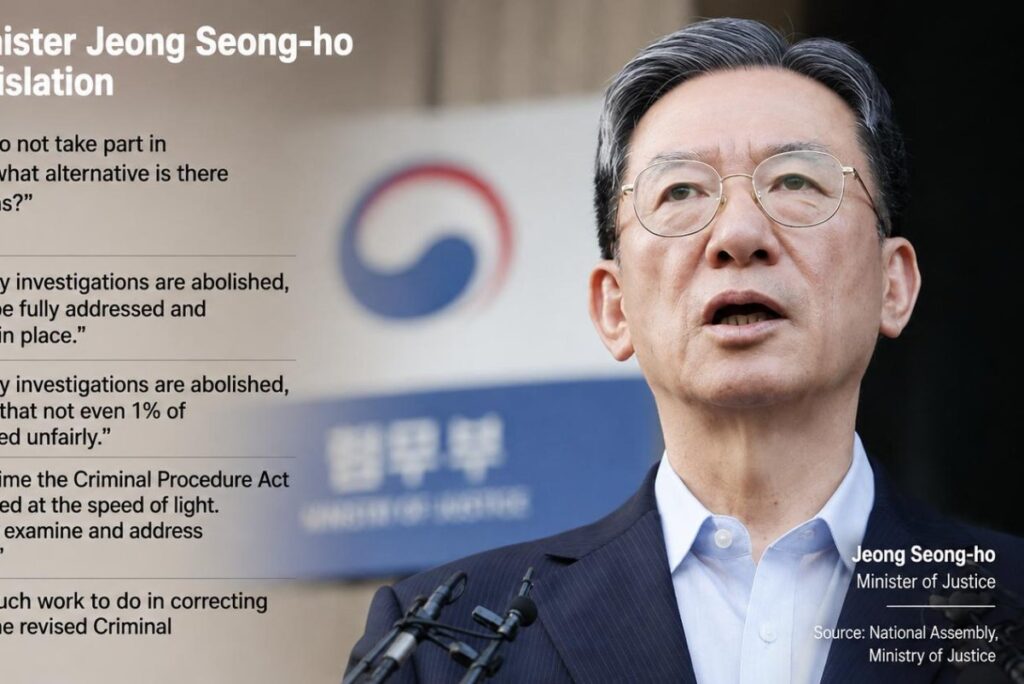
Justice Minister Jeong Seong-ho’s key remarks on prosecution reform legislation from June through August, including concerns over abolishing prosecutors’ supplementary investigative authority. Graphic by Asia Today and translated by UPI
Aug. 20 (Asia Today) — Debate is growing over whether South Korea’s recently amended Criminal Procedure Act should be revised again before it takes effect in October after Justice Minister Jeong Seong-ho signaled plans to pursue supplementary legislation when he returns to the National Assembly.
Jeong submitted his resignation Tuesday and said he expected to have “a great deal of work to do in the National Assembly to quickly correct problems that emerged during discussions on revisions to the Criminal Procedure Act.”
Jeong’s resignation and remarks were also reported by Yonhap, which said he had repeatedly expressed concerns about implementation of the government’s prosecution reform legislation.
Jeong has consistently taken a cautious position on legislation centered on abolishing prosecutors’ authority to conduct investigations directly.
During the legislative process, he repeatedly warned that completely eliminating prosecutors’ ability to conduct supplementary investigations could weaken mechanisms for addressing incomplete or delayed police investigations.
After the legislation passed the National Assembly, Jeong said it had been amended at “the speed of light,” indicating that he believed there had been insufficient debate. He also made clear that problems arising during implementation should be reviewed and addressed through additional legislation where necessary.
The revised Criminal Procedure Act abolishes prosecutors’ direct investigative authority while allowing them to request supplementary investigations from police.
Police are generally required to carry out such requests and report the results to prosecutors within one month.
Legal experts say that if Jeong returns to the National Assembly and pursues supplementary legislation, lawmakers should focus on ensuring such requests can operate effectively.
With prosecutors no longer empowered to investigate cases themselves, procedures governing supplementary police investigations need to be more clearly defined, they say, along with responsibility between prosecutors and police.
One major concern is that a uniform one-month deadline could encourage inadequate investigations at a time when investigative agencies are already dealing with substantial case backlogs.
Legal experts say emphasizing deadlines without sufficiently considering staffing, workloads and the complexity of individual cases could result in formal case closures taking priority over substantive fact-finding.
They have called for follow-up rules to specify when extensions may be granted and what standards should be used to approve them.
Another issue is the possibility of cases repeatedly moving between prosecutors and police in what legal professionals sometimes describe as “case ping-pong.”
Even when police do not adequately fulfill a prosecutor’s request for further investigation, prosecutors would no longer be able to investigate the missing elements themselves. That could send cases back and forth between the two agencies.
If the statute of limitations approaches or evidence is lost during that process, responsibility could also become unclear.
Legal experts therefore say the system needs both a mechanism for correcting inadequate supplementary investigations and a clearly designated authority responsible for the final decision.
“The key to restructuring the criminal justice system is not simply reallocating investigative powers but finding a balance between the effectiveness of the state’s authority to punish crimes and the protection of citizens’ fundamental rights,” a criminal defense attorney said.
“Detailed procedures and clear responsibility are needed so that supplementary investigation requests, which are the greatest concern, actually work in practice without causing harm to the public.”
The Justice Ministry is also understood to be facing substantial difficulties revising related laws following the Criminal Procedure Act amendment.
Changes are required to numerous individual statutes, including laws governing child abuse, domestic violence and sexual violence.
Separately, about 180 other legal provisions were written on the assumption that prosecutors possessed investigative authority. Officials must examine each one for potential inconsistencies or conflicts with the revised system.
“The more we work on follow-up legislation, the more previously unforeseen loopholes and conflicts continue to emerge,” a Justice Ministry official who requested anonymity said. “There is also discussion inside the ministry that revisions or supplements to some provisions of the current Criminal Procedure Act are unavoidable.”
— Reported by Asia Today; translated by UPI
© Asia Today. Unauthorized reproduction or redistribution prohibited.
Original Korean report: https://www.asiatoday.co.kr/kn/view.php?key=20260819010006262