
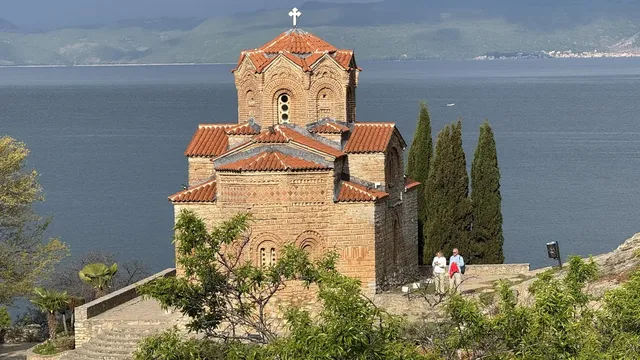
Lake Ohrid, one of Europe’s oldest ecosystems, is known for its exceptional biodiversity and for preserving traces of thousands of years of human history.
Threatened by urbanisation, illegal construction and pollution, Lake Ohrid has for now avoided being placed on UNESCO’s List of World Heritage in Danger.
The United Nations Educational, Scientific and Cultural Organization has given Albania and North Macedonia five years to strengthen protection of the lake. Failure to do so could ultimately put its World Heritage status at risk.
Lake Ohrid, one of Europe’s oldest ecosystems, is known for its exceptional biodiversity and for preserving traces of thousands of years of human history. It was first inscribed on UNESCO’s World Heritage List in 1979, with the protected area extended to include the Albanian side in 2019.
The shared natural and cultural landscape between Ohrid in North Macedonia and Pogradec in Albania is considered a rare combination of environmental richness and cultural heritage.
That balance is now under growing pressure from rapid urbanisation.
Along the Albanian shore, especially around Pogradec, Drilon, Tushemisht and Oktapodi, illegal buildings, hotel complexes and investment projects have increasingly occupied the lakeside. Tourism pressure is compounded by wastewater pollution and infrastructure projects that threaten both biodiversity and public access to the lake.
UNESCO has repeatedly warned the two countries over the condition of the region, while civic protests have continued, including under the slogan “Stop the towers by the lake in Pogradec!”
Experts and environmental groups have for years criticised the slow response by the authorities and the lack of effective coordination between Albania and North Macedonia.
On July 24, 2026, during the 48th session of UNESCO’s World Heritage Committee in Busan, members decided not to place the Ohrid region on the List of World Heritage in Danger. Sixteen of the committee’s 21 member states supported the decision.
Albania and North Macedonia now have five years to implement UNESCO’s recommendations.
The requirements include removing unauthorised construction, bringing urban plans into line with international standards, carrying out strategic environmental assessments and suspending new development projects until such assessments are completed.
UNESCO has also called for the potential impact of major infrastructure schemes, including projects linked to Corridor VIII, to be assessed.
For Albanian environmental and World Heritage expert Arian Meroli, however, the five-year deadline offers little reason for optimism.
“For me personally, this is not a decision that inspires hope. I have followed this process since 2020 and found that some of the responsible institutions do not even have information about the strategy and the recovery plan,” he said.
Meroli has called for a detailed implementation plan with clear deadlines and responsibilities, while questioning whether the two governments are genuinely prepared to meet their commitments.
“I am sceptical about the real willingness of both countries to fulfil these obligations. If the commitments arising from the World Heritage Convention are not respected, the region risks losing its World Heritage status,” he warned.
He also criticised the way progress is officially monitored.
“The annual reports do not reflect the reality on the ground and do not professionally address UNESCO’s recommendations or the way the problems should be solved,” Meroli said.
Environmental organisations and civil society groups have likewise criticised the slow pace of implementation.
North Macedonian Prime Minister Hristijan Mickoski, for his part, has stressed that protecting the lake is a shared responsibility and that problems accumulated over more than three decades cannot be solved in just two years.
Little has changed
While the North Macedonian government presented the World Heritage Committee’s decision as a diplomatic success, environmentalists saw it as yet another warning about the condition of the Ohrid region.
Foreign Minister Timcho Mucunski said the additional five years granted to the country were the result of coordinated government efforts led by Mickoski.
“We clearly presented our positions, our commitments and our political will to protect the Ohrid region. We worked decisively and in a coordinated way, with a clear goal: to bring positions closer through dialogue, strengthen the confidence of our partners and secure the necessary support for the final decision,” he said.
North Macedonia’s delegation in Busan was led by Ambassador Igor Nikolov, who told the committee that the decision had been accepted “with a sense of responsibility” and should serve as an incentive to continue reforms aimed at protecting the region’s natural and cultural heritage.
“We will also continue to work closely with the Republic of Albania, in a spirit of partnership and shared responsibility, to ensure effective transboundary management of this unique heritage,” Nikolov said.
Environmentalists remain much less optimistic.
Trajche Talevski, a professor at the Hydrobiological Institute in Ohrid, wrote on the Facebook page of the civic initiative Ohrid SOS that the current situation was the result of 25 years of indecision and weak coordination.
“Urbanisation. Illegal construction. Coastal degradation. Insufficient wastewater treatment. Inadequate urban plans. Infrastructure projects without sufficient impact assessments. Failed management and poor coordination,” he wrote.
“The most worrying thing is that these findings do not disappear from the reports. They are repeated. And with every new inspection, new problems are added. This does not mean UNESCO has become stricter. It means the old problems are not being solved quickly enough or thoroughly enough.”
Almost half a century after entering the World Heritage List, the Ohrid region continues to face the same threats: excessive urbanisation, illegal construction, pollution and tourism pressure.
Known for its architecture, ancient churches and unique natural landscape, Ohrid and its lake could ultimately lose the status designed to protect this exceptional natural and cultural heritage. | BGNES