
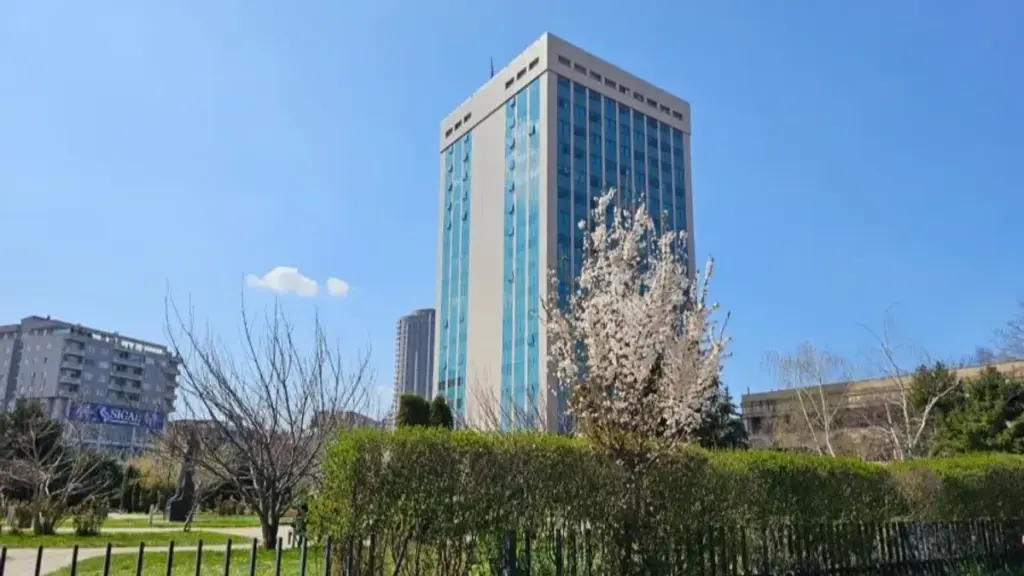
A group of domestic producers joined the PDK protest outside the Government building on Thursday. PDK secretary Vlora Citaku said the Assembly belongs to the citizens, not to lawmakers.
“The Assembly is not the property of lawmakers, but of the citizens,” Citaku said, adding that it is the place where the problems of doctors, teachers, farmers and other citizens should be discussed.
While the PDK and the AAK refuse to talk to Kurti, DSK leader Lumir Abdixhiku met with him, and the two spoke for three hours about the criteria for a future president without announcing a specific name. The meeting caused divisions within the DSK itself. Lawmaker Hikmete Bajrami openly raised the question of whether Kurti is trying to avoid constituting the Assembly.
“But if you do not constitute the Assembly, the country goes back to elections. So what are you trying to avoid?” Bajrami asked.
What if Kosovo Has No President by October 4?
Acting President Albulena Haxhiu took over the office on April 4, after Vjosa Osmani’s five year term expired. The Constitution allows a maximum of six months of acting service, which means that deadline expires on October 4.
What happens after that date if the Assembly still has not elected a new president is not clearly spelled out in the Constitution, and experts disagree on how to interpret it. Eugen Cakoli of the Democratic Institute of Kosovo and Meljos Koljsi of the Kosovo Institute of Justice argue that the six month deadline is absolute and cannot be extended under any scenario. Cakoli believes that failing to elect a president by October 4 would be the most dangerous constitutional scenario Kosovo could face.
Self-Determination lawmaker Adnan Rustemi holds the opposite view, arguing that the six month deadline starts running again once a new speaker of the Assembly is elected.
“It is in the spirit and substance, and in the function, of the Constitution to guarantee institutional continuity. Never, and for no reason, can the country be left without a president or an acting president. There can be no institutional vacuum under any circumstances,” Rustemi said.
Under the Constitution, the president is elected by the Assembly in a secret ballot, by a two thirds majority of 80 out of 120 lawmakers, over a maximum of three rounds. If the election fails even in the third round, the Assembly is dissolved and new elections are called within 45 days.
AAK lawmaker Burim Ramadani claimed at a news conference that 463 political appointees were employed across government institutions before the June 7 election, with monthly salaries costing about 486,000 euros. According to him, their status is now in question, since some ministers have since been sworn in as lawmakers.
The Assembly that emerged from the June 7 election, the 11th convocation, still has not been constituted. As the dispute continues over whether an agreement on the president should come before constitution or the other way around, the 60 day deadline for electing a president, which only starts running after constitution, keeps edging closer to the October 4 limit.