
- Ireland launches three-year campaign to promote beef and lamb exports across Singapore, Japan, and China.
- Bord Bia leaning on Origin Green sustainability programme to differentiate products from competitors.
- Country targets high-end channels to build demand.
It recently launched a three-year promotional campaign across Singapore, Japan and China aimed at raising awareness of European beef and lamb from Ireland.
According to Bord Bia, the Irish food board, the country is positioning sustainability as a key differentiator as it cannot compete with larger exporters on volume.
“We’re not competing in volume, but in quality, food safety, sustainability and long-term partnerships,” said Peng Zhang, market specialist, meat and seafood, South East Asia, Bord Bia.
Irish beef exports to Asia declined from €87.1m in 2021 to €60.4m in 2023 before recovering slightly to €62.9m in 2024, according to export data. Beef exports reached €30.1m in 2025.
Irish lamb exports to Asia were valued at €6.6m in 2023, up from €2.1m in 2022, but fell sharply to €652,777 in 2024 and €394,213 in 2025.
The decline reflects lower sheep throughput in Ireland over the past two years, with producers prioritising markets closer to home.
Against this backdrop, the new campaign aims to boost awareness and demand for Irish and European lamb in APAC to support the market’s long-term growth potential.
‘Ireland takes this very seriously’
At the heart of Ireland’s sustainability narrative is Origin Green, a national food and drink sustainability programme that brings together more than 61,000 farms and over 300 food and drink companies.
The programme was designed to establish measurable sustainability targets across the supply chain, covering areas such as carbon emissions, animal welfare, resource management and food traceability.
Origin Green members account for approximately 90 per cent of Ireland’s food and drink exports.
Participants are subject to independent audits every 18 months, creating a framework that enables Irish producers to make verifiable sustainability claims.
“Ireland takes this very seriously. It has created a full ecosystem of sustainability practices, genuinely from farm to fork. That’s underpinned by Ireland’s national food sustainability programme, Origin Green,” said David Mulholland, EU programme specialist, Bord Bia.
Mulholland emphasised that Origin Green is a certification that encourages continuous improvement.
“It’s not just signing up and becoming a member. It’s continual improvement to continually reduce carbon emissions and continually get better.”
According to Origin Green, members of the Sustainable Beef and Lamb Assurance Scheme (SBLAS) achieved an average 8% reduction in CO₂ emissions per unit of beef produced, while members of the Sustainable Dairy Assurance Scheme (SDAS) recorded an average 9% reduction in CO₂ emissions per unit of milk.
Compliance with the schemes has also resulted in the calculation of more than 367,000 farm carbon footprints.
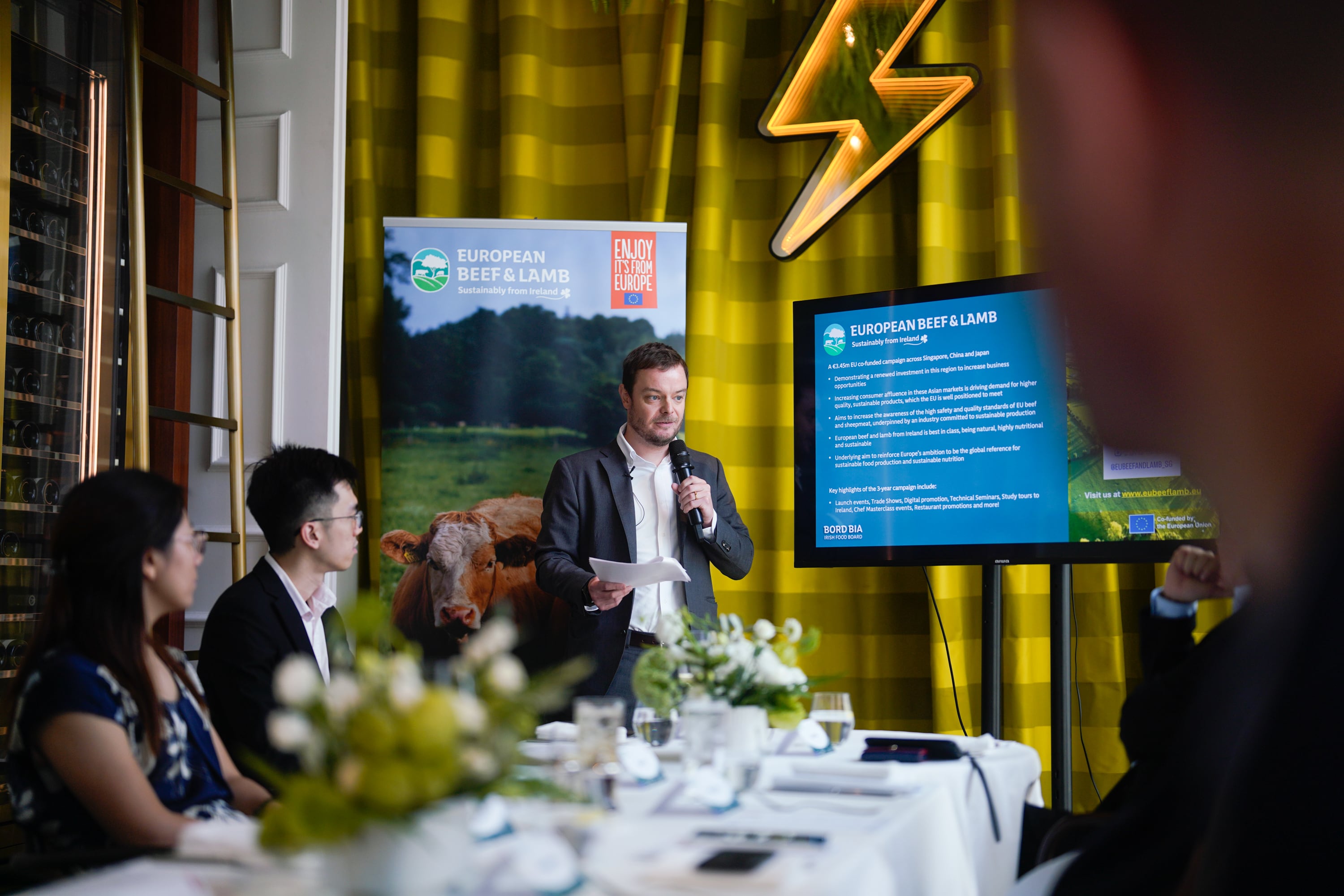
“Ireland takes this very seriously. It has created a full ecosystem of sustainability practices, genuinely from farm to fork,” said David Mulholland, EU programme specialist, Bord Bia. (Bord Bia)Proving value
For many exporters, the central question is often whether sustainability can command higher price tags.
This is especially so in Asia, which is why Bord Bia believes Origin Green is so important in differentiating its beef and lamb exports from larger competitors in Asia’s premium meat market.
Zhang believes that Asian consumers are becoming more interested in provenance, food safety and sustainability.
He acknowledged that price remains an important purchasing consideration, which is why it is increasingly important to have evidence to support environmental and ethical claims.
“What we find in Asian markets is that people care about sustainability, provenance and evidence. How do you prove this is sustainable? We need verified data.”
At the farm level, Ireland is investing in tools intended to help farmers manage sustainability.
One example is AgNav, a free digital platform that enables farmers to develop personalised sustainability plans based on their existing production systems and management practices.
The platform was developed by Teagasc, Bord Bia and ICBF, with support from the Department of Agriculture, Food and the Marine.
It provides farm-level emissions data, forecasting tools and action-planning capabilities.
AgNav has been integrated into the sustainability programmes of 13 dairy and beef processors, helping support corporate and sector-wide climate targets.
Many processors are also incentivising farmers to use the platform and develop action plans through financial assistance or programme-based support.
Farmers can input information about their operations, receive sustainability recommendations and track progress over time.
According to Bord Bia, more than 10,000 farmers have already registered to use the platform.
The tool forms part of a wider effort to help producers translate sustainability goals into measurable on-farm actions, whether through improvements in resource use efficiency, emissions management or production practices.
The grass-fed differentiator
Another key component of Ireland’s marketing message is its grass-fed system. Its cattle and sheep spend around 240 days each year grazing outdoors, with production systems relying predominantly on natural pasture.
This approach provides both sustainability and animal welfare benefits while also contributing to product quality, said Mulholland.
“That’s very different from what many competitors can offer, and it’s a very strong sustainability credential. It helps tell the story behind the product and intrinsically leads to healthier, happier animals that produce better-quality meat. The result is a product that is rich in protein, much leaner, and different from grain-fed options,” said Mulholland.
One of the challenges Bord Bia faces is the relatively low awareness of Irish beef and lamb.
Ireland is betting that premium restaurants can serve as powerful brand ambassadors, helping communicate the sustainability and quality story behind its beef and lamb.
Japan offers one of the clearest examples of how Ireland’s premium-focused strategy can succeed in Asia.
After gaining market access around a decade ago, Ireland gradually built relationships with Japanese importers and restaurateurs.
Rather than competing directly with larger suppliers, exporters focused on niche opportunities and premium segments.
One such opportunity was beef tongue, a prized culinary delicacy in Japan.
According to Mulholland, approximately 80% of Ireland’s beef tongues are exported to the Japanese market.
“We’re not going to be the cheapest product, but we can offer a genuine story about how the product was developed sustainably and why it tastes as good as it does.”