
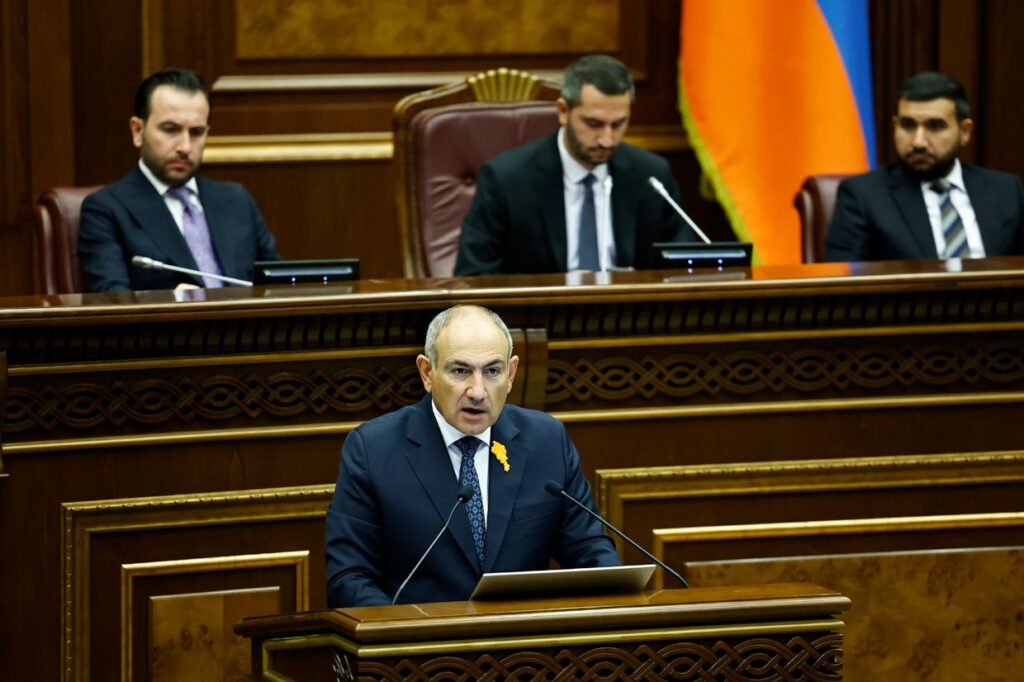
Prime Minister Nikol Pashinyan told parliament on Monday that Armenia has entered the era of its ‘Fourth Republic’. Pashinyan presented the 2026–2031 government programme, based on the ‘Real Armenia’ ideology which defines the state’s main function as securing peace, freedom, and prosperity within internationally recognised borders.
In his speech, Pashinyan presented the government’s priorities before taking questions from the opposition. The programme covered a wide range of ongoing issues including his conflict with the Church, the peace process with Azerbaijan, EU membership, the Trump Route, non-combat deaths in the army, economic difficulties, constitutional changes, and Armenia’s dependency on Russia for energy, among other issues.
Pashinyan discussed the foreign policy pivot, saying Armenia is moving away from the ‘Karabakh Movement’ that had defined its foreign policy in the past decades. He said his country is now prioritising peace with Azerbaijan and the implementation of the US-backed Trump Route, a multi-function transit route connecting Azerbaijan to its exclave of Nakhchivan through Armenian territory.
Pashinyan argued that Armenia’s June elections showed that voters returned to re-elect the Civil Contract, which means that they accept the new doctrine his government brings. He said that the 1990 Declaration of Independence, which saw the purpose of the Armenian state as restoring ‘historical justice’, will no longer be referenced in the new constitution. Although the details of the new text are not specified, he said it will be published in the upcoming months.
Pashinyan still lacks the constitutional majority in parliament required to set a referendum to amend the constitution. However, he and other members of the Civil Contract party continue to address constitutional amendments in their speeches. Although Pashinyan has repeatedly stated that the amendments were in Armenia’s own interests, the opposition has argued that changes to the constitution were an Azerbaijani demand and a precondition for the still unsigned peace treaty.
Pashinyan discussed the Trump Route in the context of the broader ‘Crossroads of Peace’ initiative. The US–Armenian joint venture plans to build rail lines, roads, pipelines, and power lines through Armenia’s Syunik region, connecting Azerbaijan to its exclave of Nakhchivan. Armenia has a 26% stake in the company that will manage the Trump Route, with the remaining shares going to the US. The agreement is in force for 49 years, after which Armenia can raise its share to 49% and continue the partnership.
Pashinyan emphasised that the project would not involve any foreign military or armed presence, and that it would connect Armenia to Russia and Central Asia via the historic Soviet-era rail networks. It would also open a new rail corridor between the Persian Gulf and the Black Sea through Iran, Nakhchivan, Armenia, and Georgia.
He also noted the issue of the Soviet-era railway line that runs through the Yeraskh community in Yerevan — the railway is legally owned by Armenia, but is managed by Russian Railways, which Pashinyan says is an obstacle for Armenia in its bid to attract international investors due to Western sanctions on Russia. Pashinyan has appealed to Moscow to sell the concession to a ‘third country acceptable to both Armenia and Russia’, warning that failure to resolve the issue would mean that Armenia would miss out on the economic benefits of the Trump Route.
Regarding EU membership, Pashinyan has said Armenia will soon submit an official application for EU membership as an essential step before Armenia holds a national referendum on joining the bloc. Speaking on Monday, former Russian President Dmitry Medvedev called Armenia’s EU aspirations ‘unrealistic’ and warned that pursuing this goal would damage Armenia’s ties with Russia and the Eurasian Economic Union (EAEU).
Pashinyan also spoke about the ongoing conflict with the Armenian Apostolic Church, announcing an upcoming report on what he described as a ‘deep systemic crisis’ within the institution. He addressed Catholicos Karekin II by his secular name, Ktrich Nersisyan, and accused him of instructing clergy to promote the ‘Republic of Artsakh’ during church services and of having a daughter. Each time Pashinyan addressed the Catholicos by his secular name, the opposition banged on their tables.
Karekin II and six other senior church officials are standing trial on charges of deliberately obstructing the enforcement of a lawful court decision through abuse of power. If convicted, they can face up to two years in prison.
Relations between the Church and Pashinyan’s government have been tense since May 2025, after Pashinyan criticised Church leadership for failing to properly maintain churches across the country. As accusations against the Church, and specifically against Karekin II, continued to grow, Pashinyan gradually made clear that he was seeking to oust the Catholicos — a plan that made its way to his government programme.
On Tuesday, parliament adopted the government’s 2026–2031 programme with 63 votes in favour, 24 against, and no abstentions.