
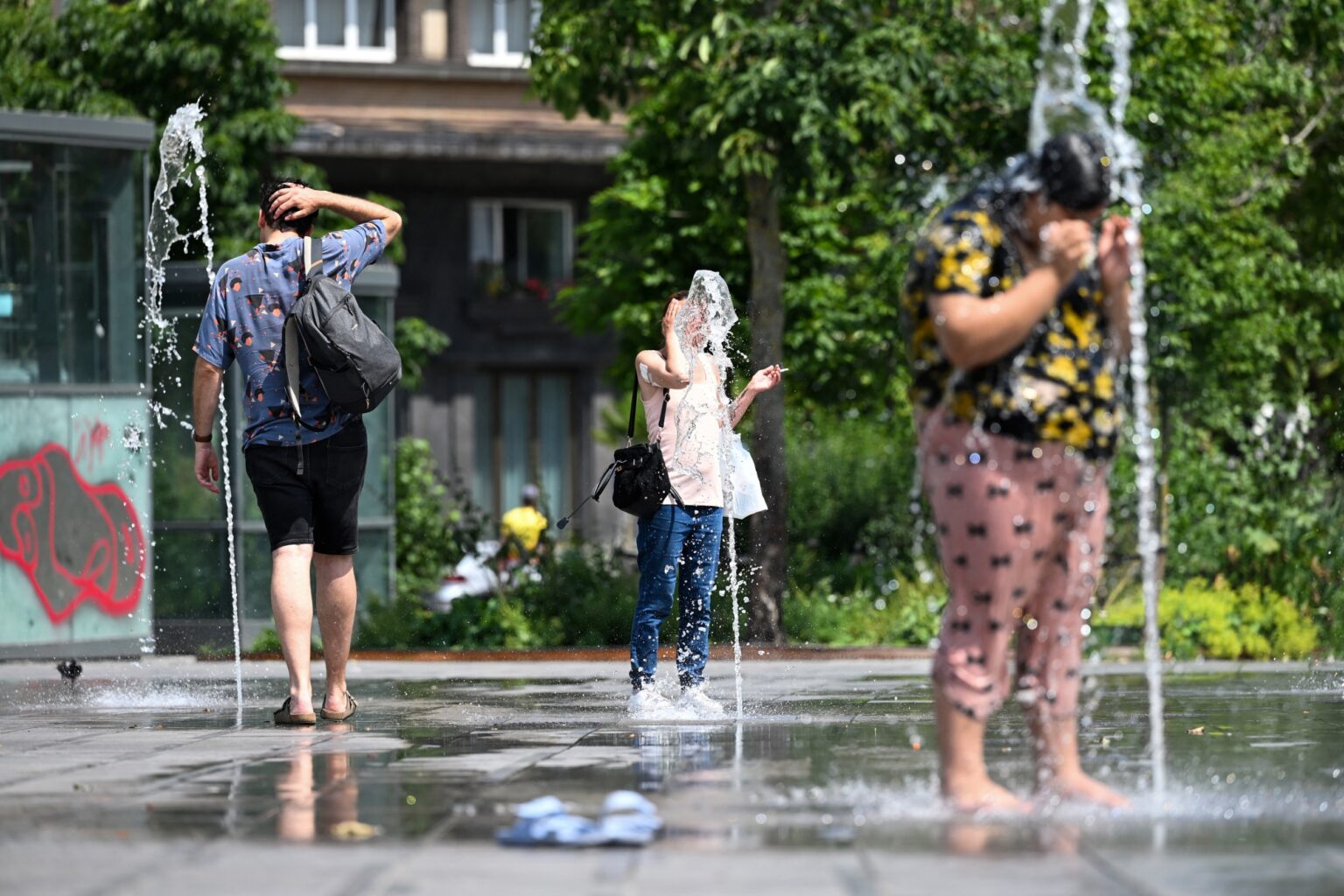

People cool off under the water sprays in Brussels, during a heatwave on June 19, 2026.
Nicolas TUCAT/AFP via Getty Images
Europe’s summer of 2026 has ended with a provisional death toll of at least 35,000 excess deaths — a figure drawn from barely half the continent, with most of August still uncompiled, that already surpasses the final confirmed tolls of many prior heatwave years. The Guardian reported 35,000 excess deaths on August 25, noting the consecutive heatwaves that baked western Europe from late May through August were the worst in the continent’s modern record, and the figure almost certainly undercounts the true human cost by a significant margin.
Four back-to-back heatwaves drove temperatures 10°C to 15°C (18°F to 27°F) above seasonal norms in a summer that began in late May — weeks before the traditional July-August window — and did not release western Europe until after August 22. Spain recorded 4,947 heat-attributed deaths from May through the final week of August, making 2026 the country’s worst heat year since monitoring began, surpassing the 4,520 deaths recorded during the brutal summer of 2022. Germany’s Robert Koch Institute (RKI) estimated 14,000 deaths through August 9 alone — already far ahead of the country’s previous annual record of 8,900 set in 2018. Karl Lauterbach, Germany’s former health minister, said the data published so far would probably prove to be underestimates.
Scale That Records Cannot Fully Capture
The scale of the 2026 summer can only be understood against the trajectory that preceded it. Europe’s summer of 2023 produced an estimated 47,000+ heat-related deaths across the continent, according to a peer-reviewed Nature Medicine study by the Barcelona Institute for Global Health. The summer of 2024 produced an estimated 62,700, according to a second Nature Medicine peer-reviewed analysis from the same research group. The summer of 2025 produced an estimated 24,400 heat-related deaths in European cities, with scientists at the London School of Hygiene and Tropical Medicine and Imperial College London calculating that approximately 68 percent of that toll — around 16,500 deaths — was directly attributable to climate change.
At 35,000 from fewer than half of Europe’s nations, with August data still being compiled across most countries and with eastern Europe not yet counted at all, the 2026 summer is on a trajectory that makes it one of the most lethal on record. The EuroMomo continental mortality monitoring network — which draws from 23 participating countries — estimated more than 32,000 excess deaths in Europe between mid-July and mid-August alone, before the summer was over. AFP’s count of provisional national figures from eight countries — Austria, Belgium, England, France, Germany, the Netherlands, Portugal, and Spain — reached 33,000 by August 22.
These figures are themselves undercounts. Heat is almost never recorded as the direct cause of death on a death certificate. In most cases, extreme temperatures aggravate pre-existing cardiovascular or respiratory conditions, and the death certificate records the cardiac event or kidney failure rather than the heat. Excess mortality frameworks — which compare actual weekly all-cause death counts against a statistically expected baseline — exist specifically to capture this invisible toll. In Germany, the Federal Statistical Office averaged just 21 clinically attributed heat deaths per year across the decade 2004–2014; the excess mortality model produces thousands. A final determination for every country can take weeks or months after the summer ends.
Country-by-Country: What the Data Shows
Germany has reported approximately 14,000 heat-linked deaths between April 6 and August 9, according to the RKI’s latest weekly surveillance update. The vast majority of that toll was generated by a single catastrophic week: the period of June 22–28, when temperatures exceeded 40°C (104°F) at 46 weather stations across the country and the RKI estimated approximately 9,600 deaths in those seven days alone. The RKI has described the 14,000 figure as conservative and noted that August, historically Europe’s most lethal heat month, is not yet reflected in the data.
Spain recorded 4,947 heat-attributed deaths from May through the final week of August, according to the Carlos III Health Institute’s Mortality Monitoring System (MoMo) — surpassing the 4,520 deaths recorded in 2022, which had been Spain’s worst heat year on record. Spain’s real-time mortality monitoring system compares daily mortality rates against temperature data from the national meteorological agency AEMET, making its estimates among the most current available in Europe. In some regions of Spain, temperatures remained above 42°C (108°F) for extended stretches this summer; June 23 was the hottest June day in Spain’s national records dating to 1950.
France recorded approximately 7,300 excess deaths through July 22, when its national health agency released data covering 80% of mortality based on provisional electronic death certificates. The true full-summer figure — covering all of August, with paper death certificates incorporated — will not be finalized until later in the year. France spent 52 days under official heatwave conditions this summer, a record since monitoring began in 1947; for comparison, the 2003 heatwave that shocked Europe lasted 22 days. On June 24, France logged its hottest day ever on the national temperature record. Despite worse thermal conditions than 2003, France’s death toll is roughly half of 2003’s ~15,000, a gap that public health researchers attribute to France’s Plan National Canicule — the heat response system built after the 2003 disaster — which includes cooling centers in all municipalities, mandatory check-ins on isolated elderly residents, a four-tiered national alert system, and a free helpline, all detailed by Grist.
England recorded an estimated 2,877 heat-related deaths during just May and June’s heatwaves, according to the UK Health Security Agency. The UKHSA warned that the 2026 full-year figure could be substantially higher when later periods of heat are accounted for — including the fifth heatwave that struck Britain in mid-August.
Belgium, a small country by European standards, recorded 2,570 excess deaths between June 18 and July 17, according to the Sciensano national public health institute. That toll is expected to rise further when updated data covering the period from July 25 to August 16 is published in September — a window that includes the beginning of Belgium’s worst wildfire in modern history.
The Netherlands recorded approximately 968 excess deaths between June 22 and July 5 alone, according to the RIVM national public health institute.
When People Flee the Heat: 301 Drownings in France
The heatwaves did not only kill through heat. They also sent people across France rushing to any water they could find — rivers, canals, lakes, private pools — producing a sharp and documented surge in drowning deaths.
As of late August, France had recorded 301 drownings since June 19, a 14% increase above the same period in 2025, Sports and Youth Minister Marina Ferrari told France Inter radio. Ferrari called the toll “tragic,” linking the surge directly to the heatwaves. “Lots of people have sought to hit the water, with risky behavior,” she said. “Many deadly accidents have occurred in areas that are not authorized or supervised for swimming.”
The danger is specific and physiological. Sudden immersion in cold water during extreme ambient heat can cause cardiac shock — the sharp thermal contrast triggering a cardiovascular response that can be fatal, particularly in elderly swimmers. Ferrari specifically noted that many drowning deaths among the elderly occurred in private pools, where older swimmers may push past their physical limits without realizing it. Others died in open water: rivers, canals, and unsupervised lakes where no lifeguards were stationed.
As drowning deaths climbed through June, the French government sharply increased fines for swimming in unauthorized areas. The measure did not halt the toll. When nighttime temperatures offered no relief and daytime highs sat above 40°C (104°F) in many regions, the financial risk of a fine was not an effective deterrent for people desperate for any form of cooling. The 301 figure covered the period through late August; the final summer drowning toll has not been published.
When Rivers Overheat: Nuclear Reactors Offline
The heatwave’s effects extended beyond human mortality to France’s energy grid, through a mechanism that is specifically technological: the 28°C river temperature limit imposed by EU environmental law.
France’s nuclear reactors — which supply approximately 70% of the country’s electricity — use river water as their primary cooling medium. Water is drawn from the river, circulated through heat exchangers to remove heat from the reactor, and then returned to the river. A 2006 EU freshwater quality directive stipulates that returned cooling water cannot cause river temperatures to exceed 28°C (82.4°F), because warmer discharge water reduces dissolved oxygen levels and harms aquatic ecosystems.
During the late June heatwave, the temperature of the Garonne River in southwestern France approached the statutory 28°C limit, and the operator EDF halted Golfech’s operating reactor as a precautionary measure. Reactor 1 at Golfech had already been offline for scheduled maintenance; the shutdown of Reactor 2 suspended the plant’s full 2,726 megawatt (MW) capacity. During the third heatwave in mid-July, Golfech’s Reactor 2 was shut down again when the Garonne reached 28°C. EDF also reduced output at the Bugey plant on the Rhône near Lyon and the Nogent-sur-Seine plant, with NucNet reporting a total output reduction of approximately 4.1 gigawatts (GW) — roughly 7% of France’s total power demand — at peak during the June wave.
The Golfech shutdowns illustrate a feedback loop that climate scientists call infrastructure-climate intersection: heat makes electricity demand peak while simultaneously reducing the generating capacity that meets that demand. The same rivers that can no longer legally cool nuclear reactors are also running historically low — the Danube reached an all-time record low of 31 centimeters (12.2 inches) in Budapest in late July, and the Rhine approached navigation-restricting levels in Germany — because the same drought that intensifies heat also depletes water.
Records That Define a Summer
The temperature anomalies underlying the death toll were extraordinary. June 2026 was confirmed by the European Union’s Copernicus Climate Change Service as western Europe’s hottest June on record, averaging 3.06°C (5.5°F) above the 1991–2020 reference baseline. Spain’s Fabra Observatory in Barcelona — with more than a century of continuous records — logged 40.5°C on July 8, its highest reading in over 100 years.
“Together, these records reflect a climate system continuing to accumulate heat,” said Samantha Burgess, strategic lead for climate at the European Centre for Medium-Range Weather Forecasts (ECMWF), in the Copernicus June 2026 climate bulletin. The Eiffel Tower closed early during the June heat. Dozens of schools shut across France. Red alerts covered most of the French countryside.
Among the temperature anomalies that made 2026 specifically lethal: the absence of overnight relief. Meteorologists describe a standard tropical night as any night when the minimum temperature stays above 20°C (68°F). This summer delivered what Italian forecasters called “super-tropical nights” — consecutive overnight lows above 25°C (77°F). At those temperatures, the human body cannot shed enough core heat to complete the physiological repair cycle during sleep, and cardiovascular stress accumulates over successive nights rather than being resolved.
The soil moisture deficit amplified the heat. Scientists studying the feedback loop noted that as soils dry out, they lose their natural cooling capacity — allowing heat to build more readily — creating a self-reinforcing cycle in which prior drought makes subsequent heatwaves more intense. July 2026 soil moisture levels across western and central Europe were significantly lower than even during the record summer of 2022.
Why August Will Raise the Final Number
Every provisional figure published so far carries a critical caveat: the data is incomplete, and the completeness gap runs in one direction only — upward.
Germany’s 14,000 figure covers only through August 9. The RKI publishes weekly updates, and each update for 2026 has produced a higher number than the last. Belgium’s 2,570 figure covers only through July 17, before the country’s worst wildfire in modern history began. France’s 7,300 figure covers only through July 22, at roughly 80% of total mortality. The Netherlands’ 968 figure covers only a 13-day window in late June and early July. Most eastern European countries have not yet submitted any data to EuroMomo.
When excess mortality figures are computed, they require statistical comparison against an expected baseline — a process that takes weeks as death registries compile and cross-reference records. The countries whose systems can produce near-real-time estimates (Germany and Spain) have done so; most others are still working from incomplete data. The EuroMomo network, which draws from 23 countries, still excludes significant portions of the continent’s east.
Public health experts quoted across multiple outlets this summer have stressed that the 35,000 figure is almost certainly a floor, not a ceiling. The groups most at risk — people over 75, those with cardiovascular or respiratory conditions, and those living alone without access to cooling — are also those whose deaths are least likely to be quickly attributed to heat by standard clinical processes.
Europe’s 2003 summer killed an estimated 70,000 people on a final revised count. Its 2022 summer, which seemed catastrophically deadly at the time, ultimately killed an estimated 70,000+ on the final Barcelona Institute for Global Health assessment. Its 2024 summer killed 62,700. If August 2026 continues at the rate its first nine days established — the RKI reported 2,500 additional German deaths between August 2 and August 9 — the continent’s final toll will be substantially above 35,000.
What Adaptation Proves — and What It Cannot Fix
France’s Plan National Canicule demonstrates what adaptation can do: a country experiencing its worst thermal summer on record, nearly 1°C (1.8°F) hotter than the previous record, still recorded roughly half the deaths of 2003’s less extreme heat event. The plan’s mandatory municipal cooling centers, systematic welfare checks on isolated elderly residents, and tiered national alert system saved lives at scale.
What it could not fix is the climate itself. Fifty-two days under heatwave conditions — against 22 in 2003 — is a qualitatively different stress test than a single two-week episode. A system designed for emergency response to isolated events faces fundamental limits when the emergency is continuous for three months.
The 2025 Nature Communications study estimated that without heat adaptation, European mortality could rise by 103.7 to 135.1 additional deaths per million people per additional degree of global warming. Europe is currently warming at approximately 0.56°C per decade, according to Copernicus — roughly twice the global average rate. At that pace, and with each additional summer potentially raising the baseline above which record heat occurs, the 35,000 figure may be one the continent comes to remember not as a peak but as a waypoint.
How August Data Is Still Being Counted
The path from this summer’s deaths to a final audited figure runs through national statistical offices, excess mortality modeling teams, and international coordination bodies — a process that will take months.
Each participating country feeds weekly all-cause death counts to EuroMomo, which compares observed deaths against expected baselines derived from years of prior mortality data. The model adjusts for seasonal patterns, day-of-week effects, and known demographic shifts. Temperature data from national meteorological services feeds into country-specific mortality attribution models — like Germany’s RKI system, which uses 52 weather stations — to produce the heat-specific component of excess mortality. Where these real-time modeling systems exist, they can produce weekly provisional estimates within days. Where they do not, the accounting waits for death registries to compile, which takes longer.
September will bring the first rounds of updated national figures for August. The EuroMomo network will publish revised weekly estimates as member countries submit their data. Spain’s Carlos III institute will update its MoMo figures as new mortality and temperature data arrive. By late autumn, most participating European nations will have provisional full-summer figures. The final peer-reviewed academic estimates — comparable to the Nature Medicine studies that produced the 2022 and 2024 figures — will take one to two years to complete.
What is already certain: the 35,000 figure represents deaths that occurred in a calendar that did not account for them — in buildings designed for cold winters, in hospitals without mechanical cooling, on riverbanks without lifeguards, in private pools where no one was watching.
Frequently Asked QuestionsHow many people have died in Europe’s 2026 heatwave summer?
Provisional figures released on August 25 show at least 35,000 excess deaths across Europe from barely half the continent, according to national health agency data compiled by The Guardian. An AFP count from August 22 found 33,000 deaths across eight countries — Austria, Belgium, England, France, Germany, the Netherlands, Portugal, and Spain. Germany accounts for the largest share (approximately 14,000 through August 9); Spain has set its worst heat year on record at 4,947 deaths through late August. Most of August remains uncompiled for the majority of countries, and the eastern half of Europe has yet to submit data to the EuroMomo monitoring network. The final total will almost certainly exceed the provisional figure significantly.
Why does France have so many drowning deaths during heatwaves?
When daytime temperatures rise above 40°C (104°F) with limited overnight relief, people across France seek cooling in the nearest available water: rivers, canals, lakes, and private pools. Many of these bodies of water carry no lifeguards and are officially closed to swimming. The drowning risk is compounded by specific physiological factors: sudden immersion of an overheated body in cold water can trigger cardiac shock, particularly in older adults, and the cardiovascular stress of prolonged heat exposure reduces physical reserves even in people who consider themselves strong swimmers. France’s Sports and Youth Minister Marina Ferrari reported 301 drowning deaths since June 19 — a 14% increase over the same period in 2025 — and specifically noted that many elderly deaths occurred in private pools rather than public waterways.
How does a heatwave shut down a nuclear reactor?
French nuclear plants use river water as their primary cooling medium: water is drawn from the river, circulated through heat exchangers to remove heat from the reactor, and returned to the river. A 2006 EU freshwater quality directive prohibits returned cooling water from causing river temperatures to exceed 28°C (82.4°F), because warmer discharge water reduces dissolved oxygen and harms aquatic ecosystems. During this summer’s heatwaves, the Garonne River in southwestern France reached 28°C, forcing EDF to shut down the Golfech nuclear power station — first in late June and again in mid-July. At peak during the June heatwave, France lost approximately 4.1 GW of nuclear output, or roughly 7% of total national power demand, to heat-related restrictions.
What makes 2026’s provisional 35,000 figure likely to be an undercount?
Three structural factors make the current figure almost certain to rise. First, most countries have not yet compiled August data, and August is historically Europe’s most lethal heat month. Second, excess mortality figures require statistical modeling against expected baselines — a process that takes weeks as death registries are compiled — and the countries with real-time modeling capacity (Germany and Spain) are exceptions rather than the rule. Third, the eastern half of Europe — including several countries with large populations — has not yet submitted data to EuroMomo’s network. Heat deaths are also systematically underattributed in clinical records, because a physician treating a cardiac event does not typically list ambient temperature as a cause of death. The excess mortality framework is the corrective tool for this, but it cannot produce a final figure until all the underlying mortality data has been compiled.