
 Paul Wermager stands beside a bust of Alice Ball in Hamilton Library.
Paul Wermager, a retired University of Hawaiʻi at Mānoa science librarian who spent decades researching and championing the legacy of pioneering chemist Alice Augusta Ball, died August 2, 2026.
I believe that Alice Ball’s greatest gift to humanity was hope.
—Paul Wermager
Wermager served at UH for 20 years, retiring in 2010 as head of the Science and Technology Department at Hamilton Library. Before becoming a librarian, he worked as an intensive care unit nurse and pharmacist, and earned a master’s degree in public health.
“I liked finding answers to new things, and with a science background, I thought it was a good fit,” Wermager told UH News in 2024 about becoming a librarian.
Researching a forgotten scientist
That curiosity led Wermager into a decades-long effort to restore the story of Ball, a UH alumna whose groundbreaking work developing an injectable treatment for Hansen’s disease had been largely forgotten.
His interest began with a question from a UH professor about whether there was a chaulmoogra tree on campus. After learning of the tree’s connection to Hawaiʻi‘s Hansen’s disease history, Wermager began researching Ball. He described the work as a giant jigsaw puzzle, with pieces of her life scattered across historical records.
 Paul Wermager (back left) with Hamilton Library colleagues, 1993.
His research eventually connected him with Stan Ali, a retired Baltimore resident who had independently rediscovered Ball’s story while researching Black people in Hawaiʻi. The two shared information about Ball and helped piece together her life and accomplishments.
“I finally got enough to envision what she was like,” Wermager told Smithsonian magazine in 2022, describing the research process that led him to see Ball as a “very caring and giving” person.
Wermager contributed a chapter about Ball to the 2005 book They Followed the Trade Winds, gave presentations, and co-authored a scholarly paper on her contributions. After retiring, he continued working on a comprehensive biography and was still seeking a publisher when he died.
Kimberley Haines, a former Hamilton Library colleague who became a close friend, regularly heard updates about the project, noting he never stopped seeking answers about Ball’s life.
Keeping Ball’s legacy alive
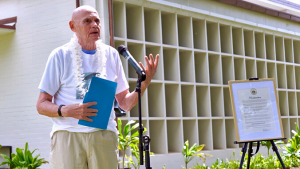 Wermager speaking at the 2024 Alice Augusta Ball Day Celebration.
Wermager’s commitment to Ball extended beyond his research. In 2017, he established the Alice Augusta Ball Endowed Scholarship to support underrepresented minority students pursuing science at UH Mānoa. The scholarship reflected his own experiences; he wrote that his family struggled financially and that others helped him complete his education, motivating him to provide similar opportunities to students. To date, 12 students were awarded the scholarship.
Wermager brought Ball’s story to wider audiences and the UH Mānoa campus. He co-produced the film The Ball Method and, in 2018, collaborated with librarian Monica Ghosh and artist Chad Kikuchi on a plaque and portrait honoring Ball, now displayed in the Science & Technology Reading Room near the life-sized bronze bust unveiled in 2024.
In 2024, Wernager and former UH President David Lassner submitted the nomination that led the American Chemical Society to designate her “Ball Method” a National Historic Chemical Landmark. The designation was celebrated at UH Mānoa in February 2026.
 Paul Wermager with scholarship recipient Destiny Apilado.
“Paul’s curiosity, tenacity and intellectual rigor were on full display through his work over these last many years to bring to light the story of one of the great scientists of the 20th century, Alice Augusta Ball,” Lassner said. “Paul’s work demonstrated how a dedicated scholar could rediscover a lost slice of history so that all of us can now celebrate her remarkable life and contributions.”
Hamilton Library Russian Bibliographer Patricia Polansky, added, “Paul was a stalwart colleague. At one point he had outlined a novel about Soviet spying, but his work on Alice Ball took precedence. That work, along with his contribution to documenting our library’s history, form a lasting legacy.”
Polansky noted in 2008, Wermager compiled SciTech: History and Recollections of the Science & Technology Reference Department, University of Hawaiʻi at Manoa Library, and the University of Hawaiʻi. “His extensive work in the archives provided not only the story of our science and technology services, but also a broader picture of Hamilton Library’s history,” she said.
Wermager often spoke of Ball not only as a pioneering scientist but as someone whose life could inspire others. In 2022, he wrote in Civil Beat, “I believe that Alice Ball’s greatest gift to humanity was hope.”
For decades, Wermager worked to ensure that Ball’s story would not disappear again. Although his biography remains unpublished, his research, scholarship and advocacy helped restore her contributions to the history of UH Mānoa and gave generations of students an opportunity to learn from her legacy.
 Wermager with UH and community members at the chaulmoogra tree for Alice Ball Day in 2024.