

Textile fragments found in an eighth-century Viking woman’s tomb at Skonager in Western Jutland offer a rare look at Nordic clothing.
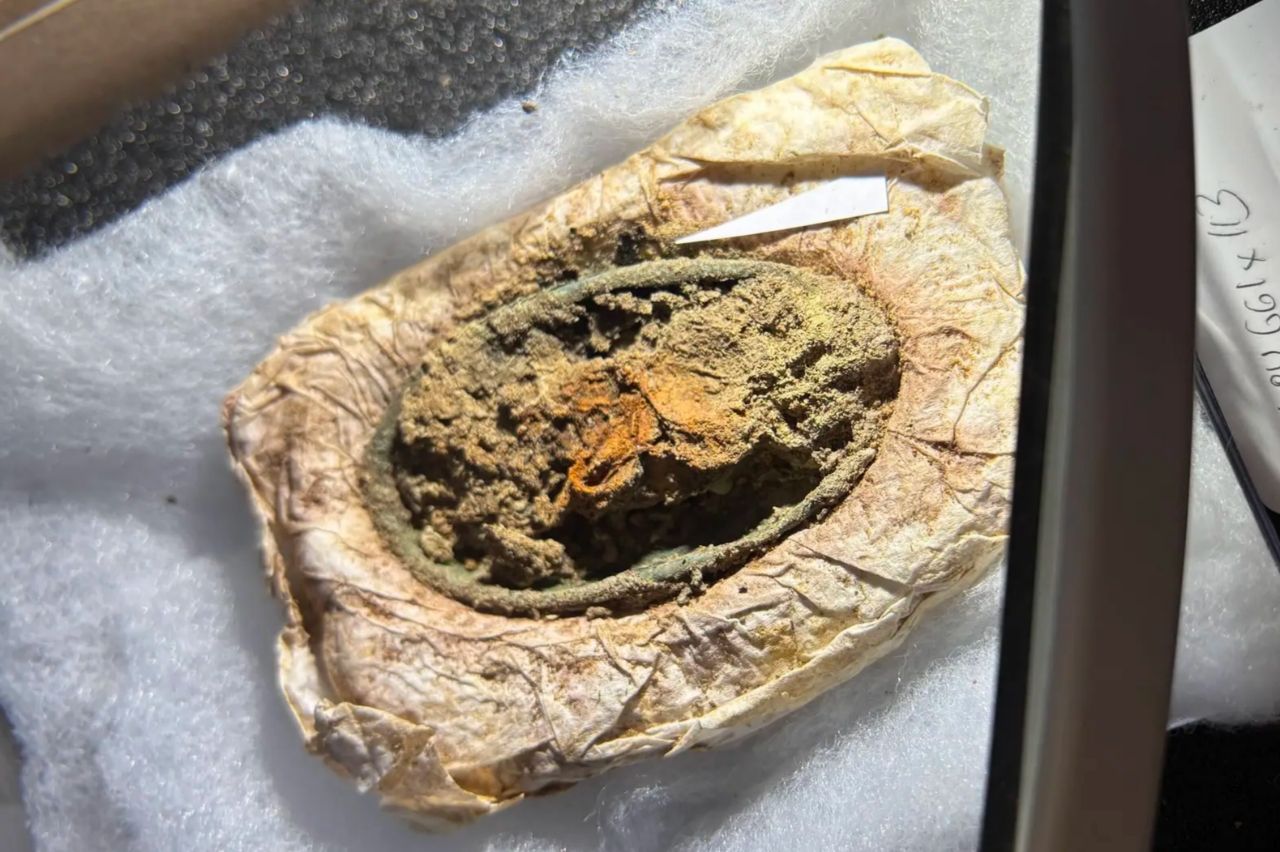 One of the brooches with preserved textile fragments. Credit: Arkæologi Vestjylland
The burial was found at the Skonager site near Varde. The woman lay in a coffin placed inside a ditch, with her head resting on a stone pillow. Alongside her remains were two concave bronze or silver brooches, known as scoop brooches. Small pieces of cloth survived on both the front and back of the brooches.
Organic fibers rarely survive in the soil of the region. Here, corrosion from the metal ornaments seems to have helped preserve the cloth. Metallic salts released as the brooches corroded created a local chemical setting where microbes were less active. This protected some of the fibers from decay for more than 1,300 years.
The position of the cloth around the brooches is especially useful. Fabric on one side likely belonged to the outer part of the woman’s clothing, while material on the other side might represent an inner layer worn next to her skin. Together, the fragments offer a rare chance to study how the garment was made and worn.
 Finds recovered from the tomb, including the brooches and preserved textile fragments. Credit: Arkæologi Vestjylland
Ancient textile expert Lise Ræder Knudsen will examine the surviving fibers. Her work will focus on the weave, patterns, thread spinning, and the quality of the cloth. Researchers also hope to learn more about the fibers and the structure of the garment.
The two brooches might hold another clue about the woman’s life. One shows signs of an earlier repair, raising the possibility that the object had been kept and passed down within a family. Radiocarbon tests on textile samples are planned, alongside dating work on the metal finds. Comparing the results should help establish whether the brooch and clothing were made at the same time.
Researchers also plan to study the colors of the surviving textiles. Ulla Mannering and Charlotte Rimstad will work with the Textile Colours of the Viking Age project to identify dyes and reconstruct the garment’s original color range. The colors could add information about how the clothing looked and how its materials were selected.
 Experts examine one of the brooches recovered from the tomb. Credit: Arkæologi Vestjylland
The burial is also being studied for clues about the woman herself. The Anthropology Unit at the University of Southern Denmark will examine her teeth for signs of age, health, diet, migration, and physical stress during childhood or adolescence. Dental evidence, including isotope signals and marks in enamel, could help trace parts of her early life.
The Vejle Conservation Center is handling the fragile excavation and recovery of the burial finds. The work requires careful removal of soil around the body, textiles, and brooches so their links to the grave context are preserved.
The research has support from the Agnes Geijers Foundation for Nordic textile research. The foundation is named after Agnes Geijer, an early researcher of Viking Age clothing and scoop brooches.
The Skonager burial offers a rare combination of human remains, metal dress fittings, and surviving textiles. Further study should provide a more detailed picture of an eighth-century woman’s clothing, diet, health, and life in western Denmark.
More information: Arkæologi Vestjylland