
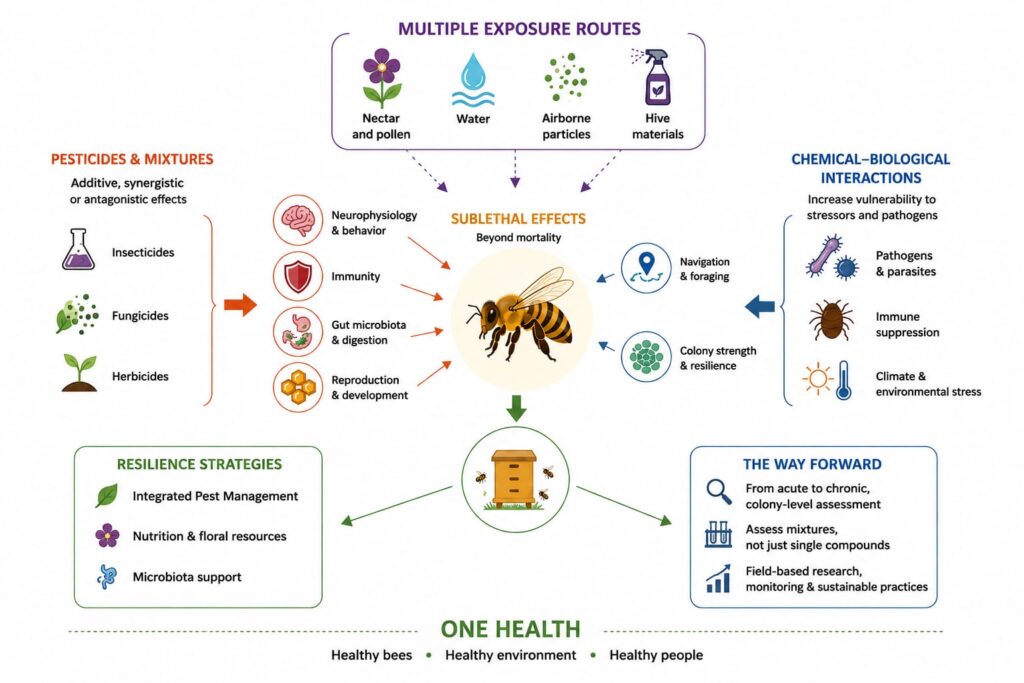
Newswise — Honey bees (Apis mellifera) are known widely as essential pollinators, but researchers working from a “One Health” approach have also identified them as biological sentinels of environmental health. Honey bees continuously interact with their surrounding environment through the collection of nectar, pollen and water, and can therefore be exposed to contaminants present in agricultural and natural ecosystems. Their health may consequently provide valuable information about environmental pressures affecting biodiversity and ecosystem functioning.
Through an international and interdisciplinary collaboration at the interface of veterinary medicine, biomedical research, and translational science, researchers working with the Sbarro Health Research Organization (SHRO) have published a review in the journal Environmental Toxicology and Pharmacology highlighting the importance of bees as a sentinel species. In particular, this review examines how pesticide exposure, particularly when combined with nutritional, biological and environmental stressors, can affect bee physiology, behaviour, immunity, reproduction and gut microbiota, potentially compromising the resilience of entire colonies.
The authors include investigators affiliated with the Local Health Authority of Foggia (ASL Foggia), Temple University, the University Magna Graecia of Catanzaro, the University of Siena, and SHRO, located at the Center for Biotechnology, College of Science and Technology Temple University.
From a One Health perspective, the significance of these findings extends far beyond the hive. Because pollination is fundamental to agricultural production and food security, disturbances affecting pollinator populations may ultimately have consequences for human societies. The review therefore places the honey bee at the intersection of animal health, environmental health and human well-being.
One Health is a holistic framework endorsed by the Italian Ministry of Health based on the recognition that human health, animal health, and ecosystem health are inextricably linked.
The review emphasizes that environmental toxicity should not be evaluated solely in terms of mortality. Sublethal pesticide exposure may alter behaviour, navigation, immune responses, reproduction and the gut microbiota, while interactions among pesticides and biological stressors may amplify their effects. This makes the honey bee particularly informative as a sentinel organism: changes in colony health can reflect the cumulative impact of multiple pressures operating within the environment.
“Honey bees can be considered biological sentinels of the environment because their health reflects the complex interaction between chemical exposure, nutrition, pathogens and ecological conditions,” says Antonio Giordano, M.D., Ph.D., Founder and Director of SHRO and Professor at Temple University. “Their protection is therefore not simply a matter of safeguarding a single species. It means protecting the ecological systems that sustain agriculture, biodiversity and, ultimately, human health.”
“The concept of bees as sentinels perfectly embodies the One Health approach,” adds Dr. Giovanna Liguori, Executive Director of the One Health Group of the SHRO. “Monitoring honey bee health can provide an integrated view of environmental stress, while linking veterinary science, environmental surveillance, agriculture and human health. Bees can become an important early-warning system for environmental changes, helping us identify biological effects before they translate into broader ecological and food-system consequences.”
The authors conclude that protecting bees requires moving from a single-contaminant perspective toward an integrated assessment of environmental stressors and colony resilience. Sustainable agricultural practices, Integrated Pest Management, adequate nutrition, protection of floral resources and strategies supporting microbial and immune health may all contribute to strengthening the resilience of pollinator populations.
“The broader message emerging from the study is therefore simple but powerful,” Giordano says. “When bees are healthy, ecosystems are more likely to be healthy; when bees are under environmental stress, they may provide an early warning that the ecosystem itself is under pressure.”
“Honey bees represent a valuable bridge between environmental monitoring, animal health, agricultural sustainability and human health,” says Liguori, “making them an emblematic One Health sentinel species.”
About the Sbarro Health Research Organization (SHRO)
The Sbarro Health Research Organization (SHRO) is a non-profit organization dedicated to cancer, cardiovascular, diabetes, and other chronic-disease research. Based at the College of Science and Technology at Temple University in Philadelphia, SHRO conducts research and trains scientists in molecular medicine, genetics, and translational science. SHRO was founded by Professor Antonio Giordano.