
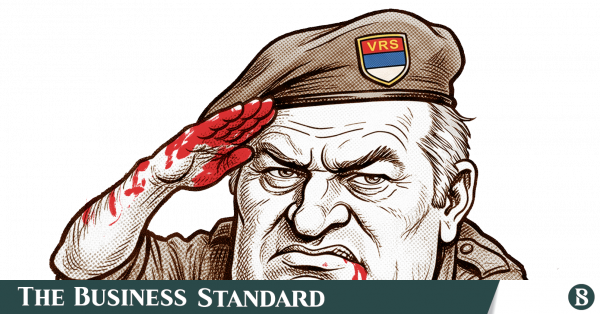
The demise of Mladic in a UN prison cell closes the legal book on Europe’s worst post-war atrocities, but the deep ethnic fissures of his military campaign remain unhealed
Sketch: TBS
“>

Sketch: TBS
On Thursday, 27 August 2026, the International Residual Mechanism for Criminal Tribunals announced the death of Ratko Mladic. The former Bosnian-Serb general, who spent his final years serving a life sentence for orchestrating the bloodiest atrocity in Europe since World War II, passed away while hospitalised in The Hague.
He was 84, going by the official record of his birth on 12 March 1942 — though his family disputes this, saying he was actually born on 8 March 1943 which would make him 83.
Mladic’s death brings a formal, physical end to one of the most notorious chapters of the Balkan conflicts, yet the shadow of his legacy continues to loom heavily over a deeply fractured Bosnia and Herzegovina.
A swift rise and a shattered nation

Mladic was born into poverty in Božanovici, a small village in the Kalinovik municipality southeast of Sarajevo, during the height of WWII. The conflict claimed his father, Nedja Mladic, a Partisan fighter killed by the Nazi-aligned Croatian fascist Ustaše regime. Raised by his mother, Stana, Mladic sought a career in the military, training at the military academy of the Yugoslav People’s Army (JNA) in Belgrade.
Graduating in 1965, Mladic joined the Communist Party and established himself as a disciplined career soldier, initially aligned with Josip Broz Tito’s ideology of Yugoslav unity over ethnic nationalism.
However, as the Yugoslav state began to disintegrate in the early 1990s and Serbian President Slobodan Miloševic mobilised Serbian nationalism to pursue a “Greater Serbia”, Mladic’s ideological trajectory shifted dramatically.
When Bosnia and Herzegovina declared independence in the spring of 1992, Bosnian Serbs established the breakaway Republika Srpska, controlling roughly half of the country. Mladic was appointed commander-in-chief of the newly formed Republika Srpska Army (VRS).
This new force inherited the vast armour, weaponry, and military infrastructure of the JNA, giving Mladic a formidable, professional army to execute his campaigns.
‘Scenes from hell’: Sarajevo and Srebrenica
Backed and armed by Miloševic, Mladic spearheaded a brutal campaign of ethnic cleansing designed to forcibly expel Bosnian Muslims (Bosniaks), Croats, and other non-Serbs to carve out contiguous Serb territory. His forces quickly overran roughly 70% of Bosnia.
Two horrific campaigns became permanently synonymous with Mladic’s name. The first was the siege of Sarajevo, which lasted 1,425 days, from April 1992 to February 1996 — the longest siege of a capital city in modern warfare.
For nearly four years, Mladic’s forces surrounded the Bosnian capital, trapping civilians in the valley below and pounding them daily with artillery, tank fire, and sniper rounds from the surrounding mountains. More than 11,000 civilians, including around 1,600 children, were killed.
The second was the Srebrenica genocide of July 1995, when Mladic’s forces overran Srebrenica, an eastern Bosnian enclave designated as a “safe area” by the United Nations. After Dutch UN peacekeepers stood by helplessly, Mladic’s troops separated Bosniak men and boys from women and children.
Over the subsequent days, his forces executed between 7,000 and 8,000 men and boys, many of whom were bound before being shot. The UN later acknowledged its own failures at Srebrenica: then Secretary-General Kofi Annan wrote, in a 1999 report to the General Assembly, that blame lay “first and foremost with those who planned and carried out the massacre,” while also conceding that the international community had made serious errors of judgement rooted in a philosophy of impartiality.
The Srebrenica killings are universally recognised as Europe’s worst massacre since WWII. In the tribunal’s November 1995 indictment of Mladic, IcTY Judge Fouad Riad described the evidence as depicting “scenes of unimaginable savagery”, adding, “These are truly scenes from hell, written on the darkest pages of human history.” The indictment cited reports of men buried alive and a grandfather forced to eat his own grandson’s liver.
The propaganda machinery Mladic employed during the massacre remains chilling.
On 12 July 1995, as the machinery of death was being readied, Mladic was filmed handing out sweets to terrified Bosnian Muslim children, telling their mothers, “No one will be harmed.” Behind the scenes, his troops were preparing mass grave sites, and would later exhume and relocate the bodies to secondary hidden graves to conceal the scale of the slaughter.
16 years in the shadows
As NATO airstrikes and diplomatic pressure brought an end to the war with the Dayton Accords in December 1995, the UN tribunal indicted Mladic for genocide and war crimes. Yet, he evaded capture for nearly 16 years.
Initially, Mladic lived relatively openly in Belgrade under the protection of Slobodan Miloševic and loyalists within Serbia’s military and intelligence services. Friends recounted how he freely moved between military barracks, played chess and table tennis, and visited the grave of his daughter, Ana.
Among the personal narratives that defined Mladic was the death of his daughter, Ana. In March 1994, the 23-year-old medical student took her own life in Belgrade using her father’s pistol. Associates and friends believed she took her life after discovering the horrific extent of her father’s wartime atrocities in Bosnia.
In November 1996, under intense Western pressure, Bosnian Serb President Biljana Plavšic dismissed Mladic and his entire general staff from their military posts, though this did little to curb his freedom in Serbia. Washington had separately offered a $5 million reward for information leading to his capture.
His security grew more precarious after Miloševic was ousted in 2000 and arrested in 2001. Mladic went deep underground, sheltered by a network of military sympathisers. His continued freedom became a massive geopolitical hurdle for Serbia; Western nations exerted heavy political and financial pressure, making Mladic’s arrest a non-negotiable condition for Serbia’s progress toward European Union membership.
On 26 May 2011, the long hunt ended. Serbian authorities cornered Mladic at a relative’s farmhouse in the village of Lazarevo, north of Belgrade. Despite carrying two loaded pistols, the once-fearsome general surrendered without a struggle, telling the officers, “Congratulations. I’m the one you’ve been looking for.”
The tribunal’s final verdict
Extradited to The Hague, Mladic faced a gruelling trial that ran for more than four years from May 2012, the culmination of the IcTY’s work. The chamber sat for 530 trial days, heard from 592 witnesses, and examined close to 10,000 pieces of evidence.
Throughout the trial, Mladic showed no remorse and consistently refused to recognise the legitimacy of the court, telling one hearing, “I do not recognise this court.” He blamed his subordinates for executing his orders.
When the tribunal sentenced him to life imprisonment in November 2017, Mladic disrupted the courtroom, shouting, “This is all lies, you are all liars!”
Presiding Judge Alphons Orie ruled that Mladic’s crimes ranked “among the most heinous known to humankind,” while prosecutor Alan Tieger, in his closing argument, had described him as “the master of life and death”.
Among those present was Fikret Alic, the emaciated prisoner whose 1992 photograph from a Bosnian Serb camp had become one of the defining images of the war. “Justice has won, and the war criminal has been convicted,” he told reporters outside the court. Mladic’s appeal was rejected and his life sentence was firmly upheld on 8 June 2021.
In his final months, Mladic’s lawyers repeatedly petitioned for his early release on humanitarian and medical grounds, citing doctors’ assessments that he was wheelchair-bound, had suffered a severe stroke that left him nearly unable to speak, and that his condition could deteriorate fatally at any time.
The court repeatedly denied these requests, ruling that he was receiving adequate and compassionate palliative care within the UN facility.
An unreconciled legacy
While Mladic’s death closes his physical chapter, it has laid bare the deep, unresolved ethnic divisions that plague modern Bosnia and Herzegovina. Legal justice may have been served at The Hague, but moral justice and social reconciliation remain elusive.
To Bosniak survivors, his death brings little closure.
Hasan Hasanovic, a Srebrenica survivor who lost his twin brother and father in the massacre and now works at the Srebrenica Memorial centre, said Mladic’s “death is just a biological necessity, and it doesn’t bring to an end the political project and military project that created that legacy of genocide”.
Munira Subašic, who lost her husband and son at Srebrenica, put it more starkly still, “Germans had Hitler, Serbs have Mladic.”
Indeed, across predominantly Serb territories in Bosnia and Serbia, Mladic is still widely celebrated as a protective hero who defended his ethnic group during the collapse of Yugoslavia.
Bosnian-Serb separatist leader Milorad Dodik called his death “a murder”, saying Mladic “was respected by Serbian people” and had “stood to defend Serbs”. Murals of Mladic decorate streets in Belgrade and Banja Luka, and following the news of his death, crowds of young Serbs — most born long after the war ended — took to the streets with flags and posters to celebrate his life.
This polarisation is actively fostered by political leadership. Mladic and other wartime leaders are not portrayed as war criminals in Bosnian-Serb textbooks; instead, they are credited as the heroic founders of Republika Srpska, which survived the Dayton Accords as a semi-autonomous entity within Bosnia.
Genocide denial has steadily worsened: the Srebrenica Memorial centre’s most recent annual report recorded 149 cases of public denial of the genocide in 2026, up from 99 the year before.