

Domhnall Gleeson is a natural at this. It’s hard not to think of him as a shiny-faced newcomer, but it is, astonishingly, 20 years since he received a Tony nomination for his performance on Broadway in Martin McDonagh’s play The Lieutenant of Inishmore.
Five or six years later he had achieved the enviable status of front-rank unavoidability. Bill Weasley in Harry Potter. General Hux in Star Wars. Prominent roles in Brooklyn, The Revenant and Richard Curtis’s About Time. You couldn’t move for Gleesonia.
What’s he doing right now?
“I’m in London, at the Langham hotel, doing a day of press for The Incomer,” he says in his amiable way. “And I was on The One Show last night. So that was great.”
He was indeed on the BBC’s easy-going early-evening magazine. With the Countdown boffin Susie Dent, no less. Now that’s class.
“We have that in Ireland as well, don’t we? Just those mad mixes of shows. But that was good fun.”
We have noted that Gleeson – son of Brendan, of course – works a lot, but what matters more is that the material remains interesting. Louis Paxton’s The Incomer is a case in point. This debut Scottish feature casts our star as a mid-level government official tasked with removing two demented siblings from an isolated island north of the much-feared “mainland”.
There is a lot of gentle comedy in the piece. An icy seam of folk horror also runs through it.
It turns out that Gleeson was at Dublin Institute of Technology with the producer.

The Incomer: Domhnall Gleeson in his new film. Photograph: Anthony Dickenson
“It was really media arts,” he says. “And loads of people from my class went on to have really, really great careers in film and broadcasting and TV and all the rest of it. And one of those people is the producer of this film, Shirley O’Connor.
“We used to hang out in college all the time. We used to have fun Fridays – and she was just the best person ever. It’s that mad thing where somebody says, ‘Will you read this script?’ And you never know how that’s going to go. And this was just super.”
There are obvious parallels with Ireland. We also have our misused isolated communities.
“Oh, for sure. You recognise the mythology,” he says. “It doesn’t feel like a message movie in any way, which I think is a good thing. But it felt full of good heart – a truly good heart, not fake good heart. It felt like you really cared about what he was doing.”
You couldn’t find a better salesman for your movie than Gleeson. He speaks in structured paragraphs that are much at home to self-deprecatory humorous asides. There is no sense that years working in Los Angeles have rubbed off any of his laconic Dublin humour.
Of course, he has never moved too far from the old manor. That must have been a temptation. Every second young Irish actor I meet seems to be on the point of relocating to north London. But Gleeson, who married the producer Juliette Bonass in 2023, does not seem to have been tempted to leave dear old Dublin. That loyalty deserves celebration.
“I never thought that networking was actually a thing,” he says. “I always just thought: everyone auditions, and the best person will get the job. And it’s funny. Over the last couple of years, spending more time in Los Angeles, I realise being around people and reminding people that you exist – and are not a bad person, actually – is not a bad thing for work at all. You know what I mean?”
That’s what every Hollywood memoir tells us. That is a strand in all satire of the entertainment industry. It is quaint that he only now seems to be figuring that out.
“It does have an effect,” Gleeson says. “But my life in Ireland just means too much to me. So it’s no sacrifice to choose to live in Ireland. And I think I’ve been very lucky with the work.
“I can understand why somebody would go away to chase it or to get better opportunities. It would make total sense to me to do that. But I feel in a place where I feel secure enough that it doesn’t seem necessary.”
Still, that strategy does mean he’s away from home a great deal. He shoots television and movies in the United States. He does the same in Britain. It can’t be all that easy to get back and maintain those links with loved ones. The actor’s life is a peripatetic one.
“It’s a constant balance in terms of everything,” he says. “But it has always been that way. I don’t like being away from the people I love – from my family and my friends. I don’t like that.
[ Brendan Gleeson: ‘I can’t go into a pub any more. I really miss it’Opens in new window ]
“But I don’t know. If you’re in my line of work, to complain about being away from home to work on a film doesn’t hold water. It’s a privilege to be able to do that.”
Of course, he will have picked up some hints on how to handle himself from his dad. Gleeson was born in 1983 to Brendan, then still a teacher, and his indomitable wife, Mary.
The eldest of four boys – Brian, five years his junior, is also a busy actor – Gleeson spent most of his childhood in Malahide, in north Co Dublin. It’s easy to forget that proper fame came to Brendan relatively late in life.
Indeed, Gleeson is probably just about old enough to remember his father taking up the acting life full-time. That must have changed things in all kinds of ways. His dad was now on the telly (a bit).
“I think I was maybe six or seven when he went professional from being a teacher,” Gleeson says. “Hilariously, probably my best friend is someone I knew when I was six. I had my friends made by the time I was six years old. I never had to question anyone. By the time he was well known in any way, I would have been into my teens – or maybe late primary school.”
Although his father is among the best-loved actors in the country, it was not, I suppose, like going to school as the son of Bono or Roy Keane.

Domhnall Gleeson. Photograph: Lloyd Bishop/NBC/Getty
“It’s funny. There are different types of fame,” Gleeson says. “There is the being-in-a-big-film fame. That’s one sort of fame. And then just being-in-Glenroe fame. That kind of takes over more.
“My friends who were in Love/Hate are much more famous than some of the other people I know who mostly do massive films. You know what I mean? So it’s all just differing levels of that, and certainly the same is true with Dad.”
Gleeson did not take the drama-college route. When he went to Dublin Institute of Technology – now Technological University Dublin – it was with a mind to work behind the camera. He then had a role in the series Rebel Heart, from 2001, and, three years later, appeared opposite his dad in Six Shooter, Martin McDonagh’s Oscar-winning short.
Looking back, it feels as if he was destined to be in front of the camera. He has those reedy good looks. He has comic timing. His work never feels forced. But there was originally another plan.
“I wanted to write and direct,” he says. “That was what I was interested in. That was where I felt my strengths lay. That’s where my passion was. Based mostly on the Coen brothers. I was a fanatic about their films and Todd Solondz and all those people.
“That was the aim. You learn from anybody who’s good at what they do. But the way it all happened was so unexpected that it was a learning-on-the-job type of situation, for sure.”
Indeed, by 2010 Gleeson had a major role in a film by his heroes. In the Coens’ adaptation of Charles Portis’s novel True Grit, he played the part originated by Dennis Hopper in the 1969 version. That year he was also seen in Lenny Abrahamson’s Frank and Angelina Jolie’s Unbroken.
That is how you arrive.
Actors who have been through drama school often bring a formal process to the work. Is that the same for him?
“It definitely evolves,” Gleeson says. “Sometimes you are trying to find a way to work on every job until you find a place where you feel like that work is done. You know what I mean? And then you can walk on set confident in some way.
[ Domhnall Gleeson: ‘I live in Dublin because it’s home’Opens in new window ]
“So it does change all the time. Sometimes it comes relatively easily. I always think there’s no point driving yourself mad for no reason if you already have it in you and you feel good to go. I wouldn’t question that.”
But it doesn’t always come naturally.
“Other times you’re two weeks out from the shoot, or you’re one week out from the shoot, and you’re still searching, searching, searching, searching. Sometimes you’re into the first week or two and you’re still finding your feet. That’s when you just hope that you still have a few more weeks to shoot.”
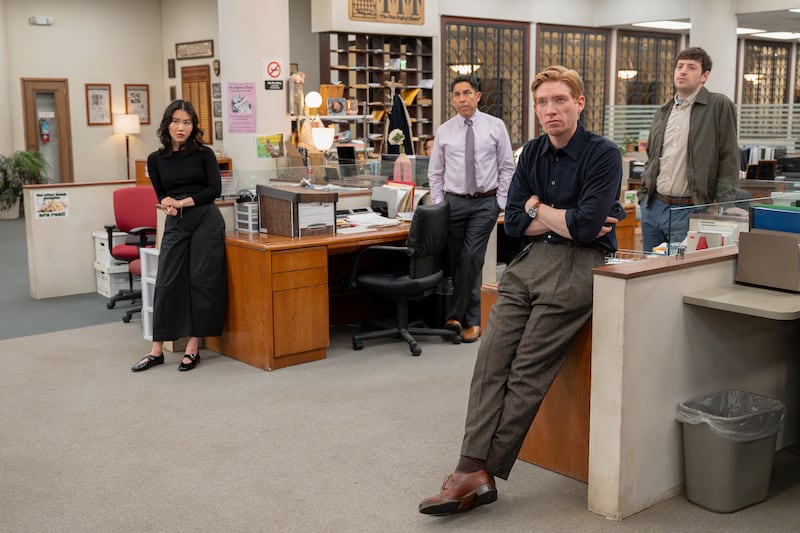
The Paper: Domhnall Gleeson in the spinoff from the American version of The Office. Photograph: John P Fleenor/Peacock
We are currently in the Season of Domhnall. Or maybe that now lasts all year round. The Incomer is on the way. As he and I speak, the second season of The Paper, an adorable spin-off from the US version of The Office, is about to land on TV, and Werner Herzog’s Bucking Fastard, a largely Irish production from the renowned German director, is set to premiere at Venice International Film Festival. Gleeson has the lead role in the former and a supporting part in the latter.
Everyone is in a flurry about Bucking Fastard. What is this thing? We know that Rooney Mara and Kate Mara play twins. We know it is roughly based on real characters. We know it was filmed in Naas and Dublin.
“I wasn’t in a lot, but it was an opportunity to see Werner work,” he says. “I loved the script. It was such an unusual thing, and it was a chance to work with Rooney and Kate, both of whom I’d met before, and I think had kindly suggested me maybe to Werner. I’m not sure about that.”
He ponders his own role in Bucking Fastard.
“He’s a good man in a film where there’s lots of people who are maybe not out for the greater good. I really enjoyed it. It was an incredible thing to be a part of. I can’t wait to see the film. Yeah, I’m looking forward to it. It could go any way, as all his films can.”
In The Paper, Gleeson stars as the new editor-in-chief of the Toledo Truth Teller, a local newspaper. The series has the same gentle, off-centre humour as The Office, but it also has something to say about the significance of old-school journalism.
“I obviously I feel that’s super important,” he says. “That’s one of the things we often talk about, front and centre. It can’t always be ‘journalism is important’. That can’t be the point of the show. But I like that, fizzing along in the background, is both the struggle of trying to do good journalism and the importance of it all.”

Star Wars: The Force Awakens – Domhnall Gleeson in JJ Abrams’s 2015 film
One can hardly imagine a more satisfactory accidental career. Gleeson has carved out a place at the centre of the industry. As long ago as the 2016 Oscars it was much noted that he starred in four major nominated films: The Revenant, Brooklyn, Ex Machina and Star Wars: The Force Awakens. If his cog slips out of the Hollywood machinery, the entire structure might come grinding to a halt.
“When you get good work it really makes you feel alive,” he says with a smile. “It makes you feel connected. When the work is good it makes it hard to imagine doing anything else.”
The Incomer is in cinemas from Friday, September 4th