
August 31, 2026
Forecasting Eye: The cost of war – Middle East conflict to strip £70.4 billion from UK households’ real disposable incomes
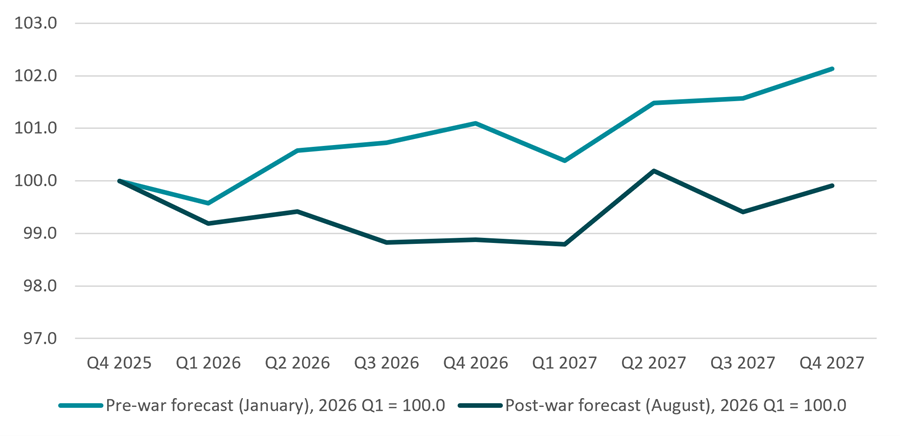
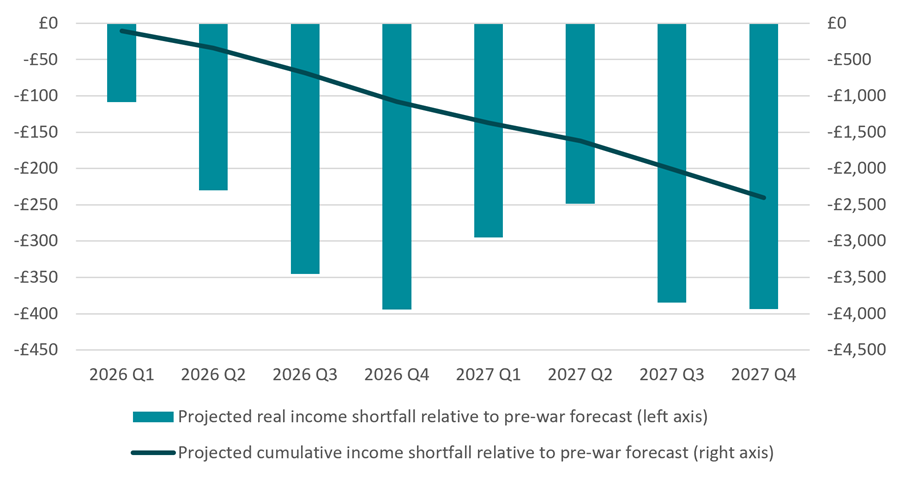
The war in Iran is being paid for in diminishing UK spending power. Higher inflation and weaker wage growth since February’s US and Israeli airstrikes on the Iranian regime are eroding the real value of household incomes: we estimate that for the average UK household, real incomes will be £1,100 lower in 2026 and £1,300 lower in 2027 than they would otherwise have been, bringing the total cost per household to £2,400.
Figure 1: Real household income outlook downgraded post-conflict
Source: Cebr forecasts & analysis
Figure 2: The cost of war builds for the average UK household
Source: Cebr forecasts & analysis
The strikes triggered the second major energy supply shock of the post-pandemic era, after Russia’s invasion of Ukraine in 2022. Six months on the war continues, with the US this week announcing economic sanctions on Iran and its trading partners. Whatever the strategy of the US administration, the effect of the war is clear: obstructed shipping through the Strait of Hormuz has reignited inflationary pressures that, before the conflict, looked to be fading. Indeed, prior to conflict escalation, several rate cuts had been widely predicted for 2026.
That shock reaches households through two channels. The first is direct: higher energy costs feed straight into bills and into the price of almost everything else, so each pound of pay buys less.
The indirect channel is slower but as important, running through monetary policy and the labour market. We anticipate rate cuts to remain on hold for the rest of the year, keeping borrowing costs high and the housing market on the back foot. Squeezed margins have pushed firms into a defensive stance on investment and hiring, with vacancies, already depressed when the conflict began, slipping to their lowest level in over a decade in the three months to July, outside of the pandemic period. With labour demand failing to keep pace with supply, wage growth is in slowdown. The same shock that lifts prices is reinforcing wage deceleration, leaving real incomes squeezed from both sides.
Set against our January forecast, a month before the first missiles, the picture is stark: inflation is forecast to be higher and nominal wage growth slower. While the path from conflict to prices is clear, the path to wages is admittedly more nuanced, with factors such as demographics and AI-led technological disruption also feeding in. Nevertheless, business surveys, including the Business Confidence Monitor from the Institute of Chartered Accountants in England and Wales (ICAEW), bear out the stifling effect of the conflict on sentiment and this extends to hiring and wage dynamics.
Excluding the effect of population growth on aggregate disposable income, conflict-linked inflation accounts for 32.1% of the real earnings erosion this year, rising to 44.6% in 2027. Price pressures remain concentrated in the most energy-sensitive components, such as transport and household utilities, with the dominant driver shifting from fuel prices this year to bills next.
Ofgem this week confirmed more energy pain is coming. The price cap rises on 1 October, adding £60 to a typical dual-fuel bill, even after the roughly £45 saving from scrapping VAT on electricity. Energy’s contribution to inflation will build through the winter, with Cornwall Insight’s forecast indicating a further 9% rise in the price cap in the first quarter of 2027.
In aggregate, eroding real incomes drain the spending power that drives growth. Indeed, consumer spending is expected to slow through the rest of 2026 and into 2027, reflecting the erosion of real incomes by an estimated £31.5 billion and £38.9 billion, respectively.
A conflict fought thousands of miles away continues to bear on UK households, with real income erosion felt in the weekly shop, at the pump and on the energy bill. Until energy markets calm, the squeeze will persist. With the price cap rising in October and energy’s contribution to inflation building rather than fading through the winter, the cost of living is likely to remain atop the agenda for UK households for many months to come.
For more information contact:
Liam Daly, Senior Economist, ldaly@cebr.com