
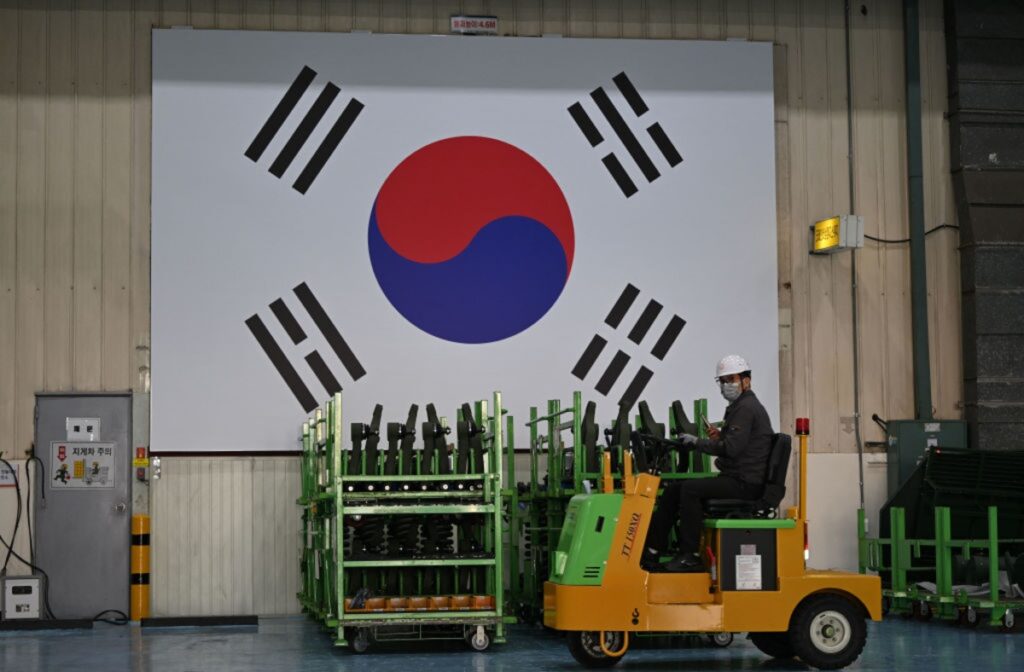
A South Korean engineer drives past a South Korean flag at Hanwha Aerospace factory in Changwon on November 21, 2024.
JUNG YEON-JE/AFP via Getty Images
South Korea’s Hanwha Aerospace signed an execution contract with Spanish defense firm Indra Sistemas on August 31 to supply K9 self-propelled howitzers and related equipment to Spain, bringing the weapon’s total operator count to eleven nations and marking its first entry into Western Europe. The contract’s financial floor — at least 667.6 billion won (approximately $485 million) — is derivable from South Korean securities rules, which require disclosure when a contract exceeds 2.5 percent of recent annual revenue. What those rules cannot compel Hanwha to reveal is the provision that has drawn the most scrutiny since the deal was first reported: Indra will design and manufacture the vehicle hulls in Spain, retaining design authority over them — terms that echo the agreement South Korea struck with Turkey in 2001, which eventually produced a competing gun.
Spain Becomes the Eleventh K9 Nation — and the First in Western Europe
Prior K9 exports reached all four compass points of Europe’s eastern and northern flanks: Poland, Romania, Finland, Estonia, and Norway have all placed orders since 2016, driven largely by the urgency that Russia’s full-scale invasion of Ukraine created in 2022. Spain is different in geography and in posture. As an Atlantic and Mediterranean NATO member with no land border near the active conflict zone, it had time to negotiate — and it used that time.
The program Spain is executing is a large-scale replacement of its aging fleet of M109 howitzers, an American design in service since the 1970s. In December 2025, the Spanish Defense Ministry awarded a tracked-artillery modernization program to a consortium of Indra and Escribano Mechanical & Engineering. The total program budget is approximately €4.55 billion (about $5.3 billion). The package covers 128 tracked artillery guns for the Army and Marine Corps, plus 120 ammunition resupply vehicles, 21 recovery vehicles, and 11 command-and-control units.
In March 2026, Hanwha and Indra signed a binding memorandum of understanding in Madrid, formalizing K9 as the program’s base platform. Hanwha CEO Son Jae-il and then-Indra chairman Ángel Escribano attended the signing; Escribano resigned from Indra in approximately late April 2026 amid unrelated conflict-of-interest allegations, and the company has since replaced its leadership twice. The current Indra CEO, Josep Maria Recasens, told analysts at an earnings presentation after the leadership change that the company remained “fully committed and determined to carry out the project together with Hanwha.”
Under the payment terms disclosed in the regulatory filing, Indra will pay 20 percent of the contract value as an initial advance payment after signing, followed by an additional 5 percent by December 31, 2026. Full contract details — value, unit count, and delivery schedule — will remain confidential until at least November 28, 2026, at Indra’s request.
Indra Holds the Hull — and That Is the Question
What distinguishes the Spain deal from every prior K9 export is the scope of industrial transfer under negotiation. Indra will design and manufacture the vehicle hulls at its plant in Gijón, in northern Spain, retaining design authority over that component. It will also supply the mission systems, battlefield management software, and communications equipment, integrating its own electronics onto the K9 platform.
That is not, by itself, unprecedented for Korea’s export model. India’s variant — the K9 Vajra-T, produced by Larsen & Toubro — incorporated 50 percent domestic content from the start, including the fire control system and communications. Australia’s AS9 Huntsman is built at Hanwha’s Geelong facility, with Hanwha retaining design authority but local assembly rising over time. Romania’s deal, signed in July 2024, involves a new H-ACE Europe facility in Petrești targeting 80 percent local content, with groundbreaking in February 2026.
What separates Spain’s terms is that Indra’s hull design authority reportedly extends to developing a Spanish variant that need not carry the K9 name, and that Spain is said to have sought rights to export the resulting platform to third countries. A Hanwha Aerospace spokesperson told the Korea JoongAng Daily that negotiations on the exact scope of technology transfer are ongoing, and that “nothing has been decided about its exact scope.” Later reporting in the Korean financial press — after earlier accounts described an outright intellectual property transfer — indicated a structure more like a long-term license, under which Hanwha retains ownership of the intellectual property and holds prior-consent rights over any new partner that would gain access to core technology and drawings.
Does Selling the Technology Create the Next Competitor?
The structural risk this deal raises is not hypothetical. South Korea has faced it before, with consequences that are still visible on export order books today.
In July 2001, Samsung Techwin — Hanwha Aerospace’s corporate predecessor — signed a contract transferring hull and fire control technology to Turkey for what became the T-155 Fırtına. Turkey produced 281 of these vehicles between 2004 and 2014. The T-155 now competes against the K9 in international tenders, and in January 2025 FPV drones struck T-155 units in Syria — weapon actively deployed by a Turkish-backed force. The original deal generated more than $600 million for Hanwha’s predecessor — significantly less than the bilateral relationship would have generated had Turkey continued purchasing finished howitzers rather than producing them domestically.
Egypt presents a more recent iteration of the same dynamic. A $1.6 billion contract signed in 2022 covers 200 K9A1EGYs and 100 K10EGYs produced in Egypt, with technology transfer for local manufacturing including the engine. By October 2024, Egypt’s Ministry of Military Production had announced SMV1000 engine production — Korea’s domestic replacement for the German MTU unit — and Egyptian officials stated their intent to become a regional export hub for the K9 system serving African and Arab countries.
The pattern, across Turkey and Egypt, is: technology transfer enables local production, local production reduces per-unit revenue flowing back to Korea, and local production capacity eventually seeks export markets. Spain’s terms, if the re-export rights are confirmed in the final contract, would extend this pattern into Western Europe — a market where Korea has become the second-largest arms supplier behind only the United States, accounting for 8.6 percent of NATO imports between 2021 and 2025 according to the Stockholm International Peace Research Institute.
A veteran Korean defense industry adviser, speaking anonymously to the Korea JoongAng Daily, called the deal simultaneously valuable and risky: “There is clearly economic benefit, value we can capture. The question is how much of our technology gets drawn out in exchange.”
Why Spain’s Leverage Is Real
Academic experts on Korean defense exports suggest the terms are not surprising given Spain’s industrial position. Jang Won-joon, an associate professor specializing in the defense industry at Jeonbuk National University, told the Korea JoongAng Daily that “whether the contract comes together depends on how far Hanwha will go in providing design and manufacturing technology for the hull and core components, systems integration authority, intellectual property and rights to export to third countries.”
Choi Gi-il, a professor of military studies at Sangji University, offered a counterargument rooted in Korea’s export track record: “Localizing and modifying to meet local demands is how we have always done this. Korean weapons are built to NATO standards from the start, so NATO localization goes without saying.” He compared the Spain arrangement to Poland, where Hanwha supplied K9 chassis for AHS Krab production beginning in 2014 — but where Poland subsequently placed an order for 672 fully Korean-built K9PL howitzers, the largest single K9 order anywhere.
The tension in Choi’s comparison is that Spain brings a qualitatively different degree of industrial ambition. Spain is not asking to assemble Korean subsystems. It is asking to design the hull — the structural core of the vehicle — and to integrate its own electronics. One industry source told the Korea JoongAng Daily that Indra’s apparent willingness to absorb pressure from a Spanish transmission maker (SAPA, which holds about 8 percent of Indra and wants its proprietary gearbox substituted for the Allison X1100-5A3 that powers the standard K9) illustrates the complexity of the industrial politics involved: replacing the Allison unit would require a redesign of engine management, cooling, hull structure, and control software. Hanwha is a supplier to Indra in this arrangement — not the prime contractor, as it would be in a direct government-to-government deal — which limits the leverage it holds over which additional companies gain access to core technology and drawings.
What Will Reveal the True Scope
Three events, in sequence, will clarify what Spain has actually acquired. The first is Hanwha’s export approval filing with South Korea’s Defense Acquisition Program Administration (DAPA), which must specify whether finished howitzers or individual modules are physically leaving Korea. The second is the final contract text, which will fix the scope of the technology license and whether re-export rights are included. The third is whether Santa Bárbara Sistemas — General Dynamics’ Spanish subsidiary and a K9 competitor whose legal challenge to the artillery program was filed with Spain’s Supreme Court before being paused in July 2026 to allow negotiation over entry into the program — gains access to K9 design data if it joins the program structure. Hanwha’s reported prior-consent right would, in theory, allow it to block Santa Bárbara from that access, but the leverage is thinner as a subcontractor than as a prime.
The K-Defense Model Hits a Fork
Monday’s filing is the latest data point in a broader transformation of South Korea’s defense export model. At the NATO Defence Industry Forum in Ankara on July 8, 2026, Jacek Cyrek, President and CEO of Hanwha Aerospace Europe, presented the company’s explicit strategic pivot under the banner “Built with Europe, for Europe” — emphasizing local manufacturing, European supply chain integration, and technology transfer as the foundation of its European strategy. The H-ACE Europe facility in Romania, the technology transfer elements of the Polish K9PL Batch II deal, and now the Spain arrangement all reflect that pivot.
The Korea Economic Institute of America noted in a recent policy analysis that only Hyundai Rotem’s K2 tanks currently meet full NATO interoperability standards among Korean defense platforms. That gap means that Korea’s near-term path to deeper integration in NATO procurement runs through exactly the kind of industrial co-production arrangements the Spain deal represents — arrangements in which Korea transfers technology in exchange for market access and local legitimacy.
The unresolved question is whether the price of that access — in intellectual property, design authority, and potential third-country competitive exposure — is one Hanwha can sustain across a growing portfolio of such deals. Jang Nam-hyun, an analyst at Korea Investment & Securities, expressed optimism in a report earlier this year, forecasting that Poland’s third K9 contract would advance alongside the Spain execution. The cumulative picture those two deals present — Poland with licensed local production, Spain with hull design authority and possible re-export rights — suggests the answer to the technology transfer question will be written not once but repeatedly, in every European NATO capital where Hanwha’s negotiators sit across from procurement officials who have learned, from watching each other, what Spain was able to extract.
Hanwha and Indra Extend the Partnership Beyond Howitzers
The execution contract follows a separate memorandum of understanding signed in April 2026 under which Hanwha and Indra agreed to cooperate on Chile’s armored vehicle modernization program, with Hanwha providing its TIGON wheeled armored vehicle platform and Indra supplying mission and comms systems. Both companies have described their intent to use combined Korean-Spanish industrial capability to expand jointly into the Latin American land defense market.
Whether that partnership deepens or strains will depend partly on how the technology transfer terms in the Spain howitzer program are resolved — and on whether the coming DAPA export filing shows Hanwha leaving Korea as a supplier of finished systems, or as a provider of something smaller, that Indra will turn into a howitzer of its own.
Frequently Asked QuestionsWhat is the K9 howitzer and why does the Spain deal matter?
The K9 Thunder is a 155mm tracked self-propelled howitzer designed and manufactured by Hanwha Aerospace, with roughly 1,900 units built since entering service in 1999 and a claimed 52 percent share of the global market for such systems by deliveries since 2000. The Spain deal matters because it is the weapon’s first sale to a Western European country, and because its terms — Indra will design and manufacture the vehicle hulls and retain design authority — are structurally different from all prior K9 exports, raising the possibility that the technology Hanwha transfers to make the deal work could eventually support a competitor in the same European market.
Has South Korea’s technology transfer in defense created competitors before?
Yes. Turkey’s 2001 deal for hull, turret, and fire control technology produced the T-155 Fırtına, which now competes against the K9 in international tenders. Egypt’s 2022 deal, which included technology transfer for local engine manufacturing, has resulted in Egypt publicly stating its intent to become a regional export hub for the K9 system in Africa and the Arab world. The Spain deal, if it includes re-export rights as reported, would introduce the same competitive dynamic into Western Europe — a market where South Korea ranks second as arms supplier to NATO members behind the United States.
Why does hull design authority matter technically?
The hull is the structural skeleton of a tracked armored vehicle — it determines where the engine and transmission mount, where ammunition is stored, the geometry of the armor layout, and the integration points for every other system on the vehicle. A company that designs the hull can modify the vehicle’s overall form factor, change the power pack, alter internal layouts, and develop follow-on variants without returning to the original designer for permission on structural changes. Hanwha’s reported prior-consent clause over new industrial partners is intended to limit this risk, but its effectiveness depends on whether Hanwha is negotiating as a prime contractor or as a supplier to Indra — a distinction the final contract will settle.
What is South Korea’s NATO interoperability gap and why does it matter for these deals?
According to the Korea Economic Institute of America, only Hyundai Rotem’s K2 tank family currently meets full NATO interoperability standards among Korean defense platforms. The K9 fires NATO-standard 155mm/52-caliber ammunition and country-specific variants integrate NATO fire-support and communications systems, but these are variant-level adaptations rather than platform-standard certification. This interoperability gap means Korea’s path to deeper NATO procurement integration runs through the kind of co-production and technology transfer arrangements the Spain deal exemplifies — giving buyers the ability to adapt platforms to NATO standards locally. It is also why Spain’s demand for hull design authority, rather than simple licensed assembly, is likely to become a template other NATO buyers cite in their own negotiations.