
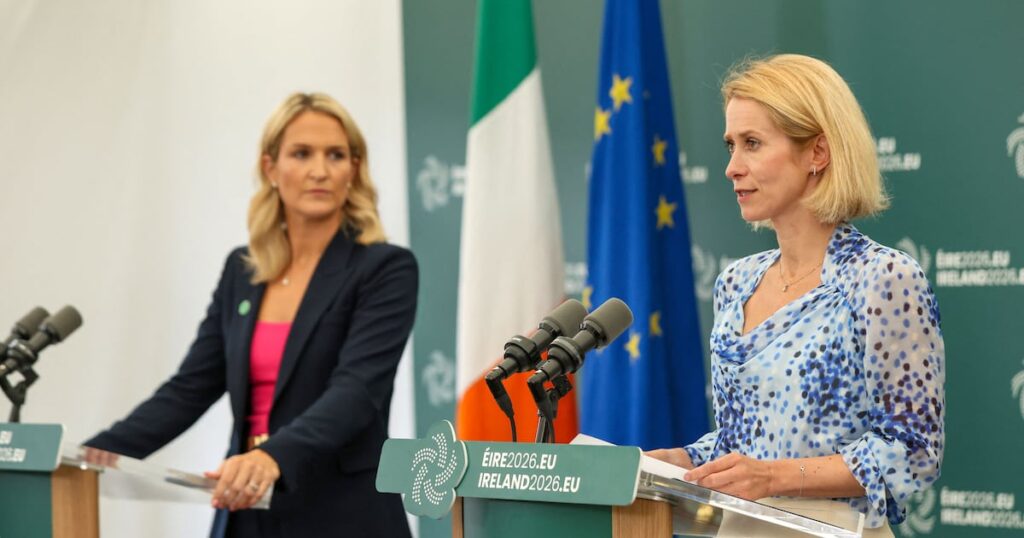
More than 10 EU states are willing to contribute resources and people to a new military and civilian mission to advise and train Lebanese forces after UN peacekeepers withdraw this year, the bloc’s foreign policy chief, Kaja Kallas, said on Tuesday.
The mission would aim to strengthen Lebanon’s Internal Security Forces to help free up the Lebanese army to focus on disarming the Iran-backed armed group Hezbollah.
“Planning is progressing well, and we aim for the [European] Council decision to launch in October,” Ms Kallas said after a meeting of EU defence ministers in Ireland.
Irish Foreign and Defence Minister Helen McEntee said it was important not to leave a void after the UN Interim Force leaves Lebanon by December 31. The US vetoed the renewal of Unifil’s mandate last year after almost 50 years of presence in southern Lebanon.
“We do not want to allow a gap to exist where we know there needs to be a continued presence. It’s really important that we can reach an agreement soon,” Ms McEntee said.
With 274 military personnel in Unifil, Ireland is among the leading contributors to the force of more than 7,000 peacekeepers from 46 countries.
The aim is not to replace the Unifil mission, Ms Kallas said, but to help Lebanese security forces “establish order” and support “border and maritime security”.
“We are in close contact with the Lebanese government, what they need from their side and what member states are willing to contribute,” she said. “But there were more than 10 countries when I counted who are willing to contribute resources and people as well.”
Dialogue with Lebanon
Lebanon is understood to want to extend Unifil’s mandate, which would require approval from the UN Security Council, but the US position on this remains unclear.
France, which currently holds the rotating presidency of the Security Council, would be open to backing an extension, French Foreign Minister Jean-Noel Barrot told reporters in Paris.
Mr Barrot said France was discussing Unifil’s future with Lebanese authorities. “If they deem that the situation requires an extension, we will support that position in our dialogue with them.”
In June, France and Italy announced a joint initiative to create an international coalition to replace Unifil, in co-ordination with the EU and Nato, to strengthen the Lebanese state. It is supported by the Lebanese leadership but opposed by Israel, which is fighting Hezbollah in southern Lebanon.
Israel has long accused Unifil of failing in its mission to disarm Hezbollah, and that criticism has been embraced by US President Donald Trump’s administration. Unifil supporters say disarming Hezbollah was never its mandate, and that its role was to support the historically weak Lebanese army in doing so.
Options include a European-led force or a combination of UN and coalition support, France’s UN ambassador, Jerome Bonnafont, told reporters on Tuesday.
He said the UN Security Council held closed consultations last week on conditions in Lebanon and would continue talks with council members, troop-contributing countries and regional states in the coming weeks over arrangements to succeed Unifil.
“Unifil or a new force or a combination between a UN presence, a coalition that France and Italy are discussing … a European mission, perhaps,” Mr Bonnafont said.
Any new arrangement would be aimed at supporting the Lebanese Armed Forces and would be built around the principles of Security Council Resolution 1701, he said.
Mr Bonnafont said the central objective was to restore Lebanese state sovereignty and ensure the Lebanese Armed Forces held a monopoly on weapons throughout the country.
Lebanon and Israel have engaged in the past months in seven rounds of direct talks in Washington and the US embassy in Rome, which focused on the so-called “pilot zones”. These are designated areas to which Israeli forces would withdraw, the Lebanese army would assume control and Hezbollah would disarm.
Yet so far, Israel has withdrawn from only two pilot zones. Lebanon hopes an international presence could accelerate an Israeli withdrawal.