
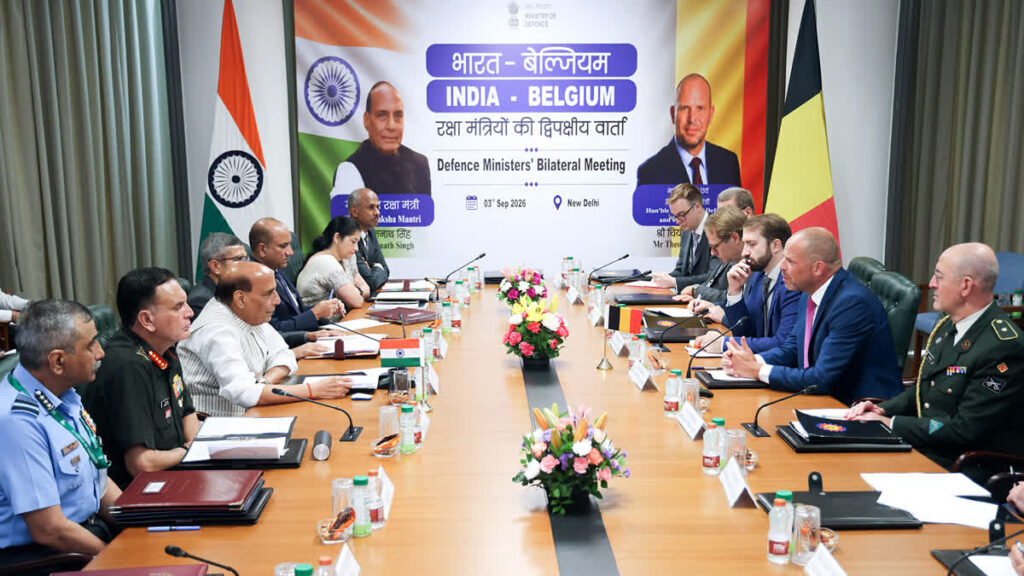

Defence Minister Rajnath Singh, holds a bilateral meeting with the Minister of Defence and Foreign Trade of Belgium, Theo Francken, in New Delhi on Thursday. (ANI)
New Delhi: As Europe reassesses its defence requirements amid the continuing war in Ukraine and India seeks stronger partnerships with European countries for defence technology, manufacturing and maritime security, Belgium is emerging as an important partner in building a more diversified and resilient India-Europe security architecture.
Ahead of the bilateral summit meeting between Prime Minister Narendra Modi and his Belgian counterpart Bart De Wever here on Thursday, Defence Minister Rajnath Singh held separate talks with Belgium’s Minister of Defence and Foreign Trade Theo Francken.
According to a statement issued by the Ministry of Defence, during the Singh-Francken interaction, the two sides reviewed the entire spectrum of defence and industrial cooperation.
“The two ministers agreed to expand bilateral ties through defence cooperation dialogue, high-level visits, training and capacity building,” the Ministry stated.
“Both leaders also discussed issues of regional peace and security and acknowledged the need for maritime security collaboration in the Indo-Pacific. They reiterated that the partnership between India and Belgium is based on shared values of mutual trust and respect.”
Addressing a joint media briefing with De Wever following the bilateral summit, Modi said that defence and security cooperation is a key pillar of the India-Belgium relationship.
“Today, we agreed to enhance military exchanges and training cooperation between the two countries,” he stated. “The agreements between our governments and defence industries will open up new opportunities for defence co-development and co-production. We will also further strengthen intelligence sharing and cooperation between our agencies in combating crime.”
Following the summit meeting, the two sides signed a Letter of Intent on Defence Cooperation and a Memorandum of Understanding between Belgian Security and Defence Industry (BDSI) and Society of Indian Defence Manufacturers (SIDM).
According to a joint statement issued by the two sides, the two Prime Ministers welcomed the signing of the Letter of Intent between the two Ministries of Defence, establishing a framework for regular exchanges, staff talks, education and training, research cooperation, and defence-industrial partnerships.
“They noted that the agreement builds upon the understanding reached between the Defence Ministers of India and Belgium in March 2025 to institutionalise and further strengthen bilateral defence cooperation,” the statement reads. “The two leaders welcomed the steadily deepening engagement between the two defence establishments on maritime security, emerging technologies, education and military exchanges, and cooperation in the Indo-Pacific.”
According to the statement, the two sides also agreed to post defence attaches in each other’s embassies.
India-Belgium relations have traditionally been driven by trade, investment, diamonds, technology, pharmaceuticals and people-to-people links. Belgium was among the first European countries to establish diplomatic relations with independent India in 1947, while the two countries share a broad commitment to democracy, pluralism, federalism, the rule of law and multilateralism.
Defence, however, was for a long time a relatively modest component of this relationship. That is changing rapidly.
The shift reflects two parallel developments. First, India is seeking to diversify and internationalise its defence-industrial partnerships, particularly in advanced technologies, while reducing excessive dependence on any single source of military equipment. Second, Belgium is seeking to strengthen its defence-industrial base and integrate its companies more deeply into European and international defence supply chains as Europe moves towards greater defence preparedness.
The two approaches are complementary.
India brings a large defence market, engineering capabilities, manufacturing capacity and an expanding indigenous defence ecosystem.
Belgium, despite its relatively small size, possesses specialised technological and industrial capabilities that can be plugged into larger international programmes and supply chains.
The Belgian defence establishment itself has been emphasising the importance of connecting domestic companies with international partners, particularly in areas such as drones, counter-drone systems, maritime security, advanced aerospace materials, autonomous systems, photonics, electronic warfare and secure communications.
The most important development underpinning this new phase is the India-EU Security and Defence Partnership signed in January 2026.
The agreement established a comprehensive framework for India-EU cooperation on security and defence, covering maritime security, cyber issues, artificial intelligence and emerging technologies, hybrid threats, protection of critical infrastructure, counterterrorism, space security, defence-industry cooperation, training and capacity-building.
The partnership was followed by the first India-EU Security and Defence Dialogue in New Delhi in March 2026.
The two sides exchanged assessments on the war in Ukraine, developments in West Asia and Iran, and the Indo-Pacific, while identifying maritime security, counterterrorism, cyber, non-proliferation, space and other areas for closer cooperation.
The Indo-Pacific is emerging as a major factor behind the growing defence relationship.
Belgium does not possess the naval weight of France or the Netherlands, but its position as a maritime trading nation gives it a direct interest in the security of global sea lanes. India, meanwhile, regards the Indian Ocean and wider Indo-Pacific as central to its security and economic interests.
The disruption of maritime trade routes, attacks on commercial shipping, piracy, terrorism, strategic competition and vulnerabilities in critical maritime infrastructure have demonstrated how quickly instability in one region can affect another.
The reference by Singh and Francken to maritime-security collaboration in the Indo-Pacific therefore has significance beyond a bilateral naval relationship. It potentially connects India’s maritime capabilities with European efforts to preserve freedom of navigation, secure sea lanes and protect critical maritime infrastructure.
For Belgium, closer engagement with India also provides a means of increasing its profile in the Indo-Pacific through European and bilateral frameworks without attempting to replicate the large military footprints of the major European powers.
The Ukraine conflict has also fundamentally altered European perceptions of defence production.
It has demonstrated the importance of ammunition stocks, industrial surge capacity, drones, counter-drone systems, electronic warfare, secure communications, logistics and resilient supply chains. According to a posting on Francken’s website, Belgium has highlighted the lesson that technological innovation and industrial capacity are indispensable to military power and deterrence.
According to Robinder Sachdev, strategic affairs expert and president of the New Delhi-based Imagindia think tank, the very fact that a decision has been taken to appoint defence attaches in each other’s embassies indicates that the two countries are establishing an institutional framework in defence cooperation.
“Belgium, though a small country, happens to have good technologies in defence,” Sachdev told ETV Bharat. “Belgium is a small market itself, right? So, Belgium companies need big markets outside wherever they are. India is a huge market.”
Sachdev also referred to Francken’s statement that a stronger Indian defence sector could contribute to greater stability across South Asia and the Indian Ocean, a key region for the Belgian economy.
“India wants to rapidly expand its military-industrial base,” Francken stated in a post on his X handle. “We have a direct security interest in that. India is a stabilising factor in South Asia and in the Indian Ocean, a vital artery for our economy. A stronger India can provide a useful counterweight to China’s dominance in Asia and thus ensure a more stable balance of power. India is also a useful factor in the search for peace in the war between Russia and Ukraine.”
Gulshan Sachdeva, Professor at the Centre for European Studies in the School of International Studies, Jawaharlal Nehru University, said that Belgium should not be seen as an exception.
“In the last few years, trade and economy were key areas of cooperation between India and the EU,” Sachdeva said. “But now, defence and security cooperation has emerged as a key pillar of the relationship. We already have strong defence partnerships with the UK, France and Germany.”
He said that given the uncertainty in ties with the US, a major transformation is taking place in the European defence space.
“The issue is how to link up India’s defence industrial complex with the European defence industries,” Sachdeva said. “The European countries want to build their own defence industries. It will help in our own defence private sector.”
He said that Belgium is known for its specialisation in small arms, ammunition and high-quality drones.
“We can link up with them on these,” Sachdeva added.