
The following is a translation of an article written by Réka Zsuzsánna Máthé, a research fellow at the Europe Strategy Institute of the University of Public Service, originally published on the Five Minutes Europe blog of Ludovika.hu.
From competition with China to energy dependence: the Commission President identifies six specific challenges, but it remains to be seen whether the 27 member states will be able to act in unison to address them.
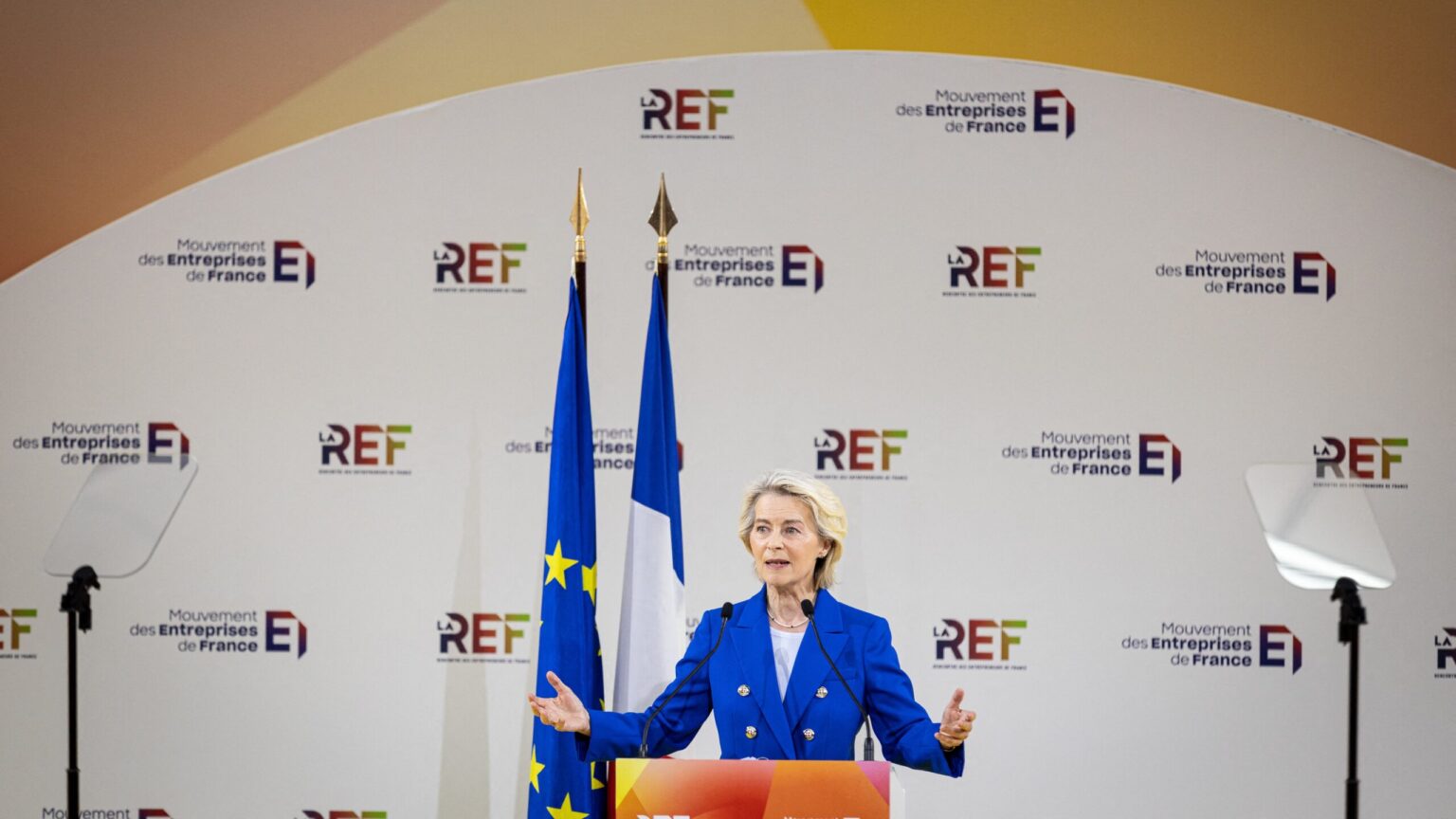
On 27 August in Paris, at the annual conference of the French business federation (La REF 2026), the President of the European Commission delivered a somewhat surprising speech. What was surprising was the candour with which the Commission President addressed a problem affecting the EU economy that has long been the subject of heated and widespread debate:
‘For a long time, the European economic model was based on a few obvious assumptions. Cheap imported energy. Open world trade. Growing access to the Chinese market. Strategic American protection. And Western technological progress. These have disappeared.’
The head of the institution that exercises the European Union’s exclusive right to initiate legislation did not elaborate on the causes of the problem. Instead, she identified six current challenges and proposed solutions for each.
She began by mentioning challenges surrounding competitive conditions and the regulatory burden. In her view, European companies are at a competitive disadvantage in global markets due to high energy prices, an overregulated internal market, and unfair foreign competitors. She acknowledged that ‘some estimates suggest that more than half of European industrial production is now facing competition from China’. She also addressed the issue of strategic dependencies—namely, that China controls key links in numerous important supply chains, and that the EU is more than 80 per cent dependent on China for critical raw materials and 90 per cent for certain rare earth metals.
As a solution, the Commission promises to reduce administrative burdens by 25 per cent (35 per cent for SMEs) by 2029 through the 12 omnibus packages. In addition, member states are urged not to adopt stricter regulations than those established by the EU. The response to China is based on the principle of ‘derisking without breaking ties’: more than 30 new trade defence investigations were launched last year (nearly three times the historical average), which are intended to protect 600,000 European jobs.
‘European companies are at a competitive disadvantage in global markets due to high energy prices’
According to the Commission president, the second challenge facing the European economy stems from obstacles related to the financing of the economy. The problem here is not a lack of capital or technology, but rather that a significant portion of the 10 trillion euros in accumulated household savings lies unused in bank accounts, while growing companies often end up seeking funding outside the EU.
The proposed solution is the ‘savings and investment union’, which, through proposals on securitization, banking and insurance investments, and the integration of market supervision, could unlock up to 470 billion euros in additional investment—ideally with the agreement of all 27 member states, but, if necessary, with a smaller coalition as well. In addition, the EU budget would also be expanded: more than 450 billion euros from the European Competitiveness Fund and the Horizon Europe programme, financing the entire chain from research to industrial production.
Third, von der Leyen highlighted the shortcomings of the single market, particularly in the areas of services, energy, telecommunications, and the digital economy. According to her speech, internal barriers have an impact equivalent to customs tariffs of up to 45 per cent (for goods) and 110 per cent (for services). The solution to this is the ‘28th Regime’ and the ‘EU Inc’ initiative. In addition, after 20 years, merger control rules are being reviewed, and the Industrial Acceleration Act is being launched (European preference, faster approvals, and leading markets in the steel, cement, aluminium, automotive, and battery industries). This also addresses the problem that two-thirds of SMEs cannot find suitable professionals; therefore, a labour mobility package will be introduced this fall to facilitate employment within the EU and the recognition of qualifications.
As the Commission President put it, energy is currently the main obstacle to competitiveness and independence: European prices are two to three times higher than in the United States or China, and more than half of energy consumption still comes from imported fossil fuels—the crisis in the Middle East has already caused 50 billion euros in additional costs.
The proposed approach involves accelerating electrification (as outlined in the Electrification Action Plan), long-term contracts to protect against volatility, grid development, and ensuring that electricity is not taxed more heavily than natural gas. With the modernization of the EU carbon market, free emission allowances would continue to be available after 2030 for companies investing in decarbonization, and starting in 2027, a new Investment Accelerator could mobilize 30 billion euros, while the Industrial Decarbonization Bank could mobilize more than 100 billion euros by 2030.
‘As the Commission President put it, energy is currently the main obstacle to competitiveness and independence’
The Commission President describes artificial intelligence as both an economic and technological battleground and the most powerful driver of productivity. The challenge is to ensure that Europe does not fall behind in computing capacity, semiconductors, cloud computing, data, and models, and that it does not become dependent on others in these areas. The strategy can be summed up in two words: ‘produce and apply’. To this end, 20 billion euros will be mobilized for AI gigafactories, while the Cloud and AI Development Act and the Chips Act 2.0 will strengthen the entire supply chain, from components to models. The second pillar is the actual deployment of AI across every corner of the economy—in factories, laboratories, hospitals, and energy grids.
Finally, regarding the challenges identified in the area of trade: in an increasingly fragmented world, openness can become a strategic advantage, provided that Europe does not depend on any single partner. As a solution, they cite the expansion and deepening of trade agreements, specifically CETA with Canada.
It is worth noting that the Commission President frames these six—in reality quite heterogeneous—areas, ranging from regulatory simplification to geopolitical dependencies, within a unified narrative. Responses to this challenge can be divided into two groups. The first group consists of measures whose implementation depends largely on decisions at the Commission or technical level (EU Inc, Omnibus simplification, targeted trade defence instruments) and which could therefore have a measurable impact within the foreseeable future, perhaps as early as 2026–2027.
The other group consists of initiatives where the real obstacle is the persistent conflict of interests among the 27 member states, such as the Savings and Investment Union, energy network development, and certain trade agreements. These programmes have met the same structural obstacles for years, so this tension is unlikely to simply resolve itself now.
It is also noteworthy that the speech refers to Mario Draghi’s competitiveness plan as well, which, among other things, proposed mobilizing an additional 750–800 billion euros annually to improve competitiveness, and, to raise these funds, she proposed the issuance of joint EU bonds (joint debt issuance). Furthermore—and this is at least as important, though the Commission President does not mention it in her speech—how do they intend to replace US protectionism and the global markets that are so vital to the EU’s open economy?
Related articles:
Click here to read the original article.
At a time when public debate is increasingly polarized and superficial, Hungarian Conservative remains committed to depth, intellectual honesty, and independent conservative thought.
Producing high-quality journalism requires resources. Your contribution helps us expand our coverage, reach new audiences, and keep our content accessible.

Please consider supporting our mission.