
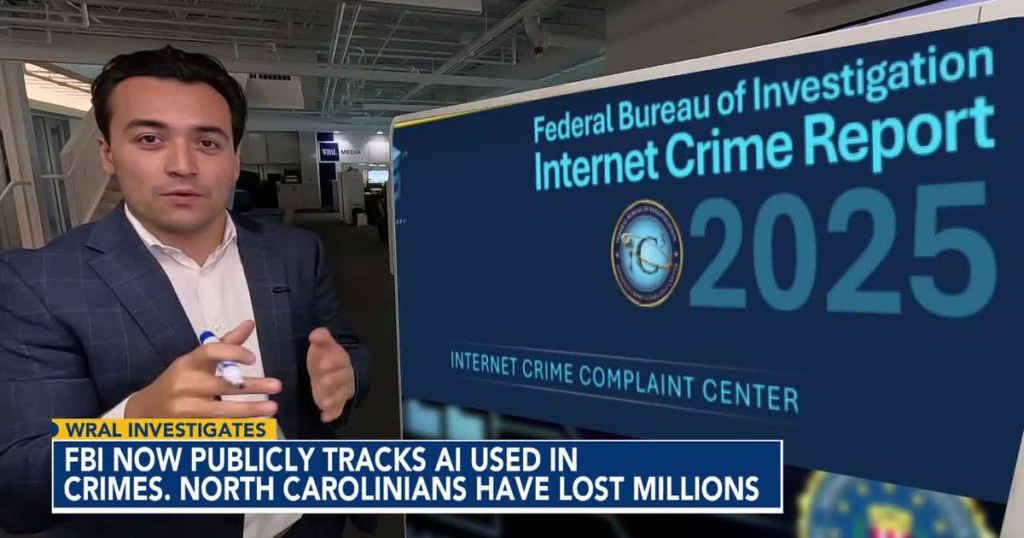
North Carolina reported millions of dollars in losses in 2025 at the hands of artificial intelligence, as the Federal Bureau of Investigation has now begun distinguishing cases that are “AI related” in its annual internet crimes reporting.
According to recent reporting via the Internet Crime Complaint Center, North Carolina recorded $15.6 million in losses tied to “AI related” internet crimes in 2025. It signals a notable addition in the agency’s methodology, as the FBI did not previously carve out artificial intelligence in its state level reporting as a “descriptor” for internet crimes.
The addition of AI to the agency’s annual crime reporting data signals the rising risk of rapidly evolving technology to consumers, says Special Agent in Charge of FBI Charlotte Reid Davis.
“If it’s being carved out, we’ve had significant growth in that arena,” Davis says. “It means there are more eyes on it, and more resources toward it. Carving that vector of fraud into its own threat line.”
The FBI now lists artificial intelligence as a “descriptor” among other internet crimes, meaning it’s a “medium or tool” used in the commission of other crimes registered in the FBI’s IC3 portal. It is the first year in which artificial intelligence has its own, separate sub-category within the public reporting. In the same vein, previous crime data shows “cryptocurrency” and “cryptocurrency wallets” were added to the annual state reports as descriptors in 2022.
“The longer it [AI] is around the cheaper it becomes to obtain it. Now it’s so widely available to the public,” Reid says. “Most are legitimate uses, but they [criminals] are figuring out how to leverage it to commit fraudulent acts,”
North Carolina recorded 152 complaints of an AI related crime in 2025.
Nationwide, the FBI received more than 22,000 AI related complaints, accounting for more than $890 million in victim losses.
Investigators with the North Carolina Attorney General’s Office independently brought up artificial intelligence as a rising threat in the quarterly Governor’s Crime Commission this September.
Ways in which criminals are using artificial intelligence, and how to defend against it
The most common crime type in which AI was identified in a complaint was for investment scams. In that complaint type alone, more than $600 million was lost in 2025.
The FBI warns how the new technology is now being integrated into other crime types that pre-date the advent of AI:
- Business Email Compromise: Chat generators can quickly create official-sounding emails mimicking a company’s CEO or other officials.
- Confidence and Romance Scams: Scammers are creating fake profiles and scripts produced by AI chat generators to make speech more believable.
- Employment: The use of voice spoofing, or potentially voice deepfakes, during online interviews of the potential applicants.
- Investment Scams: Subjects in investment scams often use AI to enhance their conversations with potential victims allowing the scammers to quickly generate thousands of conversations that appear different to each prospective victim
Many of the scams using AI involve some kind of manipulated form of media. Ways to identify manipulated media such as photos or videos include being aware of:
- visual distortions and warping in images and video, such as unsettling silences and distorted decibels
- video inconsistencies or unnatural movement
- poor video, lighting, and audio quality