
[Dear DemocracySOS readers, if you are enjoying DSOS content, here is a link to the $5 subscription page. Thanks for throwing a few tuppence into the hat!].
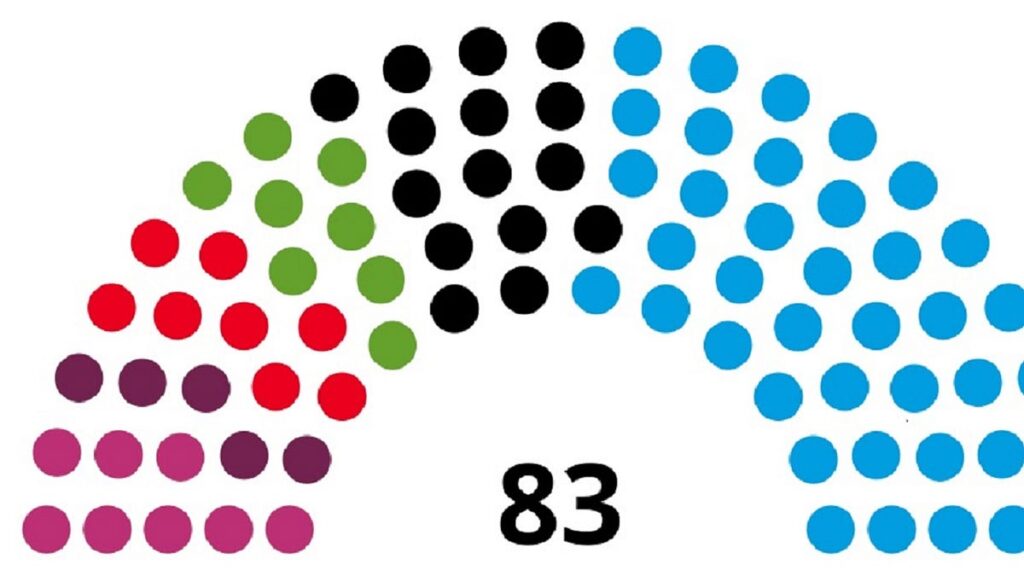
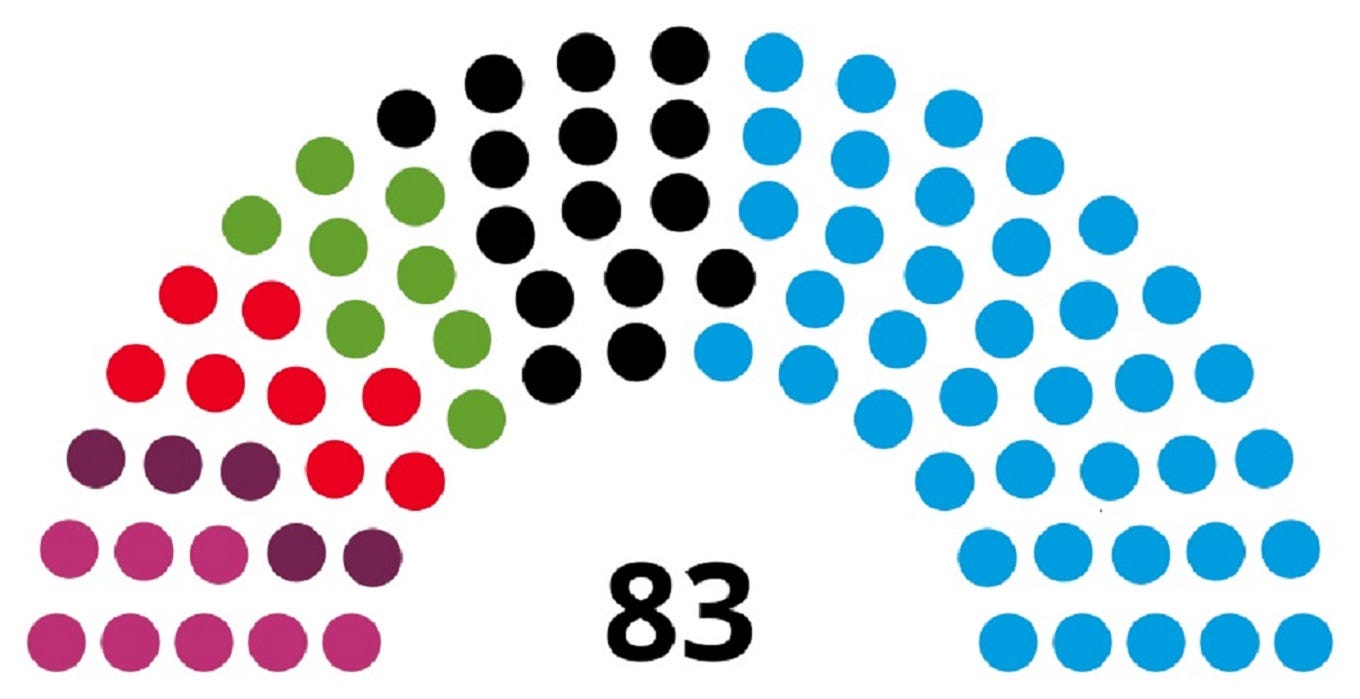
Amid many scare headlines about the “rise of the right,” the German state of Saxony-Anhalt held a Mixed Member proportional representation election in which the results have caused alarm. That’s because the far right party Alternative for Deutschland (AfD) was the leading vote-getter with 43.8%. In distant second was the previous coalition leader, the Christian Democrats, with 17.2%, a massive drop of nearly 20% since the last election in 2021. Other parties winning seats look feeble compared to the AfD, including the previously dominant Social Democrats at 9.3%, Greens at 8.9%, Die Linke (The Left) at 8.6%, and the Sahra Wagenknecht Alliance (BSW) with 5.3 percent.
Now the AfD is on the threshold of potentially forming the first government by a far right party in Germany’s post-World War II history. This is only for a state election, and a rather small and minor state from the former communist East Germany. But the AfD is currently leading in the polls in another state election coming on September 20, in a second former East German state with 35% support, followed by the Social Democrats at 30%. And, most incredibly, the AfD is also leading in the national polls with 28% national support to the Christian Democrats’ 21%, 14% for the Greens, 12% for the Social Democrats and 11% for Die Linke.
In Germany’s Mixed Member PR system, which is used not only in many state elections like Saxony-Anhalt but also but also for national elections, half of the parliamentary representatives are elected through US-style single-seat “winner take all” districts and the other half are elected from a Party List proportional representation (PLPR) method; the number of overall seats won by each party are proportional to the national or state popular votes. Another defining feature of Germany’s politics today is that, while the biggest party usually gets a chance to form a governing coalition and choose the prime minister, the other major parties have long refused to cooperate with the AfD to keep the far right out of government, in what is known as a “firewall.” With its nearly 44% of the popular vote, the AfD won 39 seats which is only three short of a governing majority. Ironically, the next four parties in the order of finish – the firewall parties — also have 39 seats together.
So the potential kingmaker party in Saxony-Anhalt’s strange bedfellows politics is the far-left BSW (Bündnis Sarah Wagenknecht), which formed as a splinter group amidst personality clashes within Die Linke, and has expressed interest in possibly joining as junior partner in a coalition with the AfD if certain conditions are met. The bratwurst-making is going to be messy as BSW tries to leverage its kingmaker position for more influence.
No question, the Party List PR half of the Mixed Member Proportional German system produced far more representative results than the “winner take all” single-seat districts half of the MMP system. In fact, if Germany had relied solely on the plurality elections within the districts, the AfD would have won 38 out of 41 seats – 93% of seats with only 44.3% of the district-based votes. That’s how distorted “plurality wins all” district elections can become. It is truly the worst electoral system in existence.
But that doesn’t mean the Party List PR system didn’t reveal its own defects in this election. Like plurality elections, PLPR can and often does result in a fair number of “wasted votes.” Wasted votes result from when voters cast votes for a losing political party or candidate. In plurality elections with multiple parties or candidates competing for seats, the number of wasted votes can be enormous. In a three candidate field in which the highest vote-getter wins with 40% of the votes, 60% of voters end up wasting their votes on losers.
Party List PR doesn’t waste nearly as many votes. But in the German system, any party that fails to win at least 5% of the vote does not win any parliamentary seats. So all voters who cast votes for smaller parties that fail to cross the 5% threshold end up wasting their votes on losers. And in a close contest, even a small number of wasted votes can make a significant difference in which party or coalition wins a governing majority. Indeed in Saxony-Anhalt, wasted votes may ultimately play a key role in the AfD achieving a coalition majority, instead of a multi-party coalition headed by the Christian Democrats.
Let’s look more closely at the results in Saxony-Anhalt. There were 16 political parties competing to win parliamentary seats, yet only six parties actually won seats. So voters for the other ten parties wasted their votes on losers. Those ten parties collectively earned just shy of 7% of the vote. Yet those losing parties were overwhelmingly from the center-left, with names like Human Environment Animal Protection Party, Garden Party, Volt, Animal Protection Alliance, Party of Progress, Grassroots Democratic Party of Germany and others. The losing party with the highest vote total was the Free Democratic Party, which won about 2.6 percent of the vote, and in previous federal and state elections has participated in center-left coalitions.
Here’s what so tantalizing about these results: If the German system allowed all these voters for smaller parties to indicate a backup choice, those center-left voters could have ranked another center-left party as their second choice, such as the Social Democrats, Green Party or Die Linke. There seems to be little doubt that the remaining center-left parties would have picked up nearly all of that 7 percent support. Those wasted votes, when added to the vote totals of remaining parties, might well have resulted in the four party coalition of the Christian Democrats, Social Democrats, Greens and Die Linke winning the three seats needed to form a governing coalition.
Without that, now the kingmaker role has been handed to Sahra Wagenknecht’s BSW and its renegade brand of politics which may well result in Germany’s first far right governing majority in 80 years.
This election in Saxony-Anhalt is yet another example of why, as DemocracySOS has pointed out before, Party List PR democracies would be wise to include ranked ballots in their own elections. The fact is, one-choice PLPR shares one of the worst defects of plurality elections – if a voter picks wrong with their single choice, her/his vote gets wasted. And the number of wasted votes can be significant, both in the share of the overall vote and in their impact on which party/parties win a governing majority.
For example, in Germany’s 2025 federal elections at the national level, there were a whopping 29 parties yet only six of them won seats. Approximately 20 percent of the List vote went to the twenty parties that fell short of the five percent victory threshold. Germany could have allowed those voters to rank more than one political party, and if their first choice didn’t get elected, their vote would have transferred to their next-ranked party. That would have reduced the number of wasted votes and greatly increased the proportionality of the elections. It would have helped 20% of German voters to feel like their vote counted for something, and wasn’t a waste of their time to bother to vote.
Wasted votes in Party List PR elections are fairly common. In Italy’s previous election, 11.2 percent of the List vote went to losing parties; in the Czech Republic 19.9 percent, Slovenia 24 percent, Slovakia 28.4 percent, Latvia 28 percent, New Zealand 7.8 percent. The losing parties in those multi-party elections, especially those that were ideologically similar, played the role of spoilers for each other, causing their voters to waste their votes.
The most alarming example of the damage caused by wasted votes in a Party List PR system is the last Israeli election in 2022. There were 40 political parties and 10 of them reached the 3.25% electoral threshold necessary to win seats. With votes for the other 30 parties wasted, it meant that 8.5 percent of voters’ votes did not count for a successful party. Two Arab-based political parties, Meretz and Balad, failed to win any seats for the first time since the early 1990s. Votes for those two parties totaled over six percent and were wasted, as were votes for other small Arab-based and progressive parties.
The beneficiary of these wasted votes was right-wing prime minister Benjamin Netanyahu and his Likud Party. Likud won support from only 23 percent of voters nationwide. However, because nearly 300,000 anti-Netanyahu votes were wasted on parties that did not reach the victory threshold and win representation, Netanyahu’s extreme right-wing, religious coalition was able to barely squeak out a majority of legislative seats. The parties in his coalition won only 48 percent of the popular vote, yet due to “wasted vote” distortions, was able to capture over a majority of seats. Given the corruption and criminality of Netanyahu personally, as well as the war crimes and genocide perpetrated by his government according to everyone from the International Criminal Court to the United Nations and Israeli historians, these “wasted vote” dynamics have had tragic consequences.
PLPR elections in other countries have resulted in much lower percentages of wasted votes, so there is not always a hard and fast rule. But when it happens in a close election, it can affect the outcome of which party finishes first and is allowed to try and form a coalition government. In Finland, the electoral system designers have found one work-around — most small parties join electoral alliances in which different parties can pool their votes. That tends to reduce wasted votes and ensures that most voters contribute to electing a candidate or party. In addition to – or instead of – allowing such alliances, Party List-based democracies could vastly improve their electoral systems by allowing voters to rank two or more parties and, if their first choice is eliminated, count those ballot for a voter’s second choice party.
As I have written previously, ranked ballots are one of the wonders of modern democracy science and should be incorporated into nearly every election situation, at federal, state and local levels, public and private. Party List PR elections, whether “closed” or “open,” which together constitute the mostly widely used electoral system in the world, would be vastly improved by allowing voters to rank their favorite choices. In the most recent Irish elections using proportional ranked choice voting (PRCV, also known as Single Transferable Vote), only one percent of votes were cast for losing parties and therefore wasted. The use of transferable ranked ballots is why PRCV can be used successfully in a district magnitude of only 3 to 5 seats (with a victory threshold of 16.7 to 25 percent), a design that is used in the Republic of Ireland and Australia. Few votes are thrown away in those countries.
In contrast, a Party List system with a low number of district seats would likely result in substantially large numbers of wasted votes and consequent instability in election outcomes and coalition-building. One method worth exploring is known as the Spare Vote, which combines ranked ballots in a List PR system.
Some people believe ranked ballots are complicated, or make the voting process more complicated, but there is no research based on actual, real-world elections, to support that view. In actual fact, there is a lot of bad anti-RCV research out there using questionable methodologies, as attorney Paul Haughey and I have exposed in our report, “Shaky Political Science.” The fact is, over 16 million voters in over 50 US cities, counties and states, as well as millions more in Australia, Ireland and other places going back many decades, have been using ranked ballots and have handled the task of ranking candidates as easily as they handle the task of ranking their favorite flavors of ice cream or movies. In exit polls from New York City’s RCV elections in 2025, 96% of voters said their ballot was simple to complete, including at least 94% of each racial group; 76% said they want to keep or expand RCV to other elections in New York City.
It would be excusable if there was nothing that could be done about the crucial number of wasted votes in PLPR systems. But there is. A hybrid based on the system pioneered by Australia and Ireland, and now increasingly used in the US, points the way toward a vastly improved Party List Proportional system.
Steven Hill @StevenHill1776 bsky.social @StevenHill1776