
The background: In January, the DOE announced the NLIC program and invited states via a request for information to express their interest in hosting a campus. By April, 26 states had submitted responses to that request.
At the end of July, the DOE signed memorandums of understanding with the first five finalists. Those MOUs, as is the case with the new West Virginia MOU, do not represent firm commitments from either party.
The DOE has yet to commit to the final number of state partnerships it plans to enact through the NLIC program. However, in an August webinar with the American Nuclear Society, Marla Morales, the acting deputy assistant secretary for spent fuel and high-level waste disposition at the DOE’s Office of Nuclear Energy, said that the DOE would likely downselect further from its five selected finalists.
So, with the industry awaiting a further winnowing of the list, West Virginia’s late entry as a finalist comes as an unexpected twist in the story.
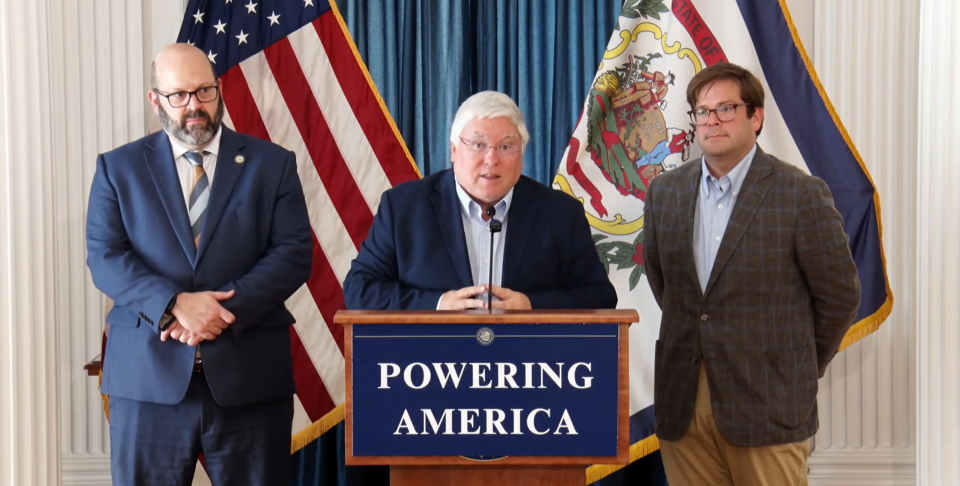
What we know: At the time of this writing, West Virginia’s RFI response is not available to the public. However, on September 8, Morrissey hosted a press conference announcing the news and providing a few general details. There, he explained that when the state was not selected as a finalist by the DOE, he and his team started “working the phones” and ramping up their engagement. “Thanks to that work, and the support of many people, I am proud to announce that today, West Virginia has finalized an [MOU] with the [DOE] to become the sixth state to participate in this initiative.”
Morrissey reiterated that this MOU does not represent any firm decisions from either party but also emphasized that the move represents another step in the right direction for West Virginia, referring to the state legislature’s 2022 decision to lift its longstanding nuclear moratorium.
While he did not dive into any technical specifics, potential site selections, or planned NLIC-related projects, Morrisey concluded his remarks with a call to action. “I have a message for the nuclear industry: Come to West Virginia.” He called on advanced reactor companies, component manufacturers, and fuel developers to reach out to him. “If you’re looking for a state with abundant energy, many skilled workers, natural resources, and an administration that is a red-tape cutting machine that is second to none, we’re here for you.”
Thoughts from NECX: At the 2026 Nuclear Energy Conference and Expo, the joint conference of ANS and the Nuclear Energy Institute, Morales talked at length in a plenary session titled “Nuclear Lifecycle Innovation Campuses: Used Fuel Storage & Recycling.”
There, she said that the NLIC program tackles a key question: “How do we address both the need for new energy, but also the recognition that we have to address the back end? That’s always been the stumbling point of any conversation with nuclear.”
The program, she said, “flips the script,” reframing used nuclear fuel as an asset rather than a liability. While the states engaging with the program are exploring a wide variety of potential fuel-related projects, disposition is ultimately the key focus. As she put it, “You can pick and choose the appetizers, whether you want fuel fabrication, reprocessing, conversion, or deconversion, but your main course and your dessert is always going to be the waste disposal,” whether it comes in the form of a mined repository or boreholes.
In other words, she said, “One of the things we knew from the beginning of this was that we had to be open and transparent with what we were talking about. We had to make sure that everyone understood: You can want all the fancy reactors you want; you’re going to have waste at the end of this. It has to go somewhere. So, by the fact that we started the conversation with waste, it really helped frame our narrative to begin with.”
That public transparency, for Morales, is a key element of the program. “Right now we’re not solving a technical, scientific, or engineering problem. It’s a social license problem. So as long as we can get to a place where communities feel comfortable with the conversation, communities feel comfortable with what they’re doing in all the proposals, there’s a real path to success that hasn’t necessarily happened before.”
Go deeper: Nuclear News has already compiled a two-part series diving into the RFI responses from the first five finalists. The first part tackles Oklahoma and Louisiana; the second part looks at Utah, Tennessee, and Idaho.