
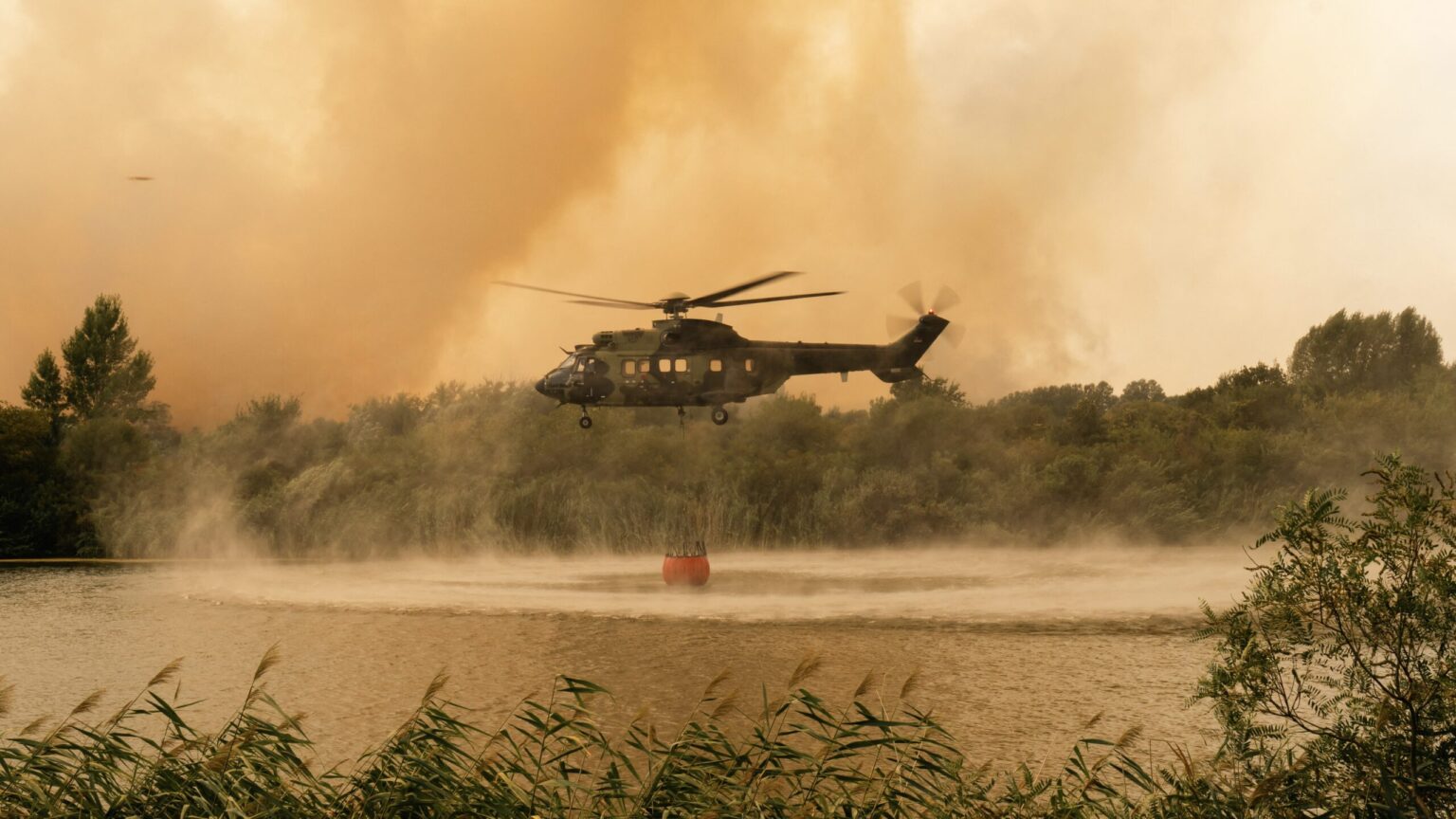
Serbia is facing a severe environmental crisis as uncontrolled wildfires, fueled by the summer heatwave, ravage the country. The problem is particularly serious because wildfires are also severely damaging one of Europe’s most distinctive geological landscapes. The ecological emergency is not limited to Serbia itself and points to a new, increasingly widespread and dangerous trend for the entire Western Balkans.
A Worrying Trend
Globally, the risk of forest fires has increased drastically in recent decades. This trend is evident in Southern Europe and the Mediterranean; however, continental countries such as Serbia have not been spared and are suffering significant economic and ecological losses due to forest fires.
The rising frequency and severity of wildfires across Europe are fundamentally driven by climate change. Projected temperature increases of 4–6°C by the end of the century, combined with prolonged summer droughts in southern Europe, are expected to transform dominant oak and beech forests into more flammable evergreen Mediterranean vegetation, further increasing wildfire risk across the region.
Serbia is not exempt from these trends. Forest fires in the country follow a cyclical pattern: in exceptionally dry years, the concentration of fires is high, while during relatively rainy years, their number drops sharply. For example, 1,354 fires were recorded in 2012 alone, with the scorched forest area exceeding 11,000 hectares, while in 2014, only 185 fires were registered nationwide.
As extremely dry years were followed by more humid ones, the vegetation had time to recover. However, a turning point came in 2024, which was Serbia’s worst wildfire year since monitoring began. Driven by unprecedented, prolonged heatwaves, 38,954 hectares of forest and vegetation burned across the country, and the next year, 2025, also broke the established pattern: almost 28,000 hectares of vegetation were lost in an estimated 191 fires. The last few years also showed a new trend with fire seasons extending into early spring and autumn. These dynamics set the stage for the problems in 2026.
2026 and Europe’s Sahara
This year Serbia experienced an unusually warm spring, which dried out the vegetation and significantly expanded the traditional wildfire risk window. According to Landscape Fire Management in the Western Balkans, Serbia recorded approximately 2,787 hectares of burned area between January and June this year. As a result, the current heatwave struck an already fire-affected and desiccated landscape as it spread across the Western Balkans in August.
In Belgrade and surrounding areas, average daily maximum temperatures soared to 35–40°C, nearly eight degrees above the long-term average. Combined with the prolonged drought, this extreme weather transformed the Serbian landscape into a disaster zone, with authorities reporting dozens of open-area fires erupting simultaneously across the country.
‘Combined with the prolonged drought, this extreme weather transformed the Serbian landscape into a disaster zone’
The major fires broke out on Mount Stolovi near Kraljevo in the country’s southwest, while the most serious blaze affected a protected nature reserve. Located 65 kilometres northeast of the capital in the Vojvodina region, the 350-square-kilometre Deliblato Sands (Deliblatska peščara) is one of Serbia’s most distinctive landscapes and the largest continental sand area in Europe. Often called Europe’s Sahara because of its vast sand dunes and dense pine forests, the terrain was shaped by wind following the retreat of the Pannonian Sea. Elevations range roughly between 70 and 200 meters above sea level. Its woodlands and unique environment have earned it designation as a special nature reserve that provides habitat for numerous endangered animal and plant species.
The fires started on 21 July and were repeatedly contained but reignited because of high temperatures, shifting wind patterns, and sandy terrain. As the sand severely limited the mobility of ground crews, the fires spread towards local settlements in the municipality of Bela Crkva. Trujino naselje, Kajtasovo, Grebanc, and Bela Crkva itself had to be evacuated. Serbian officials estimate that more than 1,500 hectares burned in total.
International Help
The fires swiftly exceeded local response capacities, so the country turned to the international community for help. The European Union started supporting local authorities with satellite mapping and analysis through the Copernicus network on 8 August.
Despite not being an EU Member State—only a candidate—Serbia activated the EU Civil Protection Mechanism on 21 August, unlocking access to European emergency assets. The European Commission mobilized four heavy-duty Black Hawk firefighting helicopters from the strategic rescEU reserve stationed in Czechia, Slovakia, and Romania. The aerial intervention proved highly useful: the Romanian helicopter released 2.6 tonnes of water per pass, while the Czech and Slovak aircraft each delivered 3.5 tonnes over the burning sand dunes. Notably, this operation also marked the first deployment of Romania’s newly delivered permanent rescEU helicopter. The Commission officially extended the deployment of the contingent until 5 September.
Germany dispatched a specialized firefighting and rescue convoy comprising 55 personnel and 24 tactical vehicles, while Romania provided support in the eastern sector with 69 ground personnel and 15 emergency vehicles. Hungary contributed a further 12 firefighters and four vehicles to the firefighting effort. Alongside European assistance, Belgrade accepted strategic air assets from the Russian Federation, which dispatched a large-capacity Ilyushin Il-76P water-bombing aircraft. The Il-76P dropped 168 tonnes of water in a single weekend to help with the rescue operations.
A Regional Warning
The environmental crisis unfolding in Serbia is part of a wider regional wildfire emergency. Neighbouring countries, also hit by severe drought and weeks of temperatures near 40°C, face similar challenges.
In Bosnia and Herzegovina, near Trebinje, a massive wildfire advanced rapidly toward the Croatian border, forcing authorities to temporarily shut down the border route linking Bosnia and Herzegovina with the Dubrovnik area to protect local villages. Similarly, North Macedonia experienced a prolonged fire season, and severe fires near Strumica forced the government to rely heavily on international aerial assistance. Montenegro and Albania also faced similar challenges as a result of their dry conditions and strong winds. Notably, Bosnia and Herzegovina was the only country that did not have to activate the EU Civil Protection Mechanism.
The forest fires in Serbia and other parts of the region portend a perilous future. The prolonged heatwaves are no longer exceptional; they are here to stay, and the Western Balkans and Europe as a whole must adapt to this new reality.
Related articles:
At a time when public debate is increasingly polarized and superficial, Hungarian Conservative remains committed to depth, intellectual honesty, and independent conservative thought.
Producing high-quality journalism requires resources. Your contribution helps us expand our coverage, reach new audiences, and keep our content accessible.

Please consider supporting our mission.