
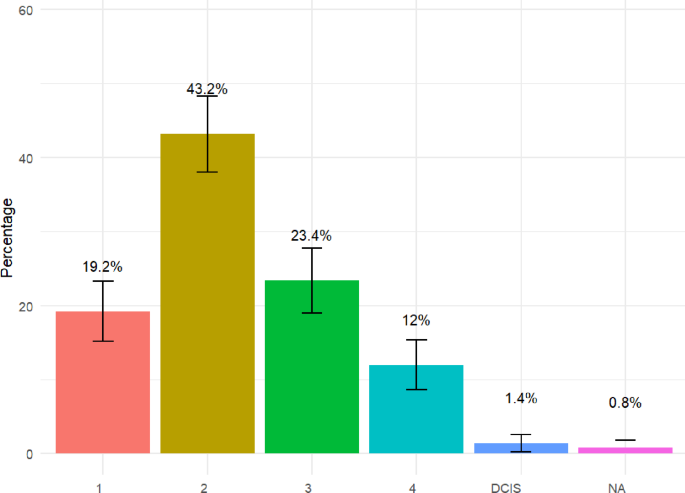
This study aimed to analyse diagnostic and treatment intervals, adherence, and survival in women with breast cancer treated at CCUoS. One of the most important findings was the evidence that there is room for improvement in performance on healthcare system outcomes involving patients’ choices—particularly the patient-related interval to diagnosis, compliance to treatment, and choice of surgery. Variability in diagnostic and treatment decisions, including delays or preferences for specific procedures, further underscores the influence of patient autonomy and perception on treatment timelines. This suggests a need to incorporate patient-centred support into the healthcare system, particularly within secondary and tertiary care, to facilitate informed and timely decision-making.
In our cohort, patients waited 38.1 days from the onset of symptoms to their first consultation with a GP, representing the patient interval in the Aarhus Model of Pathways to Treatment. This interval suggests relatively good symptom awareness and responsiveness, aligning with findings from high-income European countries, where the median ranges around 32 days.11.
Recent evidence from England indicates that median diagnostic intervals in breast cancer are approximately 24 days, with additional system-related intervals, including referral and secondary care delays, typically ranging from 11 to 15 days. Delays were found to be longer among patients presenting with less specific symptoms and in settings with limited access to timely diagnostic services. These findings highlight the combined impact of patient- and system-level factors on overall diagnostic delay and emphasize the importance of early symptom recognition and efficient referral pathways.12.
Comparable findings were reported in a Serbian multicentre study, where the median patient interval was 4.5 weeks, the system interval 9.2 weeks, and the total diagnostic interval 12.9 weeks, with one in five women waiting longer than 12 weeks before seeking care.13 By contrast, countries with well-organized screening and diagnostic systems, such as Slovenia, achieve much shorter intervals—with screening results communicated within 2–7 working days and follow-up diagnostics completed within 4–10 working days.15 These comparisons suggest that while some delay in initial help-seeking still exists, the observed patient interval in our population reflects a performance level comparable to European standards.
Several areas for improvement are noted regarding patients’ education. Notably, the proportion of breast-conserving surgery in the FBiH for early-stage (stage 1–2) cancers is relatively low compared to other countries. Surgical options are available and treatment decisions are guided by tumour characteristics; however, the observed pattern cannot be fully explained by the available data. While patient preferences may contribute, this was not directly assessed in the present study.
A range of evidence-based interventions (including “edutainment”, patient navigators, tailored educational materials, and the teach-back method) have been shown to improve breast cancer care outcomes by enhancing patient health literacy and supporting treatment adherence and screening participation.15,16,17 Better integration of primary and secondary healthcare (e.g. active involvement of GPs in managing breast cancer patients’ post-diagnosis) is also essential to improve patient choices and ultimately, clinical outcomes.
Despite limited healthcare capacity, CCUoS achieved an effective diagnostic pathway, with most breast cancer cases in Sarajevo Canton being diagnosed at early stages (1 and 2) during 2019–2023. Similar patterns have been observed in countries where screening has been introduced only recently or is still largely opportunistic, such as Moldova and Armenia.19,20 Still, the proportion of early-stage diagnoses is lower than in countries with long-standing national breast cancer screening programs, such as Belarus and Ukraine.21,21.
The COVID-19 pandemic temporarily disrupted screening services across Europe, but studies report no lasting increase in late-stage presentations.23 A recent global analysis also found a gradual decline in the proportion of metastatic (stage 4) cases and an increase in early-stage diagnoses over the past two decades, particularly in high-resource settings.24 Consistent with these observations, in our cohort the proportion of early-stage cancers detected in 2022 and 2023 was higher compared to the pre-2020 period, suggesting that post-pandemic organizational adaptations and heightened patient vigilance may have contributed to earlier diagnosis.
In Sarajevo Canton, the majority of breast cancer patients (78.1%) were diagnosed through self-referral due to symptoms, while only 7% and 9% were diagnosed through screening mammography and ultrasound, respectively—patterns similar to those in Serbia and other countries with limited screening coverage. Nevertheless, the diagnostic system performed efficiently: the mean system interval (symptom presentation to diagnosis) was 38.6 days, compared with a 12-country average of 77.7 days.12 The total diagnostic interval in our cohort (70.7 days) was also shorter than the international average (100.8 days), reflecting effective triage, referral, and coordination.
These strengths are mirrored in favourable survival outcomes. The estimated five-year PFS was 77.3% and OS 83.7%. This exceeds rates reported in several Central and Eastern European countries,—e.g. 74.2% five-year OS in Hungary25 and 74–78% in Estonia, Romania, Lithuania, and Bulgaria26—and suggests that timely diagnosis and coordinated care can yield strong outcomes even in resource-constrained systems.
To sustain progress, a national cancer control plan is essential to guide system development and establish an organised, population-based screening programme. Countries with organised or well-established opportunistic breast cancer screening programmes (i.e. with high screening coverage) demonstrate a larger share of early-stage diagnoses.10.
Currently, estimates for breast cancer screening coverage in the Federation of Bosnia and Herzegovina remain extremely low (0.8%)10. In our analysis, 7.1% of women were diagnosed through screening, reflecting limited uptake of screening services.
Similar challenges on low screening coverage rate are seen across Eastern Europe – Romania (9%),26,27 Hungary (30%),27,28 and Latvia (31–47%)28,29,3029 with frequent unfavourable combinations of low screening coverage and high inequality reported in Bulgaria, Romania, and a number of Baltic and Mediterranean countries30,31—indicating that even established programmes struggle with participation, particularly in deprived and rural areas.
Strengths and limitations
Several limitations should be acknowledged. First, the retrospective design may have introduced biases related to incomplete documentation and potential inaccuracies in the recorded data.
Second, as the CCUoS is a single tertiary referral centre and a leading institution in Sarajevo Canton, the study population is largely drawn from this region and may not be fully representative of the broader population of Bosnia and Herzegovina. Although the centre receives referrals from other areas, regional differences in access to diagnostic and treatment services may limit the generalisability of the findings. Therefore, the results should be interpreted with caution, particularly when making comparisons with other healthcare systems.
Finally, the survival analysis was not adjusted for competing mortality risks by age, and therefore should not be directly compared with age-standardised or net survival estimates from other countries.