
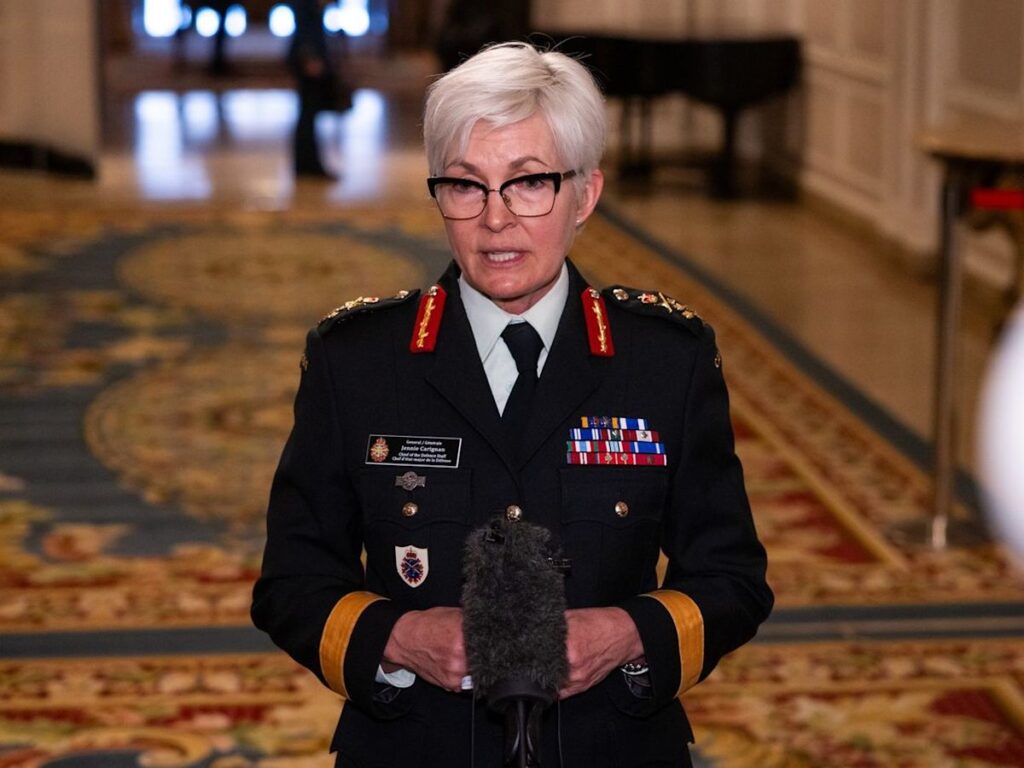
Canada’s top soldier will find out on the weekend whether she has been selected to lead NATO’s military committee at a time when the defence alliance faces some of the most difficult challenges in its history.
NATO’s chiefs of defence will meet Sept. 18 in Denmark as the military committee discusses ways to further strengthen the alliance, deal with new defence technologies and boost support for Ukraine.
But it will be a secret vote among the military leaders on Sept. 19 which will determine if Canada’s Chief of the Defence Staff Gen. Jennie Carignan will be named as chair of the military committee (CMC) — NATO’s top military role.
There are two candidates for the job of the CMC. German Defence Minister Boris Pistorius announced in February he was submitting the name of his country’s defence chief, Gen. Carsten Breuer, for the position.
In May, Defence Minister David McGuinty announced he was putting Carignan’s name forward. The last time a Canadian held the position was between 2005-2008 when Gen. Ray Henault served as CMC.
Both Carignan and Breuer are highly respected officers and the vote is expected to be close, said retired Canadian Forces Col. Brett Boudreau, who served on Henault’s staff when he was CMC.
The chair of the military committee is the senior spokesperson for the 32-nation NATO and the main advisor to its secretary general.
But Boudreau noted that while the job is important, it is largely focused on building consensus among alliance members when it comes to military advice and it comes with very little authority. “It is a position of prestige, not power,” he said.
SACEUR or Supreme Allied Commander Europe, a role traditionally held by a U.S. officer, is seen as the key position responsible for all NATO operations.
Each NATO member — from the U.S. to North Macedonia — gets one vote for the CMC election.
Boudreau noted the decision will be linked to not only how Carignan and Breuer are viewed as candidates but also how Germany and Canada are seen as NATO partners. Lithuania, for instance, might be inclined to vote for the German candidate as Germany has a significant military presence in Lithuania to protect against Russian aggression. Latvia might decide to vote for Carignan, since the Canadian Forces has a large commitment to that country.
Considering the ongoing tensions between Canada and the U.S., it is unlikely the Americans will cast their support for Carignan, Boudreau said.
The CMC-elect is expected to take office sometime in the summer of 2027. The position is a three-year term.
If Carignan wins the election, then the Canadian government will begin the process of finding a new chief of the defence staff. In Gen. Henault’s case, he was elected in September 2004 as CMC. In February 2005, Gen. Rick Hillier was named as defence chief to replace him.
If Carignan were to lose the vote, Boudreau expects she would retire and leave the Canadian Forces by mid-2027.
The winning candidate will replace Admiral Giuseppe Cavo Dragone of Italy.
McGuinty noted that Canada’s nomination reflects the country’s enduring commitment to NATO and to strengthening collective defence and transatlantic security.
Carignan has served as Canada’s top general since July, 2024.
“General Carignan is an exceptional military leader whose experience, judgement, and deep commitment to Allied collaboration make her an outstanding candidate to serve as the next Chair of the NATO Military Committee,” McGuinty said in a statement. “Her candidacy reflects Canada’s continued leadership within NATO and our determination to contribute meaningfully to Euro-Atlantic security in an increasingly complex world.”
Henault told The Canadian Press in May that the CMC job is demanding. “The kind of talent that Jennie Carignan has shown as a chief of defence is ideally suited to a job like this one,” he said.
The CMC election comes as NATO tries to deal the ongoing Russia-Ukraine conflict and rapid changes in warfare, including the widespread use of drones. It also comes at a time when U.S. President Donald Trump has continually threatened to reduce U.S. support for the alliance.
David Pugliese is an award-winning journalist covering Canadian Forces and military issues in Canada. To support his work, including exclusive content for subscribers only, sign up here: ottawacitizen.com/subscribe
Related