

CLAIRE GIANGRAVÉ, of Religion News Service, reports that record numbers of young people are seeking baptism in France. As Pope Leo arrives to greet 80,000 of them later this month, the country’s diminished Catholic Church is faced with the challenge of turning the burst of enthusiasm into a lasting renewal…
Audrey Bourgès said she had to remind herself to breathe as she walked toward the priest in the Notre-Dame Cathedral in Paris to be baptised during the Easter Vigil last year.
After a nearly three-hour ceremony, tears filled her eyes as she embraced her mother, a practicing Catholic, and her father, an atheist. Her parents had allowed their children to choose their own religious beliefs as adults. Bourgès chose Catholicism.
“It was the best day of my life,” the 26-year-old said.
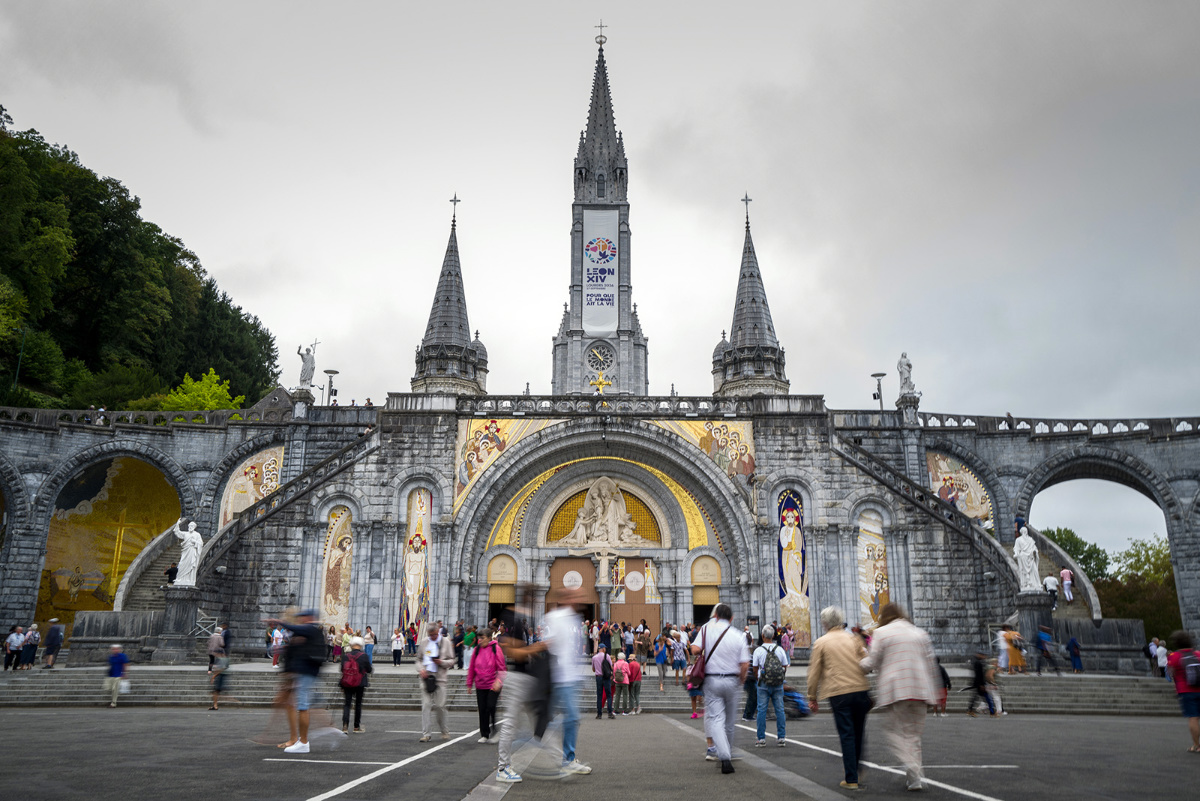
A banner on the Notre-Dame-du-Rosaire basilica announces the upcoming visit of Pope Leo XIV in Lourdes, south-western France, on Tuesday 8th September, 2026, as part of his official visit to France from 26th to 28th September. PICTURE: AP Photo/Fred Scheiber
Her journey began after a “bad breakup” left her crying on a Paris street, she said. A stranger suggested she seek help at the nearby church of Sainte-Anne de la Butte-aux-Cailles, where she met a 90-year-old nun who listened to her grief.

Audrey Bourgès is baptised during the Easter Vigil, on 19th April, 2025, at the cathedral of Notre Dame in Paris. PICTURE: Courtesy of Audrey Bourgè
“I felt like, this is my place. These are the answers to my questions.”
– Audrey Bourgès
Between 2022 and 2024, Bourgès would visit the sister every Wednesday to discuss life and faith. Eventually, she started attending Mass. “I felt like, this is my place,” she said. “These are the answers to my questions.”
Bourgès entered the catechumenate, or the instruction period ahead of baptism into the Catholic Church, in 2024. She became the first person to be baptised at Notre-Dame after its reconstruction following the blaze that nearly destroyed the gothic cathedral in 2019.
The restored cathedral offers a powerful setting for another apparent rebirth: After decades of Catholicism receding in France, Bourgès is among record numbers of adolescents and adults now seeking baptism into the church, prompting talk of a Catholic revival among the country’s young people.
That shift in one of Europe’s most secularised countries will be on display for the world to see as 80,000 young people are expected to greet Pope Leo XIV at the sold-out Stade de France on 25th September during his scheduled France trip.
At the same time, the record baptisms come among a broader decline of Catholic faithful and a shortage of priests and catechists, leaving the French church to figure out if it can turn a moment of youthful enthusiasm into lasting renewal.
France registered over 21,380 adolescent and adult baptisms in 2026, including 8,100 between the ages of 11 and 17, according to Conference of Bishops of France data. Compared to the previous year, baptisms have grown 28 per cent among adults and 10 per cent among youth. Adult baptisms have more than tripled over the last decade, the report shows.
But talk of a Catholic revival in France – and in other Western countries – might be an overstatement. While the country recorded roughly 400,000 adult and child baptisms in 2000, that number halved by 2022, signalling a faith that struggled to be passed down to younger generations. Official data shows that only 30 per cent of children are baptised in France today – a decline that cannot be offset by the surge in adult baptisms.
“It is far from certain that the overall number of Catholics is actually increasing,” said Charles Mercier, a historian and sociologist of Catholicism at the École Pratique des Hautes Études in Paris.
At the same time, he said, France is experiencing something of a “Catholic moment”, marked by greater visibility in popular culture, media and social networks. “In a sense, being Catholic has almost become culturally ‘trendy,’” he said.

Guests watch clergy members leaving the inaugural Mass at Notre Dame Cathedral, hosting its first Mass since the catastrophic fire in 2019, on Sunday, 8th December, 2024 in Paris. PICTURE: AP Photo/Alessandra Tarantino, Pool
According to the French bishops’ conference data, a majority of the catechumens are from working class backgrounds and increasingly from urban areas. Among adult catechumens, 62 per cent are female.
Mercier said the new Catholics tend to be more liturgically and politically conservative, as many seek “structure and clear frameworks in a society they perceive as increasingly fluid.” But, he added that his research suggests that these political leanings may change in the future.
“What is clear, however, is that this minority of young Catholics tends to be more committed, more fervent and more visible than the average Catholic from older generations, who grew up at a time when Catholicism was still culturally dominant,” Mercier said.
Previous barriers to Catholic affiliation, including cultural taboos and the clerical abuse crisis, appear less divisive for younger generations, Mercier said. Growing up alongside a rising population of Muslims, for whom belief is assumed, can also encourage young people from Christian backgrounds to reconsider their religious identity. “It can raise questions,” he said, “and help normalize religious faith.”
The French Catholic Church attempted to capture why so many young people were gravitating toward the faith by conducting a national survey of catechumens in 60 French dioceses this year. It found 40 per cent connected their entry to Catholicism and baptism to a crisis in their life, like illness or loss. One-third said they had a powerful spiritual experience, while 11 per cent said they were prompted by religious social media influencers.
“Religion is less and less understood as an inheritance that one simply receives and increasingly as a choice that one makes for oneself, often in adulthood,” Mercier said.
We rely on our readers to fund Sight’s work – become a financial supporter today!
Bishop Matthieu Rougé has witnessed record numbers of catechumens in his Diocese of Nanterre this year. The diocese recorded 300 adolescent baptisms and 340 adult baptisms, double the amount recorded in the previous year.
In letters Rougé received that he described as “deeply moving,” catechumens told him they were drawn to Catholicism by reading the Gospel, encountering Christians or entering a church. Many seek meaning, peace and community amid rapid social change, he said, while some are looking for ways to “express their identity in a multicultural society.” Social media plays a role, but young people ultimately desire encounters in the real world, he added.
The increase “emerged somewhat unexpectedly,” Rougé said. He also cautioned that the sudden influx of young Catholics “remains limited and fragile, and should not give rise to any pride or misplaced triumphalism.” He noted data collected by the French bishops suggesting that many believers today struggle to continue in their Catholic faith.
For this reason, the bishops of the eight dioceses surrounding Paris, together with the French military ordinariate, have convened a yearlong Île-de-France Ecclesial Provincial Assembly to consider how the church should welcome, form and retain the growing number of catechumens and newly baptised Catholics.
Launched in May and scheduled to end in the summer of 2027, Rougé said the assembly was inspired by an October, 2024, speech made by then-Cardinal Robert Prevost during a synodal gathering in Rome, where he urged local bishops to initiate dialogue among clergy and lay people to address the challenges and opportunities emerging in their dioceses.

Notre Dame and the River Seine in Paris, France. PICTURE: Sandeep SD/Unsplash
The assembly’s working document, drawn from questionnaires representing roughly 46,000 people, identified shortages of trained mentors, inconsistent formation and isolation some converts experience after baptism among the principal challenges. It also addressed “baptism blues,” referring to the feeling some have after baptism as they approach ordinary church life, where parishes are sometimes non-welcoming to outsiders.
Among its suggestions, the report considers whether structured catechumen groups should remain active one year after baptism or dissolve to promote integration within parish life.
“The catechumenate and the integration of new believers should be seen as a mission for the entire parish, not just for a small group of ‘specialists,’” said Rougé, who is also chair of the French Bishops’ Conference Council for Catholic Education.
The bishop said he has “high expectations” for Leo’s visit, especially for young people. “To all of them struggling with a society that is often fraught with tension and at times marked by violence, Leo XIV will issue a salutary appeal, as he has done since the day of his election, to cultivate the peace that comes from Christ – ‘the unarmed and disarming peace’ that gives life,” Rougé said.
Mercier added that large religious gatherings such as the Pope’s visit “can generate tremendous religious fervour”, including conversions, vocations or dedicating oneself to humanitarian work. But while such events may lead to more religious practice in the short term, they may lose momentum without structures that help sustain it, he said.
He also voiced his hope “that Pope Leo XIV’s message will encourage young Catholics to take a more critical view of attempts to appropriate Christianity for identity-based political purposes, which are currently very powerful in France as elsewhere.”
Pope Leo will meet with the assembly, catechumens and the newly baptised on 26th September at the Institut Catholique de Paris, where he is expected to deliver brief remarks and listen to the testimony of those who will be baptised next Easter.
A year after her baptism, Bourgès will attend the meeting with the Pope, whom she credits with promoting a message of unity and peace. In the Gospel, she said, young people discover “joy” and “peace” – and a community in which to live out those values.
“Who doesn’t want to live like that?” she said.