

Often a race decided by its hilly terrain, the classics specialists were those that often thrived in it. Greg van Avermaet was amongst them, whilst time trialists and climbers also enjoyed their run at success. In the 2020’s the race has been won by Diego Ulissi, João Almeida, Mattias Skjelmose, Marc Hirschi, Antonio Tiberi and most recently Brandon McNulty.
Preview Tour de Luxembourg 2026 overal classification
The overall classification is likely to be decided on the race’s time trial, whilst the hilly stages will thin out the list of those fighting for victory. The race is not stacked as it has previously been, and so Mathieu van der Poel is likely to be the main favourite because there are no top climbers who should be able to distance him on the longer climbs, or teams that might outnumber him.
On the longer side of the ascents, riders such as Igor Arrieta and Davide Piganzoli might be threats, whilst UAE and Visma are experienced at racing to win – although both teams are quite young, and under-23 riders are involved. Aurélien Paret-Peintre might also be a threat in this field.
Time trial wise, Soren Kragh Andersen is likely the one rider who could be a major target for van der Poel to distance; whilst mostly it is the teams’ depth and tactical play that can pressure him. Andrea Bagioli, Andreas Raccagni, Mikkel Honoré, Neilson Powless and Adria Pericas are all contenders for the GC win.
Prediction Tour de Luxembourg 2026 overall classification:
*** Mathieu van der Poel
** Igor Arrieta, Davide Piganzoli, Andrea Raccagni
* Aurélien Paret-Peintre, Andrea Bagioli, Soren Kragh Andersen, Emiel Verstrynge, Mikkel Honoré, Neilson Powless, Adria Pericas
Pick: Mathieu van der Poel
Preview Tour de Luxembourg 2026 stage 1
The opening stage should be one of the most controlled of the race, if not the most. Mathieu van der Poel is likely to get a clean run-in to the final climbs. Whilst the first is slightly longer, and the likes of Piganzoli, Arrieta or Mikkel Honoré might put him on the limit; I don’t think it will be difficult enough for him to get serious distanced.
Even if so, the flat finale and the lack of climbs in the end means he might find allies, or even an Emiel Verstrynge similarly strong. On the final hilltop, van der Poel is written all over.
Other explosive riders such as Andrea Bagioli and Andrea Raccagni can be quite dangerous, but will depend on the Dutchman not having his best legs.
Prediction Tour de Luxembourg 2026 stage 1:
*** Mathieu van der Poel
** Andrea Bagioli, Mikkel Honoré
* Andrea Raccagni, Aurélien Paret-Peintre, Emiel Verstrynge, Neilson Powless, Davide Piganzoli, Igor Arrieta, Adrià Pericas
Pick: Mathieu van der Poel
How: Reduced groups sprint.
Profile stage 1: Knuedler – Fëschmaart
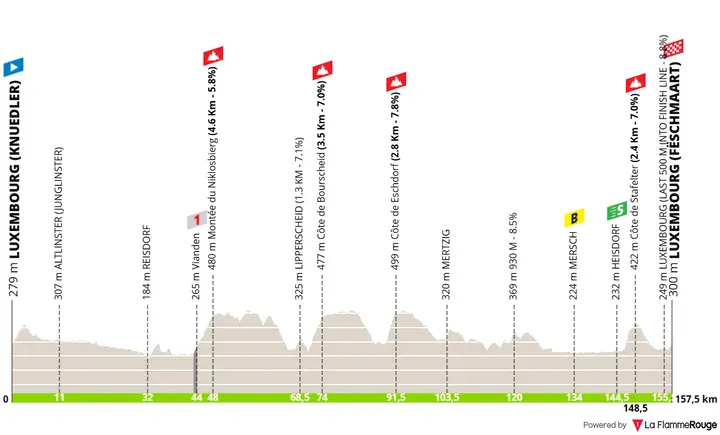
Knuedler – Feschmaart, 157 kilometers
The race begins with a stage that starts and finished in the city of Luxembourg itself, heading north into the German border and back. A day for the puncheurs to start things off, as in fact they all are in the Luxembourg race.
The first stage has one main feautre which is the Côte de Stafelter, 2.4 kilometers long at 7%, ending with 9 kilometers to go. There isn’t much of a chance for tactical racing on the first day, but a serious attack here will clearly outline those who are able to fight for the overall win, and those who are not.
The riders descend back down and then have a 500-meter long uphill sprint to the line in Fëschmaart at 9%, making it a very explosive and dangerous finale where gaps can be opened up easily.
Profile stage 2: Differdange (Niederkorn) – Junglinster

Differdange – Junglinster, 167 kilometers
The second day of the race features a start in Differdange with relatively flat terrain to be tackled, before a second half of the day that is less difficult but more difficult to control.
The riders head towards Junglinster on the second day, and take on a final circuit that features two small ascents. To be raced twice, it features a 1.5Km long climb at 4.3% (with a bonus sprint on the first lap with 23Km to go); and a 1 kilometer long ascent at 3.4%.
They end with 10 and 5 kilometers respectively, whilst the final 500 meters also feature a slight uphill tilt to the line. If any day is going to be decided in a sprint, it most likely is going to be this stage.
Profile stage 3: Wiltz – Diekirch
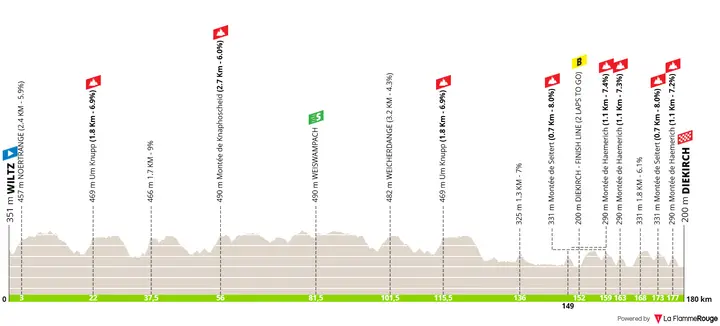
Wiltz – Diekirch, 180 kilometers
Stage 3 from Wiltz to Diekirch is a different day the previous ones, with short but very explosive climbs towards the finale, which also features a final circuit. The overall classification can suffer big chances on the third day of racing.
The 180-kilometer long route is not overly difficult until the final hour of racing, that should see non-stop action on a circuit with three climbs. Right before they enter it, with 28 kilometers to go, there is a short steep ascent.
But in the circuit itself, to be tackled twice, there will be three climbs: 1.8Km at 6.1% (12Km to go); 700 meters at 8% (7Km to go); and 1.1Km at 7.2% (3Km to go). From the last one to the finish there is only a short descent and a fast run-in to the line.
Profile stage 4 (ITT): Ettelbruck – Ettelbruck

Ettelbruck – Ettelbruck, 20.4 kilometers
Potentially the queen stage of the race, the Tour de Luxembourg’s time trial is 20 kilometers long and might open up gaps like no other stage. It is not a short effort, and not an easy one by any means either.
Starting and finishing in Ettelbruck, the route is 20 kilometers long. In its first third, there is a climb that is 900 meters long at 10%. The riders will still choose their time trial bikes, but face proper climbing challenges on it.
There is no recovery from the climb, instead a plateau section leading to the race’s intermediate point. A small climb will follow, whilst the final 3 kilometers will be fully downhill all the way to the finish line.
Profile stage 5: Mersch – Limpertsberg

Mersch – Limpertsberg, 177 kilometers
The final stage of the race is 177 kilometers long and will be a roller-coaster from start to finish. Some longer ascents int he first half of the race might see strong groups going up the road, whilst back in the city of Luxembourg, the GC might be decided on the final punchy hilltops.
The final section of the stage features consecutive efforts, entering a circuit in the middle of them. There will be three ascents of the Pabelergberg, which is 800 meters long at 8.3%.
The first (24.5Km to go) will see a bonus sprint and might detonate the race. The climb is placed with 1 kilometers to go, and could be the decisive factor in the fight for the stage win later on.
List of winners Tour de Luxembourg