

Editor’s note: Abulfaz Babazadeh is a scientist, a scholar of Japanese studies, a political observer, and a member of the Union of Journalists of Azerbaijan. The views expressed in this article are the author’s own and do not necessarily reflect those of News.Az.
Azerbaijani President Ilham Aliyev has once again raised a question to which international institutions have never provided a convincing answer: Why did a state that kept the territory of a neighbouring country under occupation for decades face neither serious political consequences nor economic sanctions?
The head of state made the remarks in Baku on 15 September 2026 during a meeting with participants in international conferences, including members and observers of the Council of Heads of Muslim Religious Administrations of the Organization of Turkic States, co-organisers of the International Conference dedicated to Yahya Bakuvi, and members of the Supreme Religious Council of the Peoples of the Caucasus.
Speaking about the consequences of the nearly 30-year occupation of Azerbaijani territories, President Aliyev said:
“Today, sanctions are imposed left and right, whether justified or not. But Armenia occupied 20 percent of another country’s territory, expelled 700,000 people from there and drove another 250,000 Azerbaijanis out of Armenia, while destroying everything, including entire cities. Why, then, did you not impose sanctions on Armenia? This means that double standards are being applied. Where these double standards come from is quite clear. In any case, they do not come from the Islamic world.”
The statement formed part of a broader assessment of the international community’s approach to the former Armenia-Azerbaijan conflict. President Aliyev recalled that the UN Security Council had adopted four resolutions, the OSCE had conducted mediation efforts for decades, and the Council of Europe and the European Parliament had repeatedly addressed the conflict. However, none of these institutions established a mechanism capable of ensuring the withdrawal of Armenian forces from Azerbaijan’s occupied territories. The full text of the president’s remarks is available on the official presidential website.
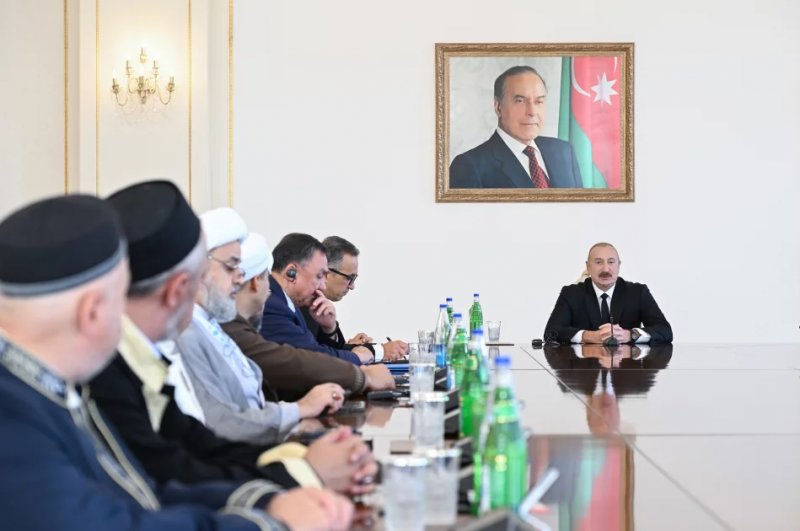 Source: AZERTAC
Four resolutions, but no enforcement mechanism
In 1993, the UN Security Council adopted Resolutions 822, 853, 874 and 884. These documents reaffirmed the sovereignty and territorial integrity of Azerbaijan, the inadmissibility of acquiring territory by force and the need for the withdrawal of forces from the occupied districts.
The first of them, Resolution 822 of April 30, 1993, demanded the immediate cessation of hostilities and the withdrawal of occupying forces from Azerbaijan’s Kalbajar district and other recently occupied areas. The Security Council adopted the document unanimously, as confirmed by the official UN archive.
However, the resolutions concerning Azerbaijan differed fundamentally from decisions adopted in response to other international crises. They did not establish a sanctions regime, freeze assets, impose a trade embargo or create a special committee to monitor compliance. Nor did they specify any consequences for failure to implement their demands.
This was the central problem: international law established what needed to be done, but influential states demonstrated no political will to enforce it.
The Security Council resolutions remained unimplemented for almost three decades. No enforcement mechanism was activated, even though the occupation continued and hundreds of thousands of internally displaced Azerbaijanis remained unable to return to their homes.
How the international community responded in other cases
The absence of sanctions against Armenia becomes particularly striking when compared with the international response to other cases of territorial aggression.
Following Iraq’s invasion of Kuwait on 2 August 1990, the UN Security Council acted almost immediately. On 6 August, it adopted Resolution 661, imposing extensive economic sanctions. UN member states were required to prevent the import of Iraqi goods, restrict exports to Iraq and deny Baghdad access to financial resources. A special sanctions committee was also established.
Resolution 661 was adopted under Chapter VII of the UN Charter, giving it a mandatory and coercive character. This is documented in the official UN Digital Library.
In May 1992, the Security Council imposed broad economic sanctions on the Federal Republic of Yugoslavia. The measures covered trade, financial transactions, air traffic, and even sporting and cultural contacts. The international community did not wait for decades in the hope that the conflict would somehow resolve itself.
Another example came after Russia’s annexation of Crimea in March 2014. Within months, the European Union introduced individual and sectoral sanctions, including asset freezes, travel bans, restrictions on investment and trade with Crimea, and later measures targeting specific sectors of the Russian economy.
The EU itself states that restrictive measures have been progressively imposed since March 2014 in response to violations of Ukraine’s territorial integrity. The timeline of these measures has been published by the Council of the European Union.
Every conflict has its own causes, scale and legal characteristics. Nevertheless, the fundamental principle in all these cases is the same: the territory of a state must not be acquired or held by force. The difference lay not in the substance of the principle, but in the willingness of powerful countries to enforce it.
In Azerbaijan’s case, that willingness was absent.
 Source: AP
The Minsk Group: mediation without accountability
Responsibility for mediating the conflict was largely delegated to the OSCE Minsk Group, co-chaired by the United States, Russia and France. Formally, these states were expected to facilitate a peaceful settlement. In practice, the negotiation process gradually became a mechanism for managing the conflict rather than resolving it.
The Minsk Group had no enforcement instruments of its own. Decisions within the OSCE are generally made by consensus, meaning that the organisation could propose settlement plans, arrange meetings and issue statements, but it could not independently impose sanctions or ensure the withdrawal of armed forces.
However, the main problem was not merely the institutional weakness of the mechanism. It was also the political position of the co-chairing countries. The United States, Russia and France possessed considerable diplomatic, economic and political leverage. They could have pursued implementation of the UN resolutions through bilateral measures or initiated stronger action within international organisations. They did not do so.
Negotiations continued for almost 30 years, while the status quo was gradually treated as an acceptable reality. Azerbaijan was repeatedly urged to exercise restraint and continue negotiations, while maintaining control over its territories brought no meaningful consequences for the Armenian side.
This produced a dangerous political paradox: the victim of occupation was expected to negotiate indefinitely, while the side interested in preserving the territorial status quo paid no price for delaying a settlement.
The Council of Europe recognised the occupation but stopped at declarations
The conduct of the Council of Europe provides another revealing example. In 2005, its Parliamentary Assembly adopted Resolution 1416, which explicitly stated that considerable parts of Azerbaijan’s territory remained occupied by Armenian forces. It also noted that the hostilities had led to large-scale ethnic expulsion and the creation of mono-ethnic areas.
The Assembly further declared that the occupation of foreign territory by a Council of Europe member state constituted a grave violation of that state’s obligations. These conclusions appear in the official text of PACE Resolution 1416.
The European institution therefore had a documented assessment of the situation. Yet this assessment was not followed by measures commensurate with the seriousness of the violation. The Armenian parliamentary delegation did not lose its credentials, Armenia’s membership was not seriously challenged, and the country was not subjected to political isolation.
This passivity stands in stark contrast to PACE’s January 2024 decision not to ratify the credentials of the Azerbaijani parliamentary delegation. Formally, that decision was based on a combination of other issues, including concerns related to human rights, elections and cooperation with the Assembly’s monitoring bodies. It would therefore be legally inaccurate to describe it as an economic sanction.
Politically, however, the contrast is difficult to ignore. An institutional mechanism was applied to Azerbaijan relatively quickly, whereas the prolonged occupation of its territory did not produce comparable consequences for Armenia.
 Source: Getty Images
The European Parliament: strong resolutions but selective attention
The European Parliament does not independently impose EU sanctions; such decisions are adopted by the Council of the European Union. Nevertheless, the Parliament influences Europe’s political climate, adopts resolutions and helps shape the EU’s foreign policy agenda.
For many years, the institution demonstrated considerable enthusiasm for criticising Azerbaijan, but it did not show comparable determination in demanding accountability for the occupation of Azerbaijani territory.
This created the impression that European values were being applied selectively. The territorial integrity of Azerbaijan and the rights of hundreds of thousands of displaced people were pushed into the background whenever their defence conflicted with established political preferences.
The problem is not that international institutions should refrain from criticising Azerbaijan. Every state can and should be subjected to legitimate scrutiny. The problem arises when certain violations trigger sanctions, diplomatic isolation and political pressure, while others are met for decades with little more than calls for negotiations.
Why sanctions were never imposed
The absence of sanctions against Armenia can be explained by several interconnected factors.
First, the major powers were interested in preserving their influence in the South Caucasus and feared that pressure on one side could alter the regional balance.
Second, influential Armenian organisations in the United States and France actively shaped the political and media agenda in those countries.
Third, mediators sought to demonstrate “equidistance” between the parties. In practice, however, neutrality between a state seeking the restoration of its territorial integrity and a side interested in preserving a territorial status quo benefited the latter.
Fourth, a persistent difference emerged in how the parties were portrayed in Western political and media circles. Armenia was often presented solely as the vulnerable side, while the legal reality of the prolonged occupation of internationally recognised Azerbaijani territories was relegated to the background.
Finally, international organisations once again demonstrated that their decisions are not implemented automatically. The effectiveness of international law depends on the political interests and determination of states possessing the necessary instruments of pressure.
The lesson of 30 years of waiting
President Aliyev’s statement reflects more than Azerbaijan’s assessment of its recent history. It addresses a systemic problem in the international order: identical legal principles are applied differently depending on the location of a conflict, the identity of the parties and the interests of major powers.
In Azerbaijan’s case, there were four UN Security Council resolutions, a formal acknowledgement of occupation in PACE documents and internationally recognised borders. What was missing was the political will to transform legal decisions into concrete action.
Ultimately, Azerbaijan restored its territorial integrity not through the efforts of the Minsk Group, the Council of Europe or the European Parliament, but through its own actions.
That is why President Aliyev’s question — “Why did you not impose sanctions on Armenia?” — has significance far beyond the former Armenia-Azerbaijan conflict. It is fundamentally a question about confidence in the entire international system.
When the response to violations of international law is determined not by universal principles but by political expediency, international law ceases to serve as a reliable security guarantee and becomes an instrument of selective pressure.
(If you possess specialized knowledge and wish to contribute, please reach out to us at [email protected]).