
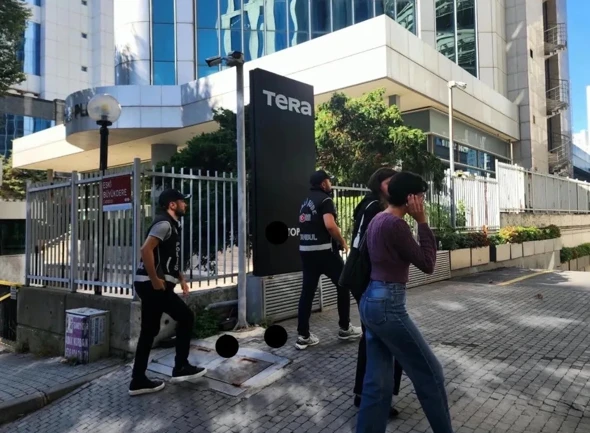
Turkish police on Thursday detained a senior manager at Tera Portföy, the Tera financial group’s investment fund business, in an investigation into suspected manipulation of shares in finance company Destek Finans Faktoring.
Officers from the İstanbul police financial crimes unit detained İbrahim Bekçi and searched the Tera group’s offices, Turkish media outlets reported. Police also searched Destek Holding, which controls Destek Finans, along with the Destek group’s stock brokerage and cryptocurrency business. Searches were carried out at the homes of people connected to the investigation.
Prosecutors had not released a statement explaining the scope of the operation or identifying any other detainees by late Thursday.
Some initial reports described Bekçi as a deputy chief executive of Tera Holding. Records on Turkey’s Public Disclosure Platform (KAP), however, identify him as a deputy chief executive and portfolio manager at Tera Portföy Yönetimi AŞ. The company manages investment funds, while Bekçi’s portfolio management role means he helps oversee how clients’ money is invested.
The operation came hours after Turkey’s Capital Markets Board (SPK) referred Bekçi to prosecutors over trades in Destek Finans Faktoring AŞ shares. The regulator cited a provision covering transactions intended to give investors a false or misleading picture of a share’s supply, demand or price.
The SPK barred Bekçi from trading on the Borsa İstanbul stock exchange and other organized markets for two years. It also canceled all of his capital markets licenses for the same period.
Destek Finans, the company whose shares are at the center of the investigation, provides short-term cash to businesses in exchange for their unpaid invoices. Its parent company, Destek Holding, owns 73.81 percent. Tera Yatırım Menkul Değerler, the Tera group’s stock brokerage, owns 10.4 percent, while a Tera Portföy investment fund owns another 8.18 percent, according to KAP.
The Tera fund that owns Destek Finans shares is one of five Tera Portföy funds named in a separate SPK closure order. The ownership links also explain why police searched companies from both financial groups.
Destek Finans became Borsa İstanbul’s second largest company by market value before its recent losses. Its shares are still more than 300 percent higher since the start of the year, even after falling 37 percent from an early July peak, Reuters reported.
Bekçi was one of 38 people the SPK referred to prosecutors over trading in three companies. Besides Destek Finans, the inquiries concern Katılımevim, which runs non-bank savings plans for home and vehicle purchases, and Gündoğdu Gıda, a dairy producer. The regulator also banned all 38 from trading for two years and suspended the capital markets licenses of Bekçi and several others for the duration of their bans.
The detention came on the same day that the SPK blocked purchases and withdrawals from funds run by Tera Portföy, Pusula Portföy and five other asset management companies. The transactions normally take place through the Turkey Electronic Fund Trading Platform (TEFAS), the online marketplace Turkish investors use to buy and sell fund units. The regulator also ordered 130 funds run by the seven companies to be closed under a process it will set.
The order applies to the funds, not to the seven companies that manage them. Closing a fund normally requires selling its assets and returning the proceeds to investors, but the SPK has not announced a payment timetable or the total value covered by the decision.
The crisis began after Pusula Portföy, one of Turkey’s largest fund managers, disclosed that some of its funds had failed to pay investors who asked to withdraw their money. Tera Portföy and Atlas Portföy, another Turkish fund manager, later reported delays in meeting some withdrawal requests. Tera and Pusula managed about $27 billion together at the end of August. Investors pulled as much as $1 billion from Turkish investment funds on Wednesday, according to Fintables data cited by Bloomberg and the Financial Times.
Market analysts told the Financial Times that some Turkish funds had spent the previous two years buying large stakes in a small group of companies linked to them through corporate relationships. Only a small portion of many of those companies’ shares was available for public trading.
The purchases pushed up share prices and raised the value of funds that owned them. The high returns attracted more investors, providing fresh money to buy the same or related shares. When investors sought their money back, fund managers had to sell assets, pushing prices lower and prompting more withdrawals.
The selling sent the BIST 100, the main measure of Turkish share prices, down almost 6 percent on Wednesday. Trading was briefly stopped after losses exceeded 6 percent under an automatic safety mechanism intended to slow panic selling.
Turkey’s Financial Stability Committee attributed the turmoil to borrowing and cash problems in some funds run by a limited number of companies. The committee called the problem “temporary and manageable” and maintained that it did not pose a structural risk to Borsa İstanbul or the greater financial system.
Tera Group Chairman Emre Tezmen described the episode on Wednesday as a “planned, deliberate and organized speculative attack” and called the cash shortage at some Tera funds temporary. Tezmen has maintained that the group complied with regulations.
Several Turkish news outlets also reported that a court had barred Tezmen from leaving Turkey while an investigation continued.
The concerns about concentrated share purchases predate this week’s turmoil. MSCI, a global index provider whose classifications guide international funds, warned in June of repeated instances of possible coordinated trading involving fund investments and smaller Turkish companies.
MSCI indicated that it could start a process that might move Turkey from emerging market to frontier market status if regulators failed to show progress by November. Such a change could prompt some funds that track emerging market indexes to sell Turkish shares.