
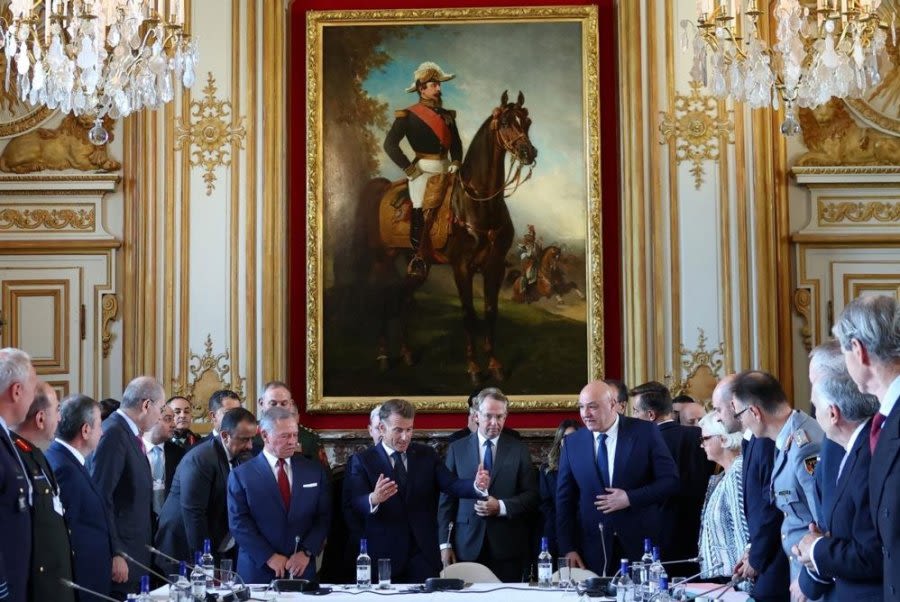
BEIRUT, Lebanon, Sept. 17 (UPI) — The leaders of France, Lebanon and Jordan, meeting in Paris on Thursday, discussed “the dangerous escalation” in the Middle East, international support for the Lebanese Army, creation of a new force to replace the U.N. peacekeeping force in southern Lebanon and Israel’s continued attacks.
French President Presidents Emmanuel Macron and Lebanese President Joseph Aoun, as well as Jordan King Abdallah II, first held a tripartite meeting during which they addressed the “dangerous regional escalation.”
They also stressed the need to intensify international efforts to achieve “a comprehensive and sustainable de-escalation that would restore stability to the region.”
Aoun emphasized that regional security is closely interconnected and called for developing a joint regional security strategy based on shared energy projects, as well as enhanced economic, security and political cooperation.
The three leaders then presided over a preparatory meeting ahead of an international conference to support the Lebanese Army and Internal Security Forces, which officials and military leaders from the United States, Canada, the European Union, and several Arab countries attended/
Aoun said the Lebanese Army is the “cornerstone” of protecting his country’s sovereignty and extending the state’s authority throughout its territory, adding that “this is not an international demand imposed on Lebanon,” but rather “a Lebanese choice … and a fundamental condition” for rebuilding the state.
He said the U.S.-sponsored framework agreement achieved by Lebanon and Israel on June 26 was meant to end the nearly three-year Israel-Hezbollah war and allow the Lebanese Army to deploy in occupied parts of southern Lebanon.
The temporary accord also provides for disarming Hezbollah, Iran’s most powerful armed group in the region.
Aoun warned that stability could not be achieved while Israel continues its attacks and occupies parts of southern Lebanon.
He cautioned that the Army’s responsibilities are “becoming increasingly demanding and complex,” with the expected departure of the U.N. peacekeeping force in south Lebanon, or UNIFIL, whose mandate is to end on Dec. 31 after 48 years of operations since the Israeli invasion of 1978.
“This transition must be orderly and carefully managed, ensuring that it does not create any security vacuum,” he said.
Macron, said supporting and assisting the Lebanese Army “is crucial for it to replace the illegal Israeli presence” in southern Lebanon, noting that ending UNIFIL’s mandate was “a major mistake,” and that he had worked closely with Italian Prime Minister Giorgia Meloni for an alternative force to support the Lebanese Army.
“We must prepare for the ‘day after,'” he said. “There is an opportunity today to restore security in Lebanon.”
Macron said he would discuss with U.S. President Donald Trump the need for Israel to respect its commitments and implement the framework agreement.
“This means, first, achieving a gradual withdrawal from the territories occupied by Israel and allowing the Lebanese state to take control,” he said.
The Jordanian monarch noted the Lebanese Army’s need for resources to strengthen security and secure the borders, as well as spare parts to support its existing equipment and capabilities to counter drones and monitor Lebanese airspace.
He stressed the need to explore ways to address the existing gaps as quickly as possible, adding that another meeting would be held at the end of this year to review progress and assess what has been achieved.
A French presidential statement released at the end of the meeting said the three leaders worked to strengthen Lebanon’s sovereignty and security, which are “essential to the stability of the entire region.”
“Working for stability in the Middle East also means acting directly in the interests of the French people,” the statement said. “By helping to reduce tensions in a region that is vital to global trade and energy supplies, and by preserving the diversity of our supply routes, France is acting to protect our economy from crises and limit their impact on energy prices.”
Macron and King Abdallah held a separate meeting during which they signed a defense cooperation agreement between their countries in a move that “enhances their ability to address changing and emerging challenges and risks,” according to Jordan’s state-run news agency, PETRA.
The agreement, PETRA said, also supports efforts to develop Jordan’s defense capabilities and strengthens Jordan and France’s joint contribution to consolidating security and stability in the Middle East and the Eastern Mediterranean.