

New excavations at the Royal Gymnasium of ancient Mieza in northern Greece are revealing more about education in Macedon during the 4th century BCE. The site near modern Naousa is linked by scholars to the place where Aristotle taught the young Alexander and other Macedonian royal heirs.
 Aerial view of excavation. Credit: Hellenic Ministry of Culture
Excavations began in 2024 under the direction of archaeologist Angeliki Kottaridi. The work covers about 30 acres and forms part of a research program run by Greece’s Ministry of Culture and the Municipality of Naousa.
Researchers have uncovered parts of a palaestra, a stadium, covered walkways, teaching rooms, and water systems. One of the largest features is a covered running track, or xystos, stretching for about 200 meters.
Finds from the gymnasium include four writing styli, pottery, coins, and architectural pieces. This year, the team focused on the eastern side of the complex, where the palaestra joined an area known as the Didaskaleion, or teaching building.
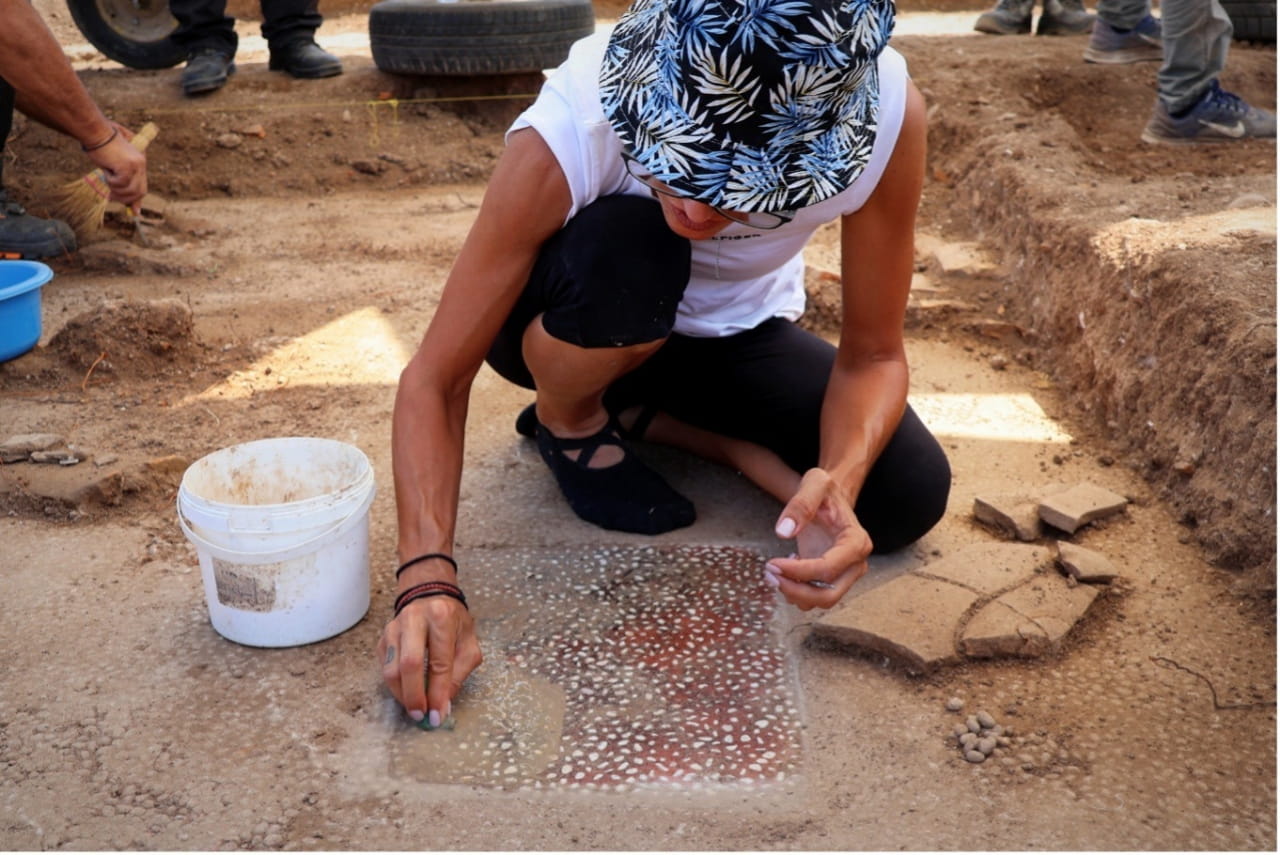 Cleaning the mosaic floor of the northern andron. Credit: Hellenic Ministry of Culture
Stone benches found in several rooms identify spaces used for lectures. The rooms offer new evidence for how the gymnasium was arranged and how students used different parts of the complex.
A large three-part building covers more than 160 square meters inside the Didaskaleion. A central entrance hall leads to two andrones, or rooms used for drinking parties and social gatherings. Both rooms have mosaic floors and raised platforms for dining couches.
Each andron held ten couches, giving each room space for at least 20 people. The quality and construction of the mosaic floors closely match floors from the palace at Aigai, the royal center of ancient Macedon.
Other architectural finds include parts of an Ionic frieze, an Ionic column, and a capital. Archaeologists also found part of a corner Doric architrave from the surrounding colonnade. The piece should help researchers reconstruct the original design of the palaestra.
Much of the complex was dismantled by the Romans after the second Battle of Pydna in 168 BCE. Yet walls with high-quality plaster, ancient floors, and other remains survived beneath layers of destruction and heavy burning.
The gymnasium dates to the middle of the 4th century BCE, during the reign of Philip II. New evidence strengthens the identification of the site with the gymnasium linked to Aristotle’s teaching of Alexander.
 Animal scene fresco in the men’s section of the Twin Ottoman Bath in Veria. Credit: Hellenic Ministry of Culture
The excavation also adds to knowledge of the role played by gymnasiums in Macedonian society. Such places combined physical training with education and social life. Mieza held a special place in the education of young Macedonians who were prepared for leadership.
The recent work in Mieza formed part of a wider cultural heritage visit in the region. Greece’s Minister of Culture Lina Mendoni also attended the return of two restored Ottoman monuments to the local community in Veria.
One was the Orta Mosque, one of Veria’s oldest surviving Ottoman monuments. The mosque dates to around 1490 or 1491 and stands in the city’s historic center. Restoration work addressed structural problems, the dome, original openings, flooring, plaster, painted decoration, and the minaret. The project received €450,000 from the Recovery and Resilience Fund.
The second monument was the Twin Ottoman Bath, also known as Tuztsi Hamam. Built in the late 15th century, the bath has separate men’s and women’s sections arranged as a complete public bath.
Paintings in the men’s section show hunting scenes and exotic animals, including an elephant and a giraffe. Such decoration is rare for an Ottoman bath. The bath operated until 1930.
Together, the projects preserve different periods of Veria’s history while the work at Mieza adds new evidence about education and life in ancient Macedon. The continuing excavation is expected to clarify the layout and use of the Royal Gymnasium.
More information: Hellenic Ministry of Culture