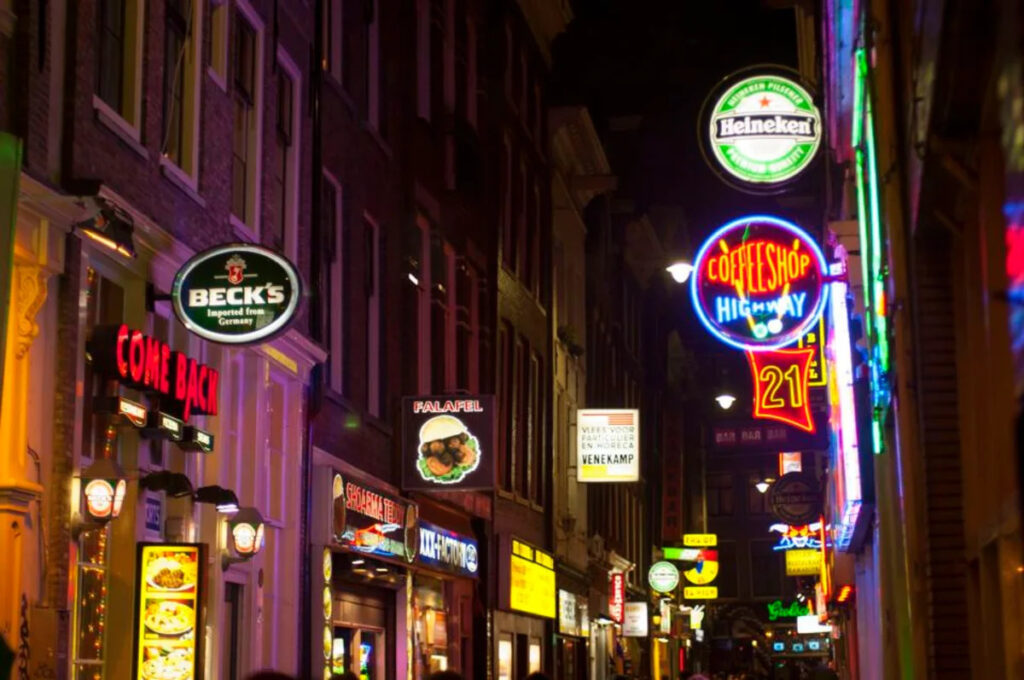
NETHERLANDS – 2006/12/30: A street scene at night with a coffee shop and colorful neon signs in the red light district of Amsterdam in the Netherlands (Holland). (Photo by Wolfgang Kaehler/LightRocket via Getty Images)
A new study on the Netherlands’ pilot to allow coffeeshops to sell cannabis through a legal supply chain has shed light on how the industry is reacting to this new way of selling cannabis.
The study highlights that the stakeholders involved—including municipalities, coffeeshops, growers, consumers, and people living near coffeeshops—are responding positively to the pilot, with some shifts in consumer behavior and sales dynamics. However, the illicit market is far from disappearing.
The pilot, which started in April last year and allowed coffeeshops in ten municipalities to sell cannabis supplied through legal channels, aims to assess the impact of a legal cannabis sales model on crime, safety, and public health. The assessment will shape the future of cannabis sales in the Netherlands.
Despite the presence of over 500 coffeeshops in which cannabis products can be consumed, cannabis in the Netherlands has not actually been legalized. Rather, it has adopted a tolerance policy that the Dutch call Gedoogbeleid, in which the sale, possession, and consumption of so-called soft drugs like cannabis are tolerated up to five grams.
Over the years, this policy has boosted cannabis tourism, especially in the capital, Amsterdam, where there are over 100 coffeeshops, with many tourists, especially younger ones, spending time in coffeeshops whose revenue is estimated to be nearly $1 billion.
But there is a dark side to the market, or rather a back-door problem. Growing cannabis remains illegal, with regulated coffeeshops obtaining their products from unregulated supply chains that fuel organised crime and the illicit market.
Therefore, a legal, tracked supply chain for cannabis would help resolve this loophole.
The Challenges Of The Pilot’s Supply Chain
One year after the start of the pilot, Trimbos Institute, along with BreuerIntraval and RAND Europe, produced a preliminary report on the pilot on behalf of the Dutch Research and Data Centre and the Ministries of Justice and Security, and of Health, Welfare and Sport. The full assessment will be available in 2028.
Researchers have conducted 85 interviews with municipalities, coffeeshop owners, growers, supervisory authorities, and other stakeholders. They also surveyed 865 coffeeshop visitors and 441 people who lived or worked near coffeeshops. Furthermore, they also assessed the number of visitors in 143 coffeeshops and analyzed product offerings and prices in menus from 134 coffeeshops, and a continuing online survey collected information about purchases on the illicit cannabis market.
The findings show that these stakeholders, both directly and indirectly involved in the pilot, provided, overall, positive feedback regarding the pilot. But challenges remain.
The legal supply chain operators, such as licensed growers, coffeeshop operators, supervisory bodies, and transporters, recorded improvements in registration, monitoring, and more standardized procedures for cultivation, transport, and sale, as well as overall greater transparency. However, the start of the pilot came with some issues, including shortages and differing interpretations of regulations related to the pilot.
Products, Prices, and Consumer Behavior
The legal products market is driving more variety in offerings, findings show. Menus analyzed continue to show a diversity in cannabis flowers, hash, and joints. As researchers note, “This means that intervention municipalities now feature a larger assortment of different types of cannabis, hash, and joints on their menus than before.”
Meanwhile, prices of cannabis flowers declined more in the participating municipalities compared to prices in municipalities excluded from the pilot. The municipalities involved in the pilot include Arnhem, Almere, Breda, Groningen, Heerlen, Voorne aan Zee, Maastricht, Nijmegen, Tilburg, and Zaanstad.
However, the average price of hash increased in the intervention municipalities, while the comparison municipalities showed a weaker or different pattern. Joint prices rose slightly in both groups.
Furthermore, coffeeshops in the participating municipalities sold a wider array of cannabis products, including edibles, vapes, and concentrates.
The number of coffeeshop visitors and the frequency of visits did not change significantly, suggesting that the experiment did not produce a clear early increase or decrease in coffeeshop attendance. Noteworthy, however, is a shift in consumer behavior: researchers report that “visitors in intervention municipalities also rate the price-to-quality ratio of cannabis more positively than before. Similar changes for hash are not clearly visible in the data.”
People who lived or worked near coffeeshops generally rated the quality of their neighborhood positively. This is a sensitive point. In recent years, especially in Amsterdam, the presence of cannabis tourists near coffeeshops has triggered protests. In 2023, Amsterdam’s city council banned cannabis consumption in the red light district. The Dutch capital has been excluded from the pilot.
Illicit Market Remains Amid Future Challenges
What the pilot is far from having ended, however, is the illicit market, which continues to operate alongside the regulated coffeeshop supply chain, often offering lower prices and larger quantities. In terms of price, cannabis flower prices declined slightly, while hash prices remained stable or rose slightly. There were no significant differences between municipalities involved in the pilot and those not involved.
A full assessment of the pilot is expected to be released in 2028. Following that, it is expected to be decided whether the pilot can be scaled up and become permanent.
In the meantime, researchers have highlighted several principal challenges of the pilot, including early limitations in product availability, uncertainty about regulations and responsibilities, as well as technical difficulties with the track-and-trace system.
There are also concerns about high-potency and alternative cannabis products, and uncertainty about the future of the experiment.
That uncertainty may discourage growers, coffeeshop owners, and other participants from making long-term investments in production capacity, staffing, and infrastructure, researchers observed.
“Growers, coffeeshops, and municipalities emphasize that uncertainty regarding the scaling up, duration, and continuation of the experiment puts investments, innovation, and cooperation under pressure,” the study reads. “There is a widespread desire for clarity, structured consultations, and a more stable policy framework.”
This article was originally published on Forbes.com