
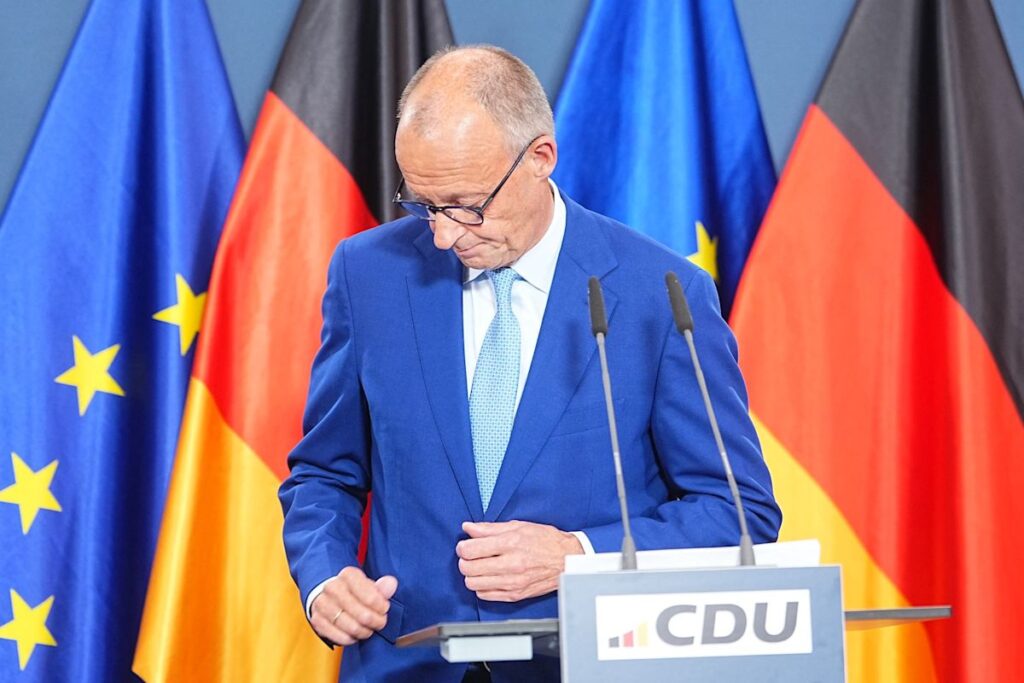
The far-right Alternative for Germany (AfD) is poised for second state election win just two weeks after its landslide victory in Saxony-Anhalt, projections showed on Sunday, with German Chancellor Friedrich Merz’s conservative party set for the worst-ever showing in its 81-year history.
The votes in Mecklenburg-Vorpommern and Berlin are a fresh humiliation for Merz, whose political future has been the source of intense speculation as his approval ratings have plummeted in recent months.
Projections by public broadcasters ARD and ZDF showed Merz’s Christian Democrats (CDU) struggling to clear the 5% threshold needed to enter the Mecklenburg-Vorpommern parliament, putting the party on course to fall well below its previous record low of 9% in Bremen in 1951.
In an unusual public statement just minutes after polls closed, Merz admitted the result was a “disaster” but insisted he would push forward with his government’s unpopular economic and social reform package, signalling he does not intend to resign.
The AfD is projected to finish top in the rural north-eastern state of Mecklenburg-Vorpommern with around 37-38% of the vote, more than double its share since the last election in 2021.
The anti-immigration party was just ahead of the governing Social Democrats (SPD), whose late recovery under state Premier Manuela Schwesig appeared to have fallen just short, with the party projected at around 36%.
In Berlin, Merz’s conservatives lost their hold of the city-state, with The Left – a successor to the socialist party that governed the former East Germany – well ahead on around 25% to the CDU’s 20%.
The AfD is further back with between 14% and 16% of the vote, up from 9.1% in 2023, with the Greens on around 15%.
AfD poised to take Mecklenburg-Vorpommern
Sunday’s elections are the last in a bumper year of five German state votes that have exposed widespread public frustration with Merz’s conservative-led coalition government at the national level.
Like Saxony-Anhalt, which saw the AfD secure a stunning win over the CDU earlier this month, Mecklenburg-Vorpommern is a former communist eastern state that lacks major industry and has struggled to deal with the effects of German reunification in 1990, helping fuel support for the far right.
The AfD party led the polls in Mecklenburg-Vorpommern for months despite being monitored as a “suspected extremist” organization by Germany’s domestic intelligence agency.
For the CDU, crashing out of the Mecklenburg-Vorpommern parliament – albeit not a state where the party has traditionally excelled – would represent a nightmare scenario for Merz.
Despite the AfD’s likely win in Mecklenburg-Vorpommern, it is unlikely to be able to govern the state, as all other parties refuse to work with the far right, a policy known as the “firewall.”
Whether Schwesig can retain power in coalition with The Left and the Greens could depend on whether the populist Sahra Wagenknecht Alliance (BSW) passes the 5% threshold to enter parliament.
A three-party left-wing coalition is also likely in the German capital, where projections suggest The Left is set to install its first mayor of Berlin after a clear victory over Merz’s CDU.
The CDU’s campaign was dealt a blow when incumbent Mayor Kai Wegner abandoned his re-election bid over his handling of an electricity blackout in January.

German Chancellor Friedrich Merz attends the Federal Cabinet meeting at the Chancellery. (is associated with: «Germany’s AfD set for second major election win in ‘disaster’ for Merz») Michael Kappeler/dpa