

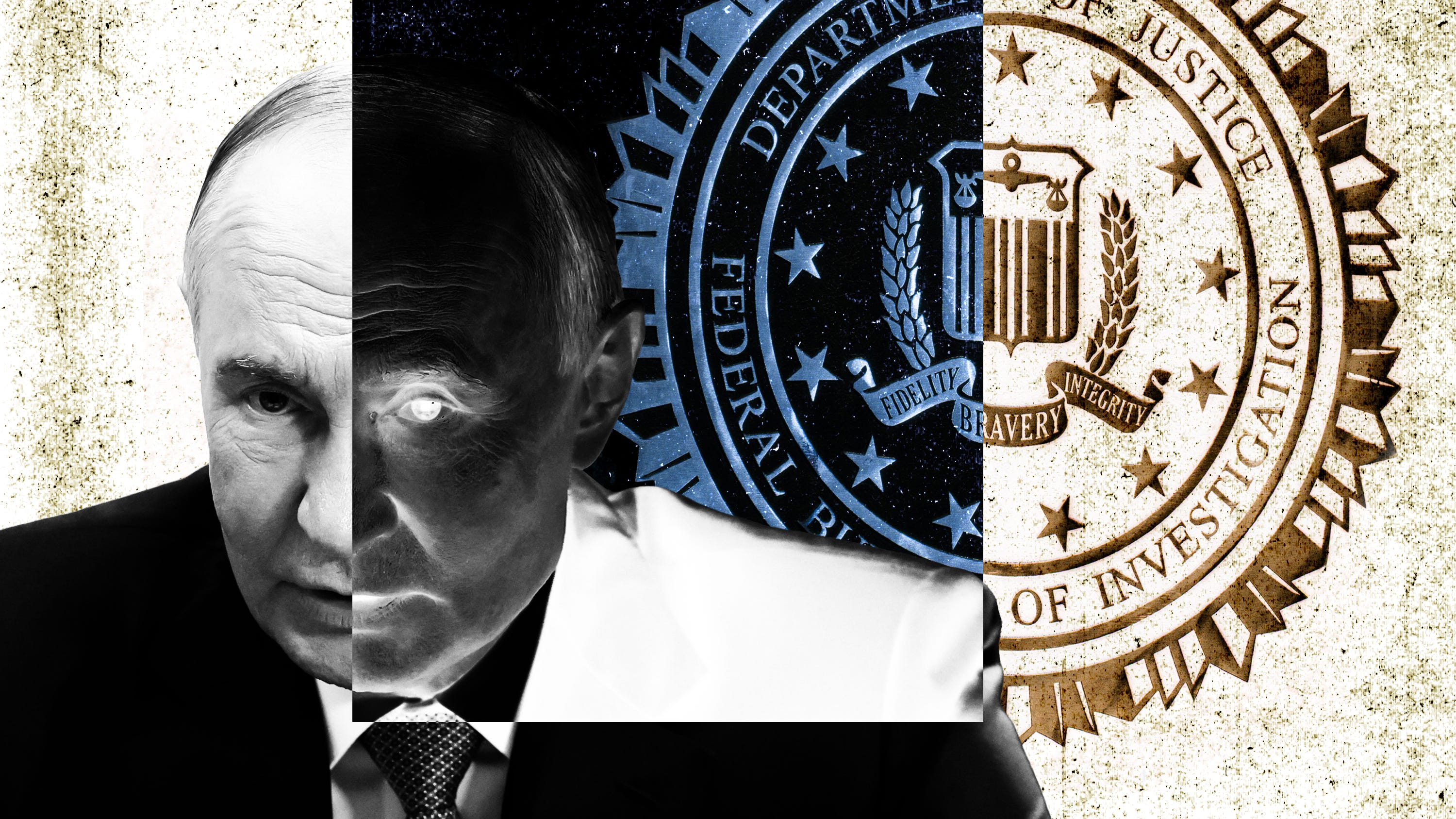
“INDIVIDUALS WORKING for the intelligence services of the Russian Federation” have, for at least the last two years, “conspired to conduct . . . attacks and murder around the world, including within the United States.” That’s the stunning news in an indictment released last week by the U.S. attorney for the Southern District of New York. The five men charged in the indictment, all believed to be living in Russia (though two are Cubans and one is a Venezuelan national), had tried to engineer a hit on a Russian dissident in exile living in the Washington, D.C. area this past July and August, with a promised $40,000 fee. Another unsuccessful assassination plot last year targeted a Russian exile in Lithuania, described by one of the operatives as a “bad guy” who was “telling lies about Russia.”
When you read the details of the indictment, the plotting sounds almost comically inept—The Americans meets The Simpsons. For instance, the members of this network exchanged voice and text messages using “construction” as code for murder and “measure a plot of land and provide measurements” for surveillance. (As in: What’s up with your guy from Washington? I don’t need him to do construction. I need him to measure a plot of land and provide measurements. Yeah, guys, totally not suspicious.) At one point, the U.S.-based contact two of the defendants, Angel Eduardo Castro and Yaidel Delgado Suarez, were trying to recruit for a hit even expressed shock at their sloppiness: “Don’t have him call me. That’s crazy. . . . You know they track everything here.” And then there’s the bit where the coordinator of the network, Yuri Khrameev, a former colonel in the Russian intelligence services known by the nickname “Colonel Yuri,” tells a potential hitman that the Lithuania-based target could be killed by “throwing a bottle of gasoline” or “sticking a knife” in him. When the would-be recruit (an unnamed U.S. citizen, apparently living in Europe) declined the scheme as too risky, “Colonel Yuri” suggested that he could do other jobs:
For example, throw a bottle of gasoline at an electrical substation. Set fire to a warehouse of property or food. You’re looking for such objects yourself. You need to approach it creatively.
Khrameev (whose son Kirill, a low-level FSB officer, was also involved in the network) explained that he was particularly interested in targeting military or dual-use facilities in NATO countries as well as “wagons [i.e., railway cars] with humanitarian aid to Ukraine.”
But don’t let the “Keystone Spies” aspect of the conspiracy distract you from how big of a deal this story is. The FBI had already busted a Russian plot last March to assassinate dissidents in Europe, arresting a U.S. resident of Serbo-Croatian background who was helping orchestrate the murders; his Russian FSB handler, Denis Alimov, was later arrested in Colombia. But an assassination attempt on U.S. soil is almost certainly unprecedented—as investigative journalist Roman Dobrokhotov told a YouTube-based Russian expatriate media project:
Russia trying to organize an assassination in the United States—nothing like that had happened not only in the history of modern Russia, but even in the days of the Cold War. There was an unspoken agreement that Russia and the United States don’t do such things on each other’s home turf. It seemed, until now, that [this agreement] remained in force—and one would think that it certainly shouldn’t be violated while [Vladimir] Putin is hugging Donald Trump. But it turns out that this red line, too, has been crossed.
Bulgarian-born journalist Christo Grozev (who played a major role in uncovering a number of Russian intelligence operations including the attempted poisoning of Alexei Navalny in 2020) also mentioned this onetime taboo in an interview with TV-RAIN, the Russian dissident network in exile—noting that reality seemed to be catching up with The Americans, the show often criticized for showing Soviet agents embedded in the U.S. frequently carrying out murders and kidnappings and ignoring the tacit “no killing on each other’s soil” rule. As Grozev put it:
I remember how ridiculous it looked on The Americans when they showed Russian spies carrying out assassinations in Washington, D.C. in the 1980s. . . . But now it all looks much more plausible: the assassination of a Russian dissident, an émigré from Russia, was actually being arranged in Washington, D.C. I’m now taking an entirely different look at The Americans.
Whoever the D.C.-area target was, the FBI is apparently taking steps to ensure the safety of other Russian political exiles in the United States. The writer Dmitry Bykov, who has lived in the United States since 2021 and is currently teaching at the University of Rochester, made a cryptic comment in a September 10 YouTube podcast interview about an upcoming publication of news that would “significantly change the way we look at the world around us.” As he revealed on the same podcast a week later, he had been referring to the assassination plot indictment, to which he had been alerted ahead of time by the FBI, even though he was not the target.
Bykov, who also revealed that he has to report to his FBI “curator” every time he travels—and who survived a Navalny-like attempted poisoning in 2019—took the news in stride, quipping that “it’s very nice to know you’re being surveilled with good intentions and not so they can slip you some poison” and that the murder conspiracy might even raise his prestige in the eyes of students. But the news is undeniably alarming, and while it’s good to know that FBI field agents are taking it seriously, it would be even better to know that the administration is doing the same.
In his interview, Dobrokhotov suggested that the D.C.-area assassination plot may have been the reason—or at least one of the reasons—for CIA Director John Ratcliffe’s clandestine visit to Moscow late last month, which generated plenty of speculation. Did he read the riot act to Russian intel officials? Nobody knows. Nor do we know why FBI Director Kash Patel (who was paid $24,000 in 2024 to appear in a Russian filmmaker’s documentary peddling conspiracy theories about the American “deep state”) is set to travel to Moscow and St. Petersburg in October, or whether he will bring up the plot reported last week.
One would also like to think that a Russian intelligence-sponsored assassination plot in the American capital would be a wakeup call for the president of the United States as far as any hopes of a friendly deal with Russia. But we all remember what Donald Trump said in 2017 when asked how his hope to “get along” with Putin could be squared with Putin’s habit of having his opponents murdered: “There are a lot of killers. You think our country’s so innocent?”