
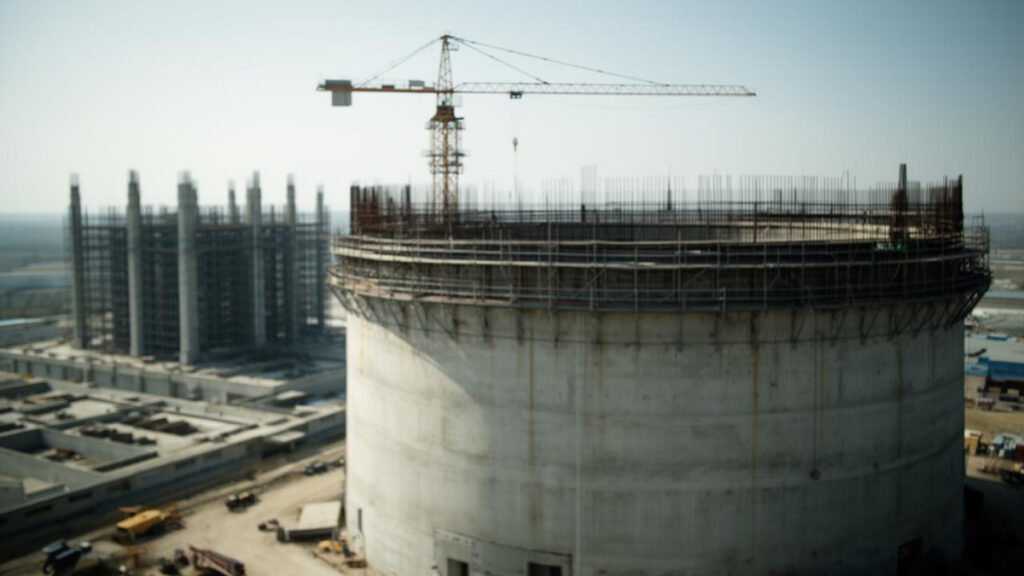
South Korea and the United States are negotiating a nuclear energy framework centered on the construction of eight large-scale nuclear reactors in the U.S., with a total project value of $120 billion (approximately 162.1 trillion won). Of the eight reactors, the leading proposal calls for six to use Westinghouse’s AP1000 design and two to use the Korean-designed APR1400. However, building APR1400 units in the U.S. would require paying Westinghouse approximately $2 billion per unit in technology fees and nuclear fuel costs, meaning the two APR1400 units alone could carry related expenses of up to $4 billion (approximately 5.4 trillion won).
Kim Jung-kwan, South Korea’s Minister of Trade, Industry and Energy, outlined these details in a closed-door briefing to the National Assembly’s Trade, Industry, Energy, SMEs, and Startups Committee on the 22nd. The South Korean government has confirmed the Texas Ensenal gas combined-cycle power plant as its first strategic investment project in the U.S., while the eight-reactor nuclear buildout and Alaska LNG development are being reviewed as follow-up projects, with final decisions contingent on commercial viability assessments and National Assembly procedures.
The most closely watched element is the potential entry of the APR1400 into the U.S. market. Under an intellectual property agreement signed in January of last year between Korea Hydro & Nuclear Power, Korea Electric Power Corporation, and Westinghouse, South Korea was effectively barred from securing new nuclear reactor orders on the U.S. mainland. The agreement reportedly requires payment of $175 million (approximately 240 billion won) in technology licensing fees and $650 million (approximately 880 billion won) in goods and services purchases per exported reactor over 50 years, while restricting market entry into Europe, excluding the U.S., Japan, and the Czech Republic.
The current negotiations are exploring an exception to the existing agreement specifically for nuclear projects pursued as part of South Korea’s strategic investment in the U.S. The approach would involve amending the separate agreement to allow construction of up to two APR1400 units on American soil. Westinghouse reportedly objected to the APR1400 — a competitor to its flagship AP1000 design — entering the U.S. market, but the U.S. government is said to have concluded that South Korea’s construction capabilities and supply chain are necessary to expand nuclear power buildout.
Rather than constructing all eight reactors simultaneously, the plan under consideration would proceed in phases of “two → four → two” reactors. A ruling party official explained, “This is not about building eight reactors at once, but rather building two first, then four, and then two more.” The phased approach allows each stage’s performance to be evaluated before moving to the next, reducing the burden of tying up enormous capital all at once.
Investment protection mechanisms have also been established. The framework includes a safeguard allowing South Korea to recover 100% of its invested capital on a priority basis if the project is terminated and liquidated. Profit distribution would be split 50-50 between South Korea and the U.S. until South Korea’s principal and interest are fully recovered, after which the U.S. share would increase. A distinctive feature is that principal and interest recovery is assessed on a portfolio-wide basis rather than per individual project — even if a specific project recovers its principal and interest first, the 50-50 split remains in effect until the entire portfolio’s principal and interest are recovered.
Cost overrun protections are also part of the negotiations. Of the total project cost of approximately $120 billion, up to $20 billion (approximately 27 trillion won) would be set aside separately as a risk management buffer against cost overruns. Even if this amount is not actually used for construction costs, it would still be recognized as fulfilled U.S. investment by South Korea. The framework is structured so that South Korea’s government would not be obligated to automatically inject additional funds even if cost overruns exceed $20 billion.
The initial investment of $10 billion (approximately 13.5 trillion won) requested by the U.S. is also being linked to the nuclear project. In exchange for accommodating the U.S. request for early demonstration of South Korea’s commitment to large-scale investment, South Korea has secured a commitment to reinvest those funds into orders for core nuclear equipment. From South Korea’s perspective, a significant portion of the transferred funds could return as orders for Korean companies, while the U.S. benefits from securing long-lead main equipment that requires four to five years or more after ordering.
The size of the Westinghouse equity stake acquisition remains a source of last-minute friction. The South Korean government is negotiating to secure a 5–10% stake, with a compromise around 7% considered possible. The government initially explored securing more than 20%, but U.S. resistance has kept negotiations ongoing. Minister Kim reportedly told lawmakers that “even at a 5–10% stake level, voting rights can be secured.” However, given Westinghouse’s strong opposition, some observers predict the actual acquisition may still not materialize.
The nuclear projects will be evaluated for investment on an individual project basis. Rather than bundling all eight reactors into a single project, each reactor will be treated as a separate project and assessed for commercial viability. The rationale is that U.S. nuclear projects are conducted on a state-by-state basis, so project economics cannot be uniform.
Liability allocation in the event of an accident remains an outstanding issue. In the U.S., nuclear accident liability falls on the plant operator. Japan, which has committed to small modular reactor investments, requested written confirmation that financial institutions would not bear liability, but received only verbal assurances and has consequently delayed fund disbursement.
For the Texas Ensenal gas combined-cycle power plant — the first U.S. investment project — the National Assembly was briefed that a total investment of $22.3 billion (approximately 30.1 trillion won) could recover between $43.29 billion and $45.403 billion (approximately 61.3 trillion won) over 20 years. The plan calls for first building a 1.4 GW gas turbine power plant, followed by expansion to 4.9 GW of combined-cycle generation capacity. However, the absence of a signed long-term power purchase agreement raises concerns about electricity buyer uncertainty.
The Alaska LNG development project carries a total project cost of $44 billion (approximately 59.5 trillion won), aiming to transport natural gas produced from northern Alaska gas fields via an approximately 1,300 km pipeline to Nikiski in the south for export to Asian countries. The massive upfront investment and uncertain commercial viability are cited as key weaknesses, and a final agreement has not been reached.
The South Korean government plans to maintain an “umbrella” investment structure with an overarching investment purpose company overseeing special purpose entities for each individual project. Under this structure, project profits would be split 50-50 between South Korea and the U.S. until the entire portfolio’s principal and interest are recovered, after which the split would shift to 10% for South Korea and 90% for the U.S. The structure is viewed as enhancing investment stability, as losses in one project can be offset by gains in others.
Minister Kim reportedly also told lawmakers that South Korea would not pursue additional investment if annual investment reaches $20 billion or if the cumulative total exceeds $200 billion (approximately 270.2 trillion won). The final announcement between South Korea and the U.S. is expected to be made directly by U.S. President Donald Trump.